|

GBP/USD analysis: dollar resumes advance

GBP/USD Current price: 1.2810

  • UK budget presentation failed to motivate Pound's bulls.
  • Dollar stronger as risk-off returns in the US afternoon.
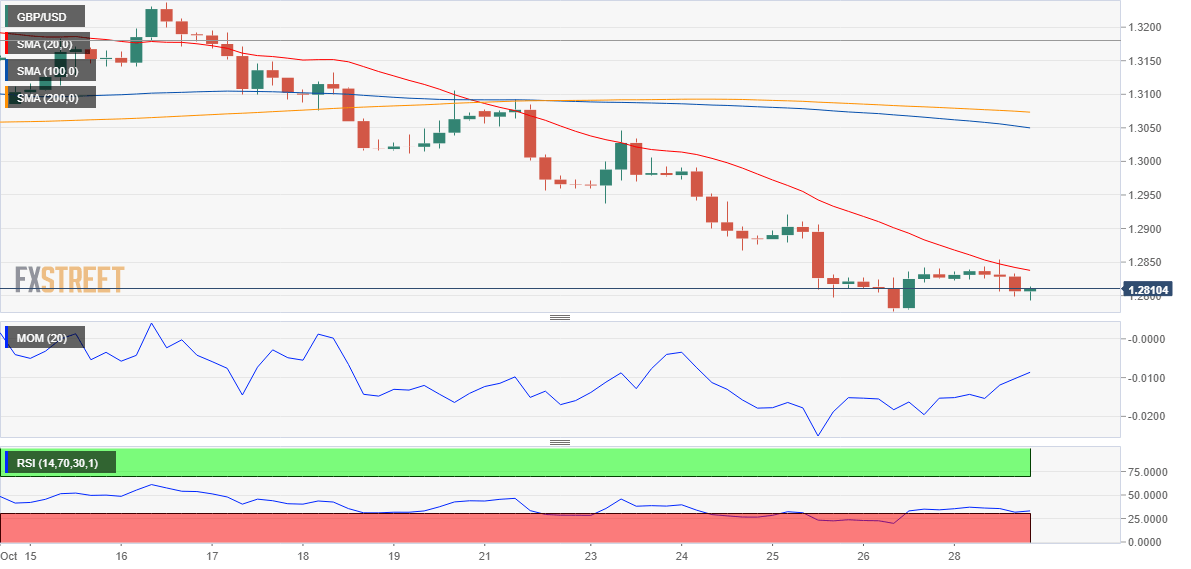
The GBP/USD pair spent most of this first day of the week holding above 1.2800 ending the day marginally lower in the 1.2800 price zone. The most relevant event of the day was UK's Chancellor Phillip Hammond presenting the kingdom's budget. Among his opening remarks, he said "the era of austerity is over," among other encouraging statements that clearly failed to motive Pound's bulls, more concerned these days about the effects of Brexit on the UK economy, and Hammond words over the weekend, claiming that a no-deal Brexit will need adjustment to this budget. Growth forecast was revised slightly higher and the expected deficit lower. Minor data from the UK showed that  Consumer Credit in the UK rose by less-than-expected in September, up by £0.785B, while Mortgage Approvals in the same month were up by 65.269K, better than the 65.000K forecasted. On Tuesday, the UK will release the CBI Realized Trades Survey for October.

Meanwhile, the pair remains near the multi-month low of 1.2776 hit last week, and technically bearish according to intraday technical readings, as the pair is below a strongly bearish 20 SMA, which capped an early attempt to advance and is currently around 1.2840, while technical indicators turned south, the Momentum accelerating to fresh daily lows and the RSI currently at 28, in line with further slides ahead particularly on a break below 1.2775.

Support levels: 1.2775 1.2740 1.2700

Resistance levels:1.2850 1.2880 1.2925

View Live Chart for the GBP/USD

Author

Valeria Bednarik

Valeria Bednarik was born and lives in Buenos Aires, Argentina. Her passion for math and numbers pushed her into studying economics in her younger years.


More from Valeria Bednarik
Share:

Editor's Picks

GBP/USD: Daily gains remain capped by 1.3650

GBP/USD leaves behind Monday’s pessimism and advances marginally on Tuesday. Cable’s humble gains, however, appear to have met quite a decent resistance in the 1.3650 zone for now, in a context of a slight selling pressure hovering around the Greenback.

EUR/USD struggles to regain pace; gyrates around 1.1670

EUR/USD clinches humble gains around 1.1670 following Tuesday’s close on Wall Street. Indeed, marginal losses in the US Dollar encourages spot to set aside two dauly pullbacks in a row and maintain the 1.1700 barrier on the cross-hairs for now. Moving forward, US inflation tracked by the PCE and another revision of Q2 GDP data should keep investors entertained on Wednesday.

Gold steadies near $4,650, eyes multi-month high ahead of US PCE

Gold stabilizes around $4,650 after the previous day's two-way swings as traders await the US PCE data, due later this Wednesday, for cues about the Fed's policy path. The outlook will drive the US Dollar and the non-yielding bullion. Meanwhile, renewed hopes for a US-Iran peace deal, weak oil prices, sliding US bond yields and diminishing odds of an immediate tightening by the Fed undermine the USD. This keeps the precious metal close to its highest level since May 14, set on Tuesday.

Ethereum rally calms after reclaiming $2,300 on-chain cost basis
After a +30% gain last week, Ethereum (ETH) broke above its realized price, or average on-chain cost basis, at $2,306. That move also pushed it above the realized price of different wallet cohorts. Historically, profit-taking often increases when prices break above investors' average on-chain cost basis for the first time after an extended bearish period.
Canada hits US goods with tariffs; The rate market sees a problem
On September 8, Canada begins charging its own importers 15%, 25% and 50% on roughly 700 lines of American goods. The measure is billed as dollar for dollar, and on the arithmetic of covered trade it is. What it is not is a tax on the United States.
Canada hits US goods with tariffs; The rate market sees a problem
On September 8, Canada begins charging its own importers 15%, 25% and 50% on roughly 700 lines of American goods. The measure is billed as dollar for dollar, and on the arithmetic of covered trade it is. What it is not is a tax on the United States.