|

GBP/USD Analysis: Brexit hopes boost the Pound

GBP/USD Current Price: 1.2258

  •  German Chancellor Merkel said that a solution to the Irish backstop could be found within 30 days.
  • French President Macron insisted on keeping the Withdrawal Agreement as it is.
  • GBP/USD to retain the bullish tone as long as above 1.2220.
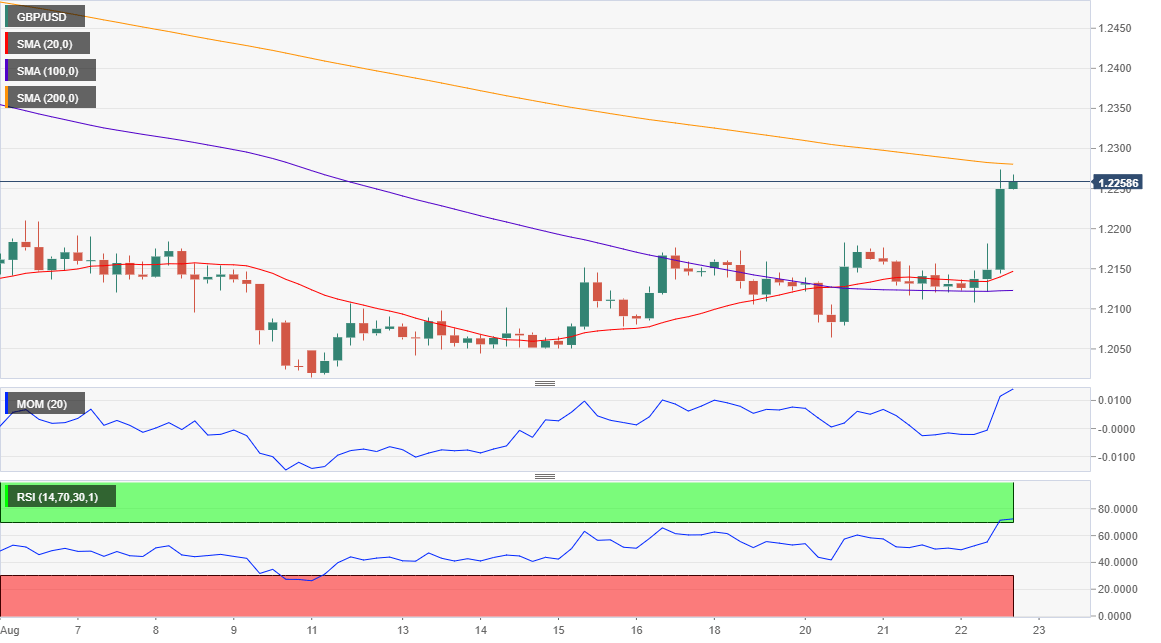
The GBP/USD pair up roared to hit a 3-week high of 1.2272 to settle by the end of the day at around 1.2250, as German Chancellor Angela Merkel said that they could work on finding a backstop solution by October 31. The encouraging headline overshadowed discouraging comments from French President Macron and discouraging data. UK PM Boris Johnson met  Macron, who in polite terms reiterated that he respects the UK’s decision to leave the EU, but he also needs to stand for the integrity of the single market. About the Irish backstop, Macron said that is the “protector of stability in Ireland” and therefore can’t be touched, adding that they won’t find a new Withdrawal Agreement in the next month. The UK saw the release of the CBI Distributive Trade Survey on realized sales, which collapsed to -49%. The UK won’t release any relevant figure this Friday, with the focus on comments from central bankers within the Jackson Hole Symposium.

GBP/USD short-term technical outlook

The GBP/USD pair holding on to gains, trading above the 38.2% retracement of the latest daily decline at around 1.2220 now the immediate support. In the 4 hours chart, the pair has soared past its 20 and 100 SMA, while the 200 SMA maintains a bearish slope, now converging with the 50% retracement of the same decline at around 1.2385 reinforcing the static resistance level. Technical indicators in the mentioned chart have lost strength upward after reaching overbought levels. A key inflection point comes at 1.2350, the 61.8% retracement of the same daily slump.

Support levels: 1.2220 1.2175 1.2120

Resistance levels: 1.2285 1.2310 1.2350

View Live Chart for the GBP/USD

Author

Valeria Bednarik

Valeria Bednarik was born and lives in Buenos Aires, Argentina. Her passion for math and numbers pushed her into studying economics in her younger years.


More from Valeria Bednarik
Share:

Editor's Picks

GBP/USD corrects lower after testing 1.3400

Following Monday's advance, GBP/USD touched its highest level since mid-June slightly above 1.3400 early Tuesday but lost its bullish momentum. The pair trades marginally lower on the day at around 1.3380 as investors adopt a cautious stance following news of Iran targeting commercial ships attempting to pass through the Strait of Hormuz.

EUR/USD holds above 1.1400 as markets focus on Middle East news

EUR/USD struggles to gain traction and trades in a narrow channel above 1.1400 on Tuesday after failing to reclaim 1.1450. The pair's upside remains capped amid a modest recovery in the safe-haven US Dollar, as renewed tensions in the Strait of Hormuz and Asian tech sell-off fuel risk aversion.

Gold recovers above $4,150 following earlier decline

Gold stages a rebound after dropping toward $4,100 earlier Tuesday and trades above $4,150 in the American session. Crude oil prices edge higher amid renewed tensions in the Strait of Hormuz, reviving inflationary concerns. This, in turn, triggers a fresh leg up in US Treasury bond yields, offering some support to the US Dollar, and making it difficult for the yellow metal to gain traction.

Bonk extends correction after $20 million hack from BonkDAO treasury

Bonk remains under pressure, trading below $0.0000044 after losing over 10% in the previous day. Monday’s correction occurred as Bonk Decentralized Autonomous Organization announced a governance exploit that resulted in the theft of $20 million worth of BONK tokens from its treasury.

Bye, forward guidance: How to trade when central banks choose silence
Central banks have spent years telling markets what might come next. Now, traders face the possibility that they say a lot less. From the Federal Reserve to the European Central Bank and the Bank of England, policymakers are pushing back against forward guidance, arguing that the current world demands more flexibility.
Bye, forward guidance: How to trade when central banks choose silence

Central banks have spent years telling markets what might come next. Now, traders face the possibility that they say a lot less. From the Federal Reserve to the European Central Bank and the Bank of England, policymakers are pushing back against forward guidance.















