|

From record high $2,484 Gold drops to $2,366 – Bears looking for $2,330?

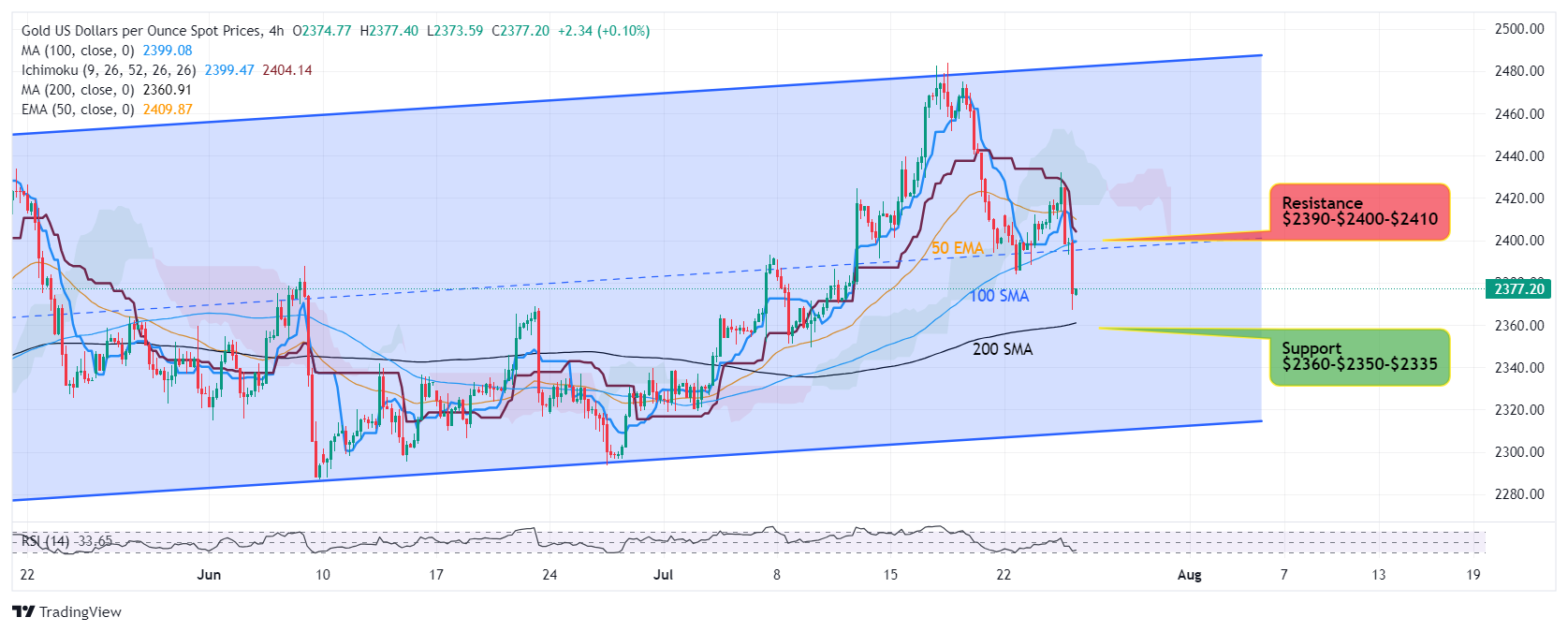
  • Gold lost $118 of recent gains from record high $2,484 as the price drops to $2,366.

  • Immediate support is seen located at 4 hourly 200 SMA $2,362 and 50 Day EMA $2,360.

  • Immediate resistance is positioned at previous swing low $2,384-$2,390.

Chart

It is a usual phenamenon that everytime Gold makes a new record high, a follow up sell off brings a healthy correction which works well for the purpose of rebalancing the equilibrium of overbought conditions and this is also a result of smart money taking out the profits at strategic zone on the initial hints of correction, causng significant decline in prices and the falling sequence continues till fair value is reached. In other words, sell off begins when market dynamics understand that prices have reached premium zone and correctioal decline starts pushing prices taking out fair value gaps left in the process and finally reaches what we call equilibrium followed by discount zone where buyers resurface for bargain buying at value area in anticipation of resumption of uptrend.

Coming to current developements, Gold has completed a significant 61.8% Fibonacci retracement of $2293 to $2484 which aligns with $2366 and some recovery attempts from current lows is likely, even if the extent is limited.

Some buying activity may be witnessed from $2368-$2360 that may take Gold to nearest resistance zone $2384-$2390 which if cleared preferably with a day close, can extend to $2400 psychological handle that coincides with 4 hourly rising 100 SMA.

Next overhead resistance is 4 hourly 50 EMA at $2410 .

On the flip side, rejection from resistance zone $2390 or $2400 will call for retest of $2366 and a tad lower at 50 Day EMA 2360 while break below this support will extend correction to next leg lower 78.6% Fibonacci zone $2334 and 100 Day SMA $2322

Author

Sunil Kumar Dixit

Sunil Kumar Dixit is Chief Technical Strategist and founder of SK Charting, a research firm based in India. He tracks Precious Metals, Energy, Indices and Currency Pairs. He also participates as an expert panellist on Channel Television, Nigeria.


More from Sunil Kumar Dixit
Share:

Editor's Picks

GBP/USD gains as easing Fed hike bets weigh on US Dollar

GBP/USD continues its winning streak for the ninth consecutive day, trading around 1.3390 during the Asian hours on Tuesday. The currency pair rises as the US Dollar faces headwinds as market participants scale back expectations for Federal Reserve rate hikes this month and in September. 

EUR/USD eases toward 1.1400 as Hormuz risks support USD

EUR/USD is easing toward 1.1400 in European trading on Tuesday, facing rejection at the 1.1450 level. The pair loses ground amid a modest recovery in the safe-haven US Dollar, as renewed tensions in the Strait of Hormuz and Asian tech sell-off fuel risk aversion.

Gold sticks to losses as inflation fears lift US bond yields and USD amid Hormuz risks

Gold maintains its offered tone heading into the European session, albeit it holds above the $4,100 mark. Crude oil prices edge higher amid renewed tensions in the Strait of Hormuz, reviving inflationary concerns. This, in turn, triggers a fresh leg up in US Treasury bond yields, offering some support to the US Dollar, and weighing on the non-yielding yellow metal for the second straight day.

Bonk extends correction after $20 million hack from BonkDAO treasury

Bonk remains under pressure, trading below $0.0000044 after losing over 10% in the previous day. Monday’s correction occurred as Bonk Decentralized Autonomous Organization announced a governance exploit that resulted in the theft of $20 million worth of BONK tokens from its treasury.

Bye, forward guidance: How to trade when central banks choose silence
Central banks have spent years telling markets what might come next. Now, traders face the possibility that they say a lot less. From the Federal Reserve to the European Central Bank and the Bank of England, policymakers are pushing back against forward guidance, arguing that the current world demands more flexibility.
Bye, forward guidance: How to trade when central banks choose silence

Central banks have spent years telling markets what might come next. Now, traders face the possibility that they say a lot less. From the Federal Reserve to the European Central Bank and the Bank of England, policymakers are pushing back against forward guidance.