French budget: The hardest part is yet to come


France’s fiscal deficit worsened in 2023 and 2024. Spending growth was maintained, despite the slowdown in public revenues growth. The 2025 budget should enable consolidation to begin thanks to a rebound in revenues. However, spending as a share of GDP is expected to remain relatively stable. The challenge of continuing fiscal consolidation in 2026 therefore remains intact. This exercise will be constrained by the expected increase in interest payments and military spending.
The next budget is already a hot topic in France. The late adoption of the 2025 budget and the difficult political context justify the early emergence of this topic. The government is once again planning to reduce the fiscal deficit in 2026, while the slowdown in growth in 2025 is already undermining this year’s deficit target (5.4% of GDP).
Looking back
It is important that the initial budget target and final execution align in 2025, after two years of significant slippage (fiscal deficit exceeding initial targets by 0.4 percentage points of GDP in 2023 and 1.4 percentage points in 2024). The increase in the deficit as a percentage of GDP was therefore steady between 2022 (-4.7%, then -5.4% in 2023) and 2024 (-5.8%). However, most other Eurozone countries continued to consolidate their public finances. The interest burden increased only moderately over the period (2.1% of GDP in 2024, compared with 2% in 2022) and is therefore not a driver. The explanation lies in a significant gap between public revenue and expenditure.
Public spending evolved broadly in line with nominal GDP growth during the inflationary period. The spending-to-GDP ratio remained high, exceeding pre-COVID levels. As a result, the budget fully offset inflation, whereas partial compensation would have brought the public spending ratio back to its pre-pandemic level. Social benefits rose sharply, outpacing inflation in 2024, while pensions offset the (higher) inflation observed in 20231.
Thus, France also maintained its higher level of public spending compared to other European countries, mainly due to the weight of its social security system, which exceeds that of other European countries. In addition, the weight of social spending in GDP increased in 2024. It thus returned to the highest level (excluding the COVID period) reached in 2014, before fiscal consolidation between 2014 and 2019 made it possible to reduce its weight slightly (Chart 1)2.
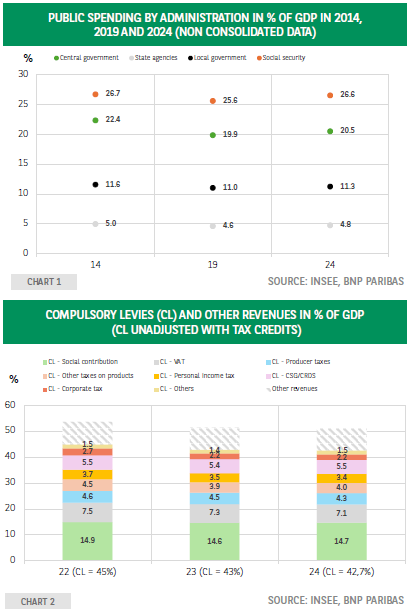
However, the tax base capable of financing these expenditures did not experience the same momentum. Wages grew more slowly than inflation, as did social security contributions based on wages. The decline in compulsory levies (CL) as a percentage of GDP also affected other items, but for different reasons (Chart 2). VAT revenues suffered from sluggish consumption, and registration fees from the decline in real estate transactions. Income tax revenues were penalised by the indexation of tax brackets to inflation. The strength of corporate margins in 2023-24 allowed stabilising of the corporate taxes in 2024 (after the 2023 normalisation of corporate income tax revenues, which had been exceptionally high in 2022 due to the impact of COVID aid on taxable income).
Author
BNP Paribas Team
BNP Paribas
BNP Paribas Economic Research Department is a worldwide function, part of Corporate and Investment Banking, at the service of both the Bank and its customers.

















