Fragile Middle East truce heightens geo-political, macroeconomic risks, including for Europe [Video]
![Fragile Middle East truce heightens geo-political, macroeconomic risks, including for Europe [Video]](https://editorial.fxsstatic.com/images/i/Israel.png)
The Israel-Iran truce fails to permanently reduce geo-political uncertainties weighing on an already subdued economic outlook for Europe, exposed to continued volatility in energy prices, but the crisis’s impact on Europe’s economy is limited for now.
Israel and Iran have agreed on a tenuous truce this week following the recent hostilities. Nevertheless, the risk of further regional escalation – and the possible effect on oil markets and international trade – remains given the lack of international consequences for Israel and the United States from their attacks on Iran and uncertainty over what impact the joint military action has had in curtailing Iran’s nuclear activities.
In addition, the shift by the US away from a traditional role as the post-war guarantor of international norms raises the risks of broader conflicts elsewhere. The issue is particularly acute for Europe considering the ongoing war in Ukraine where there are limited signs the Kremlin is interested in pursuing a full ceasefire or longer-lasting truce.
In the longer run, the Iran-Israel crisis may raise the risk of nuclear proliferation in the Middle East and beyond. The crisis may furthermore accelerate increases in regional military expenditure just as NATO members themselves have agreed to increase defence spending to 5% of GDP – more than double a former target of 2%.
Such heightened geo-political risk is a core downside risk highlighted by Scope Ratings (Scope)’s latest global macro and credit outlook, not least for Europe. Growth in the region remains more moderate than that of the United States and China while increasing defence budgets risk creating extra fiscal strain for sovereigns already struggling to cut budget deficits and reverse increasing public debt.
Germany’s stagnant performance this year should drag euro-area growth to a less-than-expected 1.1%, 0.5pps below Scope Ratings’ October-2024 forecasts, before a slight rebound in 2026 to 1.5%. By contrast, US growth remains comparatively resilient even though Scope has nevertheless lowered its projections to 1.8% for 2025 from a previous projection of 2.7%. China’s economic growth is forecast at a better-than-anticipated 4.8% this year, supported by the ambitious government target for this year of “around 5%” economic growth and the recent temporary easing of US-China trade tensions.
Energy prices to stay volatile; crisis presents a risk to inflation outlooks
Inflation remains another potential source of economic weakness including for Europe given Scope Ratings’ consistent view that borrowing rates are likely to stay relatively higher for longer given the higher structural price pressures than before the pandemic.
Here, Europe’s dependence on energy imports continues to be a vulnerability, not least if oil prices stay volatile amid the heightened and unresolved tensions within the Middle East region. This means continued risks for inflation and external-sector balances globally – especially for significant energy importers, which, inside the EU, include economies such as Malta, Cyprus, Luxembourg, Belgium and Greece.
As things stand, Brent futures (for August delivery) have dropped to under USD 70 a barrel at the time of writing, from the highs last week at nearly USD 79 a barrel. Oil is today below the levels when Israel began the attacks recently on 13 June. But the uncertainties within the region ensure the volatility in crude prices stays elevated.
Longer-run risks for energy prices remain twofold. Firstly, Iranian crude exports, which have already been declining, could fall further, which would tighten oil markets. The much more significant but less probable scenario involves a closure of the Strait of Hormuz through which 20% of global oil alongside Qatari exports of liquefied natural gas are transported by ship. That said, despite multiple conflicts involving Iran over the years, authorities have never closed the Strait partly because of the economy’s reliance on sea-borne trade with China.
As things stand, Scope projects euro-area inflation staying moderate at 2.1% in 2025 before 1.9% in 2026, but inflation risks remaining more significant for the United States, United Kingdom and Japan.
Disinflation trend continues across many economies but meets road bumps in many others
Headline inflation, with Scope forecasting, % year-over-year
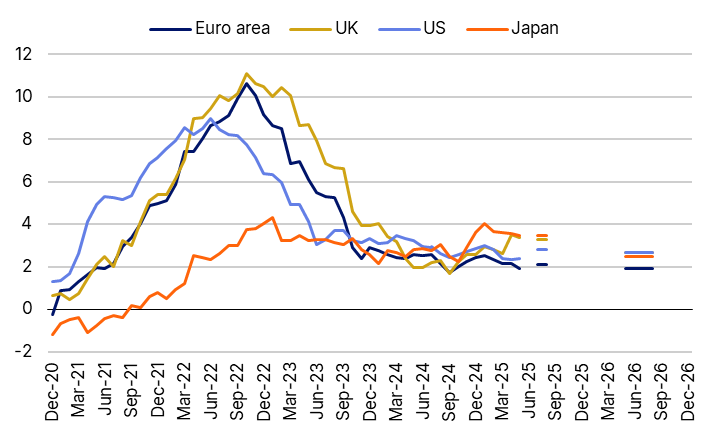
Straight lines on graphic designate Scope forecasting for calendar-year average inflation in 2025 and 2026. Source: National/regional statistics bodies, Scope Ratings forecasts.
Middle East conflict comes as trade disruptions hold back global growth
Regional instability also increases a risk of trade disruptions and the associated effects for consumer and business sentiment in the Middle East, Europe and beyond.
Global growth is forecast to slow to 3.0% in 2025 (cut 0.4pps from Scope’s October forecasts) from 3.3% in 2024 before continuing at a moderate 3.1% next year.
Author

Dennis Shen
Scope Ratings
Dennis Shen is Chair of the Macroeconomic Council and Lead Global Economist of Scope Ratings, the European rating agency, based in Berlin, Germany.