|

For the traders: Month end FX rebalancing time
Why the month-end fix still matters

The month-end fix is the market’s old clockwork. Traders have been watching it for decades, and yet it still chimes because it is not driven by conviction. It is driven by portfolio mechanics.

A foreign investor who owns US stocks but hedges the dollar is carrying two linked books: the equity asset and the FX hedge beneath it. When the equity book falls sharply, the hedge suddenly becomes too large. A $1 billion US equity portfolio, hedged with a $1 billion USD short, becomes an $890 million stock position after an 11% decline. To restore balance, the investor must buy back roughly $110 million of USD.

That is the month-end fix in its simplest form. The dollar buying is not necessarily a bullish macro bet. It is the hedge being pulled back to match a smaller asset base, like tightening a belt after the weight has come off.

It persists because many real-money managers are not paid to outsmart a one-hour FX flow. They are paid to stay close to benchmark, and the cleanest way to do that is often to reset hedges at month-end. Everyone can see the train approaching, but the passengers still need to get off at the same station.

The larger the monthly move in equities, the louder the clockwork becomes. And when liquidity is thin, or dealers are less willing to stand in front of it, those mechanical flows can push currencies further than the headlines alone would justify.

GBP/USD often becomes the preferred expression because it has enough volume to carry large rebalancing orders, but not the bottomless liquidity of EUR/USD. It can therefore move more cleanly when the fix turns into a one-way queue.

It is never a guaranteed trade. But after a violent month in equities, the London 4 pm WMR fix can briefly become the tail that wags the FX dog.

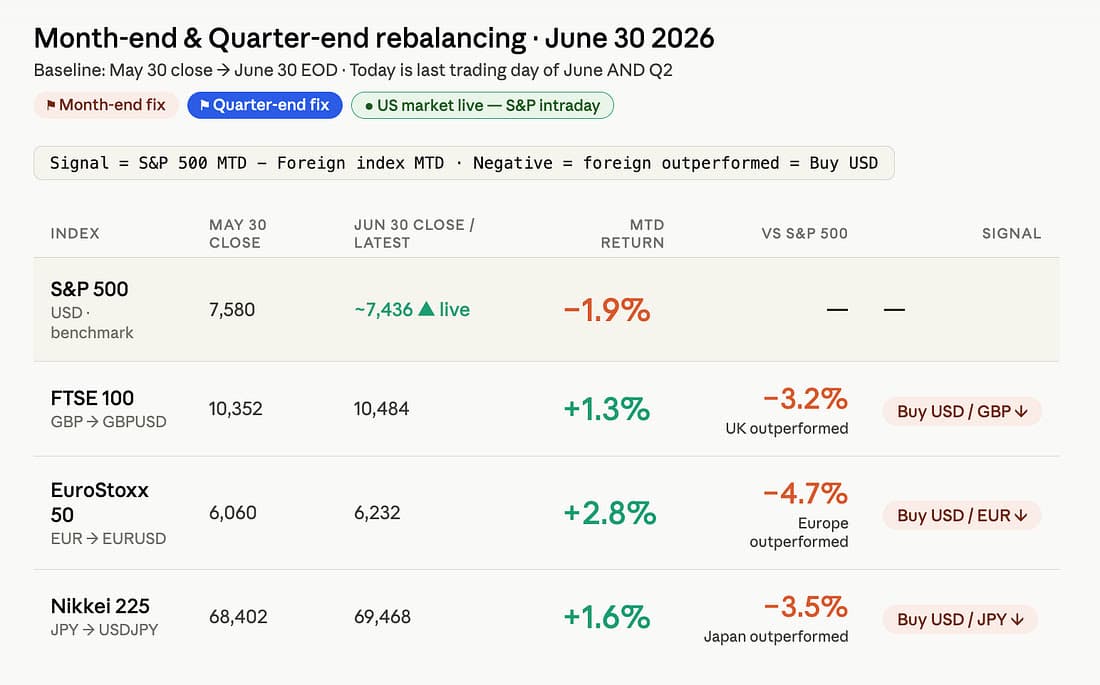
June 30 is also the last trading day of June AND Q2 — so this is simultaneously a month-end AND quarter-end fix.

This is simply math, not an opinion… not always right, but can be fun to take a pot shot at the WMR fix. Happy Hunting !!
Chart

Author

Stephen Innes

Stephen Innes

SPI Asset Management

With more than 25 years of experience, Stephen has a deep-seated knowledge of G10 and Asian currency markets as well as precious metal and oil markets.


More from Stephen Innes
Share:

Editor's Picks

GBP/USD stays weak near 1.3250 on resurgent USD demand

GBP/USD stays weak near 1.3250 in European trading on Tuesday, reversing a part of the previous day's advance to a one-week high. The pair ditches a three-day winning streak, undermined by the USD/JPY upsurge-led broad US Dollar rebound. US jobs data in next in focus.

EUR/USD keeps the red near 1.1400 on firmer US Dollar

EUR/USD remains in the red near 1.1400 in early Europe on Tuesday, snapping a three-day winning streak amid a firmer US Dollar. The pair trades with caution ahead of Germany's preliminary inflation readings and the US JOLTS Job Openings Survey.

Gold recovers early lost ground to YTD low; Fed hike bets and firmer USD to cap upside

Gold builds on its intraday recovery from the lowest level since November 2025, touched earlier this Tuesday, and climbs to the top end of its daily range heading into the European session. Any meaningful appreciation still seems elusive in the wake of a broadly firmer US Dollar. Against the backdrop of renewed Mideast tensions, mixed signals on US-Iran talks assist the USD to stall its recent pullback from the highest level since May 2025.

Ripple defends critical support, Stellar extends recovery

Ripple (XRP) trades around the key $1.00 psychological level, consolidating as the token awaits its next directional catalyst. Stellar (XLM) extends its recovery above $0.178 after posting modest gains at the start of this week.

Just like Fed, is BoJ’s independence under threat?

When talking about central bank independence, most of the focus has been on Donald Trump’s pressure on the Federal Reserve. But a similar story, a quieter one for now, seems to be happening on the other side of the Pacific: Japan’s government may be testing the Bank of Japan’s independence.

Kevin Warsh isn't expected to say much in Sintra: That's exactly why markets will listen

Financial markets could find an important catalyst in the enchanting, fairytale-like landscape of Sintra this week. The ECB Forum will, as it does every year, gather the crème de la crème of central banks. The new boss at the Fed, who has clearly said that the Fed should stop explaining everything, will need to talk – and traders should listen.