FOMC preview: Fed to stay on hold after June’s hawkish shift

While the recent surge in oil prices has led markets to increase their expectations of a Federal Reserve rate hike, June’s inflation data came in well below forecasts, and labour market figures were softer than anticipated. As a result, we expect the Fed to leave policy unchanged at its 28-29 July meeting.
Cooler inflation to keep the hawks at bay
The June Federal Open Market Committee (FOMC) meeting dispelled any fears about a potential politicisation of the Federal Reserve via the appointment of Kevin Warsh as its new Chair. The FOMC statement, and Warsh’s own commentary, emphasised a commitment to delivering price stability. The summary of economic projections, meanwhile, showed the FOMC split right down the middle on whether to raise interest rates this year.
Markets swiftly moved from pricing an 80% probability of a 25bp hike later this year to fully discounting one-and-a-half 25bp hikes. The softer‑than‑anticipated June CPI, the benign PPI readings, and the Fed’s own Beige Book – marked by a notably muted tone on pricing – collectively suggest that the urgency for action might not have been as strong as initially assumed. Moreover, the June jobs report showed non-farm payrolls rising just 57,000 after the previous three months saw an average increase of 164,000. As such, we expect the Fed to leave monetary policy unchanged on Wednesday. While nine FOMC participants projected a rate hike by December, we suspect that most of them will be non‑voters this year, given the tone and content of officials’ remarks.
Policy direction down to Oil
There is justifiable concern that the re-escalation of the Middle East conflict and the rebound in oil prices will keep inflation higher for longer. The spike in oil prices was responsible for a 20bp jump in expectations of cumulative Fed rate hikes by the first quarter of 2027 over the past seven days. Our counterpoint, though, is that gasoline prices didn’t fall in line with oil price declines, as the chart below shows. Admittedly, we saw the oil price fall below $70/bbl for only a brief period. But ordinarily, this would be consistent with gasoline prices dropping $3.50/gallon. Prices got nowhere near that.
WTI Oil price versus US retail Gasoline prices
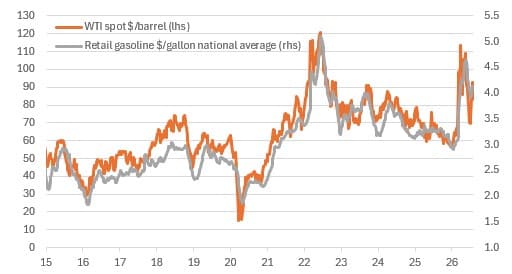
Instead, the current oil price is historically consistent with gasoline prices of just above $4/gallon, which is where we currently stand. With natural gas prices remaining little changed in the US given ample domestic supply, the energy situation doesn’t guarantee that we’ll see inflation push higher again.
A de-escalation of the conflict and a resumption of flows would likely mean oil prices drop sharply and rate hike expectations start to unwind. After all, the mid-term US elections are less than four months away. US President Donald Trump could quickly pivot to a position that eases some of the financial pain for the electorate. The alternative is that we see a deterioration in conditions should Houthi rebels choke off Red Sea supply to Asia from Saudi Arabia. A further tightening of global supply conditions would mean oil prices could rise towards $120/bbl. That would lead to sharply higher headline inflation. The Fed would likely respond with higher interest rates.
For now, we’re leaning in the direction of a de-escalation, but it needs to come quickly. We believe underlying price pressures are easing thanks to cooling housing costs, weaker wage growth and tariff refunds improving corporate cash flow. But we’ll need to see a return to dialogue in the Middle East and a de-escalation that prompts a reversal in energy prices in order to shift market pricing.
Precautionary Dollar buying
Since Warsh’s debut press conference last month, the dollar is generally stronger across the board. In the G10 space, the low-yielding yen, Swiss franc and Swedish krona have all fallen around 2%, while in EM, some popular CEE trades are off 3-4%. The recent surge in oil prices has clearly been playing a role, but probably more through the prism of what higher energy prices mean for Fed policy.
Given the absence of forward guidance and lingering uncertainty around the Fed’s reaction function, investors appear inclined to stay long dollars heading into this week’s meeting. No one knows whether the Fed will be looking at 30-year Treasury yields hitting 5.20% again and concluding that a pre-emptive hike might be useful after all.
US short-dated rates drive the Dollar higher
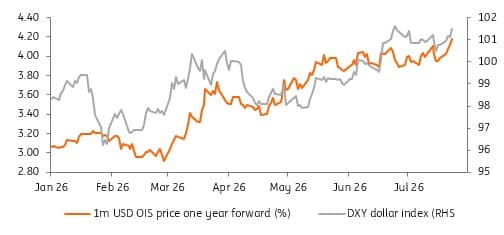
We suspect that a brief FOMC statement and a press conference that once again avoids offering forward guidance will do little to challenge the market’s increasingly firm expectations for a 25bp hike in September. The Fed simply will not have enough information at this stage to push back against such thinking.
Until the US and Iran can agree a renewed ceasefire and energy prices come lower, we expect the dollar to stay strong. EUR/USD can retest the lows 1.13s, while USD/JPY can grind towards 165. Higher global interest rates will keep the Swiss franc under pressure. If the long end of the bond market starts to sell off more aggressively, carry trade positions in high-yield emerging currencies will come under pressure.
Author

ING Global Economics Team
ING Economic and Financial Analysis
From Trump to trade, FX to Brexit, ING’s global economists have it covered. Go to ING.com/THINK to stay a step ahead.

















