Five Fundamentals for the week: Jittery markets fear the ECB, US inflation and more
- US inflation figures are in focus ahead of the critical Fed decision next week.
- The European Central Bank is set to cut rates and may convey a dovish message.
- Additional US and Chinese gauges are eyed as global recession fears increase.

Is there still a chance? Investors hope for a 50-bps rate cut from the Federal Reserve (Fed) but also fear a global recession is underway. The world's three largest economies, the US, China, and the eurozone, are set to rock global markets.
1) US inflation still may alter Fed decision
Wednesday, 12:30 GMT. Fed Chair Jerome Powell has clearly said the focus is on the labor market – but that is thanks to low inflation. The Consumer Price Index (CPI) report is the first release of hard data, and is set to rock markets one week ahead of the Fed.
Core CPI – which excludes volatile food and energy prices – is set to rise by 0.2% month-over-month (MoM), a subdued level, which would keep markets nervous ahead of the Fed decision.
In case of an upside surprise of 0.3% or higher, stocks would suffer, Gold would fall, and the US Dollar would rise. However, it would not prevent a rate cut, and after the storm, I expect markets to reverse and calm down.
A surprisingly low outcome of 0.1% would boost equities, propel Gold higher, and hit the US Dollar hard. Why? Investors would begin speculating about a double-dose cut of 50 bps, and the part could last for long.
If core CPI comes out at 0.2% as expected, the focus will shift to year-over-year (YoY) data, where any surprise matters would rock markets as described above. A bigger rise would be adverse for stock markets, while a soft outcome would be positive.
2) ECB set to cut rates, doves may surprise
Thursday, rate decision at 12:15 GMT, press conference at 12:45 GMT. The European Central Bank (ECB) is set to cut interest rates for the second time in this cycle after reducing borrowing costs in June and pausing in July. Eurozone inflation has fallen toward the ECB's 2% target and seems stable.
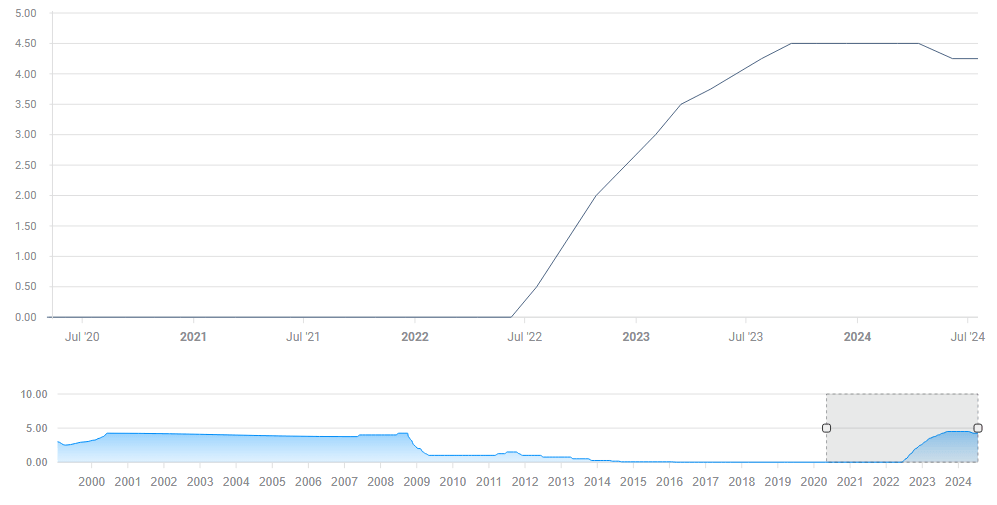
ECB interest rates. Source: FXStreet
On the other hand, growth remains solid in the 20-country bloc, and some expect the Frankfurt-based institution to move slowly. Hawks in the bank's Governing Council oppose drastic moves.
However, I expect ECB President Christine Lagarde to keep the door wide open to additional cuts in the two remaining meetings of the year. While Lagarde and her colleagues prefer denying this, they tend to follow the Fed's lead. If Powell could cut 100 bps this year, the ECB could do the same.
In case of a dovish message, the Euro would fall. For stocks, fears of a recession could limit any upside from lower interest rates.
3) Unemployment Claims eyed for labor jitters
Thursday, 12:30 GMT. Sandwiched between the ECB's decision and the presser, weekly jobless claims data from the US will be watched very closely. They are seen as the "canary in the coalmine" for massive layoffs.
Recent prints have been stable, "hugging" the 230K level. Therefore, any subtle change would move markets. The US Dollar needs a drop in claims to rise, while an increase in claims would benefit Gold.
As this indicator serves as a recession gauge, stocks would benefit from a drop in jobless claims rather than greater expectations for rate cuts.
4) US consumer sentiment to determine the close
Friday, 14:00 GMT. The University of Michigan's preliminary Consumer Sentiment Index for September provides insight into how Americans feel about the economy. The focus used to be on the inflation components of this report, but that has faded away – now, the headline matters.
Sentiment surprisingly advanced to 67.9 points in August, but it remains below levels seen in the spring. Does this reflect political uncertainty? Democrats and Republicans tend to see the economy in partisan lenses, being more optimistic when their person is either in the White House or leading the polls.
For traders, politics should not matter, but rather the data, that is seen as a gauge of consumption. It is also the last release before the close of the week and, therefore, the focus of markets. Any improvement is positive for stocks and the US Dollar, and negative for Gold.
5) Chinese data to set the market tone for the following week
Saturday, 2:00 GMT. Why does an indicator published on the weekend matter? The answer is that markets are recently more sensitive to China, the world's second-largest economy. After Beijing reported weak inflation numbers early in the week, markets struggled. Contrary to the US, weak Chinese data causes fears.
Industrial production and retail sales figures for August provide ample data about the state of the Chinese economy and will impact the opening on Monday, in a week that features the Fed.
I expect Beijing's reports to roughly meet estimates – but for markets to be skeptical about the quality of the data. Some economists have cast doubt on recent trade balance figures and other reports. Doubts about good data or weak figures could trigger a risk-off open on Monday.
Premium
You have reached your limit of 3 free articles for this month.
Start your subscription and get access to all our original articles.
Author
Yohay Elam
FXStreet
Yohay is in Forex since 2008 when he founded Forex Crunch, a blog crafted in his free time that turned into a fully-fledged currency website later sold to Finixio.