|

Fighting inflation: SNB signals more hikes ahead

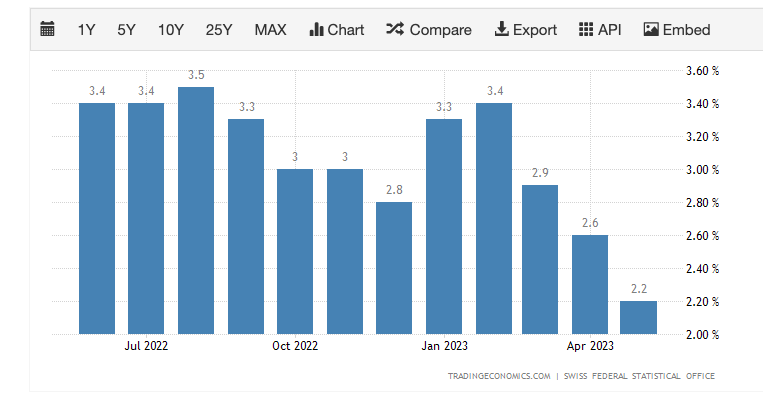
Last week the SNB increased inflation to 1.75% from 1.50% and signaled that further rate hikes were likely. Headline inflation in Switzerland is the second lowest in the G20 at 2.2% y/y.
Chart

However, although the SNB acknowledged this falling inflation it was mainly attributed to lower inflation on imported goods, mainly oil products and gas.

Inflation fears

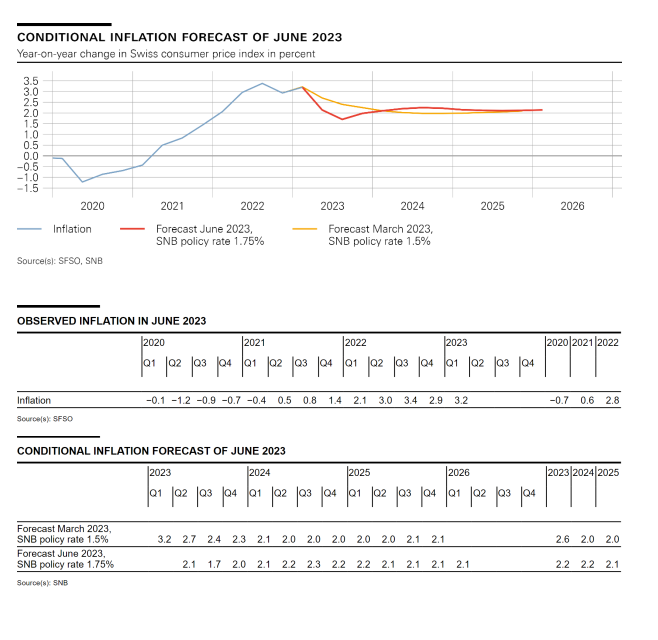
With average annual inflation projected at 2.2% for 2023 and 2024, and 2.1% for 2025, the SNB believes the battle against inflation is far from over. The next interest rate meeting on September 21 is expected to result in a 25 bps hike to 2.00%. Short-term interest rate markets anticipate a terminal rate of 2.12%, indicating optimism that the SNB is approaching the peak of its rates.
Inflation

Rate expectations from here

The next interest rate meeting for the SNB is on September 21. Expectations are that the SNB will hike by 25 bps to 2.00%. Short-term interest rate markets see a terminal rate of 2.12%, which is lower than before the SNB meeting. So, rate markets are happier that the SNB is closer to reaching the peak of their rates.

What does this mean for the future?

Keep a close eye on incoming inflation data as it holds significant importance for the SNB’s rate policy. Higher-than-expected inflation could boost the Swiss franc (CHF) as markets anticipate higher rates. Conversely, a sharp decline in inflation data may lead to CHF depreciation, as hopes arise that the SNB will not need to hike rates again in September. Stay alert to incoming inflation data!


Learn more about HYCM


Author

Giles Coghlan LLB, Lth, MA

Giles is the chief market analyst for Financial Source. His goal is to help you find simple, high-conviction fundamental trade opportunities. He has regular media presentations being featured in National and International Press.


More from Giles Coghlan LLB, Lth, MA
Share:

Markets move fast. We move first.

Orange Juice Newsletter brings you expert driven insights - not headlines. Every day on your inbox.

By subscribing you agree to our Terms and conditions.

Editor's Picks

EUR/USD holds above 1.1750 due to cautious trade before FOMC Minutes

EUR/USD holds ground after four days of little losses, trading around 1.1770 during the Asian hours on Tuesday. The pair remains steady as US Dollar moves little amid market caution ahead of the Federal Open Market Committee December Meeting Minutes due later in the day, which could offer insights into the Federal Reserve’s 2026 outlook.

GBP/USD finds key support near 1.35 despite year-end grind

GBP/USD remains bolstered on the high end as markets grind through the last trading week of the year. Cable caught a bullish tilt to keep price action on the high side of the 1.3500 handle, though year-end holiday volumes are unlikely to see significant progress in either direction as 2025 draws to a close.

Gold gains on Fed rate cut bets, safe-haven demand

Gold price edges higher above $4,350 during the Asian trading hours on Tuesday. The precious metal recovers some lost ground after falling 4.5% in the previous session, which was gold's largest single-day loss since October. Increased margin requirements on gold and silver futures by the Chicago Mercantile Exchange Group, one of the world’s largest trading floors for commodities, prompted widespread profit-taking and portfolio rebalancing.

Crypto market outlook for 2026

Year 2025 was volatile, as crypto often is.  Among positive catalysts were favourable regulatory changes in the U.S., rise of Digital Asset Treasuries, adoption of AI and tokenization of Real-World-Assets.

Economic outlook 2026-2027 in advanced countries: Solidity test

After a year marked by global economic resilience and ending on a note of optimism, 2026 looks promising and could be a year of solid economic performance. In our baseline scenario, we expect most of the supportive factors at work in 2025 to continue to play a role in 2026.

Crypto market outlook for 2026

Year 2025 was volatile, as crypto often is.  Among positive catalysts were favourable regulatory changes in the U.S., rise of Digital Asset Treasuries (DAT), adoption of AI and tokenization of Real-World-Assets (RWA).