Fed to signal gradual rate hikes on Thursday, get long EURUSD

Fed to signal gradual rate hikes on Thursday
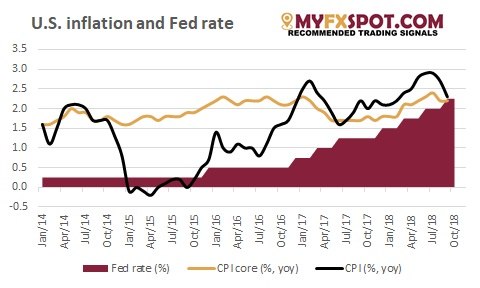
Next week, the Federal Reserve will end its seventh regular FOMC meeting of the year. It is widely expected that the committee will keep the target range for the federal funds rate at an unchanged 2.00% to 2.25%, while reiterating the outlook for another 25bp move in December. Newly appointed Vice Chair Richard Clarida said as recently as last Thursday, i.e. right before the start of the blackout period, that “even after our most recent policy decision to raise the range for the federal funds rate by 0.25 percentage point, monetary policy remains accommodative, and I believe some further gradual adjustment in the policy rate range will likely be appropriate.” Moreover, he added that “with the economy now operating at or close to mandate-consistent levels for inflation and unemployment, the risks that monetary policy must balance are now more symmetric and less skewed to the downside.” Neither the recent stock market volatility nor President Trump’s repeated comments have thus affected the Fed’s underlying policy view. This should be indicated by the statement reiterating its main policy outlook: “The Committee expects that further gradual increases in the target range for the federal funds rate will be consistent with sustained expansion of economic activity, strong labor market conditions, and inflation near the Committee’s symmetric 2% objective over the medium term. Risks to the economic outlook appear roughly balanced.”
Rather than making any immediate policy changes, the Fed will likely use the meeting to discuss the size and composition its balance sheet should have after the normalization is completed. According to the minutes of the August 1 FOMC meeting, Fed Chair Jerome Powell suggested that such a discussion of operating frameworks would likely resume in the fall. Previously, the committee had said that it wanted the smallest balance sheet that is consistent with a good monetary policy. At some point, that general statement will need to be translated into a target size for excess reserves; we expect a ballpark range of USD 500 bn to USD 750 bn, compared to the current level of USD 1.7 tn and a maximum level of USD 2.7 tn, which was hit in 2014. With regard to the composition, the Fed has suggested before that it ultimately targets a Treasury-only balance sheet, which means that all MBS and agency debt holdings would be wound down. This is likely to be confirmed. A circumstance that is adding some urgency to the topic is the fact that the effective fed funds rate continues to push against the interest paid on excess reserves. Unless the situation changes by the December meeting, it seems likely that the Fed will once again raise the interest paid on excess reserves by less than the target range in order to push the effective fed funds rate back to the middle of the band.
U.S. nonfarm payrolls increased by 250k jobs in October as employment in the leisure and hospitality sector bounced back after being held down by Hurricane Florence, which drenched North and South Carolina in mid-September.
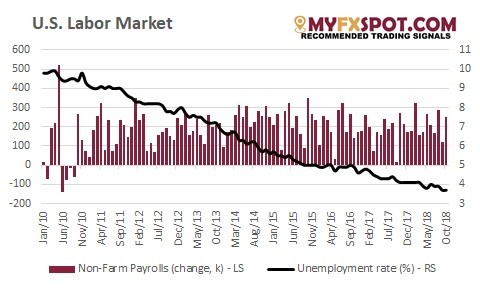
There were also big gains in construction, professional and business services payrolls, and manufacturing, where employment increased by the most in 10 months. The economy created 118k jobs in September. The Labor Department's closely watched monthly employment report on Friday also showed the unemployment rate was steady at a 49-year low of 3.7% as 711k people entered the labor force, in a sign of confidence in the jobs market. The market had forecast payrolls would increase by 190k jobs in October and the unemployment rate would be unchanged at 3.7%. Average hourly earnings rose five cents, or 0.2%, in October after advancing 0.3% in September. That boosted the annual increase in wages to 3.1%, the biggest gain since April 2009, from 2.8% in September. Employers also increased hours for workers last month. The average workweek rose to 34.5 hours from 34.4 hours in September.
EUR/USD trading strategy?
We used stronger-than-expected NFP report and a corrective move in the EUR/USD to open a long position. In our opinion Thursday's long white candle will weigh on market for some time and change the market picture. What is important EUR/USD closed above 7-day exponential moving average on Friday, which suggests bulls are getting stronger.
EUR/USD
Trading strategy: Long
Target: 1.1570
Stop-loss: 1.1345
Author

Wojciech Matysiak
MyFXspot.com
Wojciech Matysiak is a chief editor and chief economist of MyFXspot.com, currency market analyst and strategies provider.

















