Fed to cut in September, but how much more this year?

It seems a given now that the Federal Reserve will cut interest rates next month. This, to be fair, has been well understood by markets for a fair while. But minutes from the Fed’s last meeting in July confirmed the “vast majority” of policymakers are behind cutting in September. Meanwhile the US labour market may not be in such great shape as thought.
The FOMC believes that "if the data continued to come in about as expected, it would likely be appropriate to ease policy at the next meeting”. The minutes also noted how "many" Fed officials viewed the stance of rates to be restrictive and "a few participants" backed a cut in July.
BLS figures for the labour market showed sharply lower jobs growth, with an adjustment to March 2024 total nonfarm employment of -818,000 (-0.5%). That was a steep correction considering the average of the last 10 years is about –0.1%. Jason Furman suggests it means absolutely nothing.
So, a cut coming next month and perhaps as much as 100bps of cuts expected by the end of the year. Jay Powell should confirm the first part of this (Sep cut) with his speech in Jackson Hole tomorrow. However, he’s hardly going to nail his colours to the mast with the second part (100bps of cuts this year). Caution on cuts could sound like hawkishness; declaring victory on inflation would stoke the fire again.
The narrative is plausible, the market behaved as you might expect – Treasury yields down, Dollar extended its run lower towards the Dec ‘23 trough, equities firmed up. Smalls caps rose the most, with the Russell 2k up 1% and the broad S&P 500 adding 0.42%.
SPX is about 1% off its all-time high and the equal-weighted index is at it – is the peak in? Via Bofa equity guru Savita Subramanian; half of BofA's market peak signals have been triggered - prior market peaks typically saw an average of 70% of signals triggered.
European stock markets also rallied yesterday and are a bit firmer again today amid some mixed PMI data. The CAC added 0.25% on a hot services PMI, whilst the DAX trimmed gains after a mixed PMI with the mfg index down to 42.1 from 43.2, though services were much better. The FTSE 100 struggled to break 8,300 with similar gains. Tokyo led Asian stock markets on a strong services PMI.
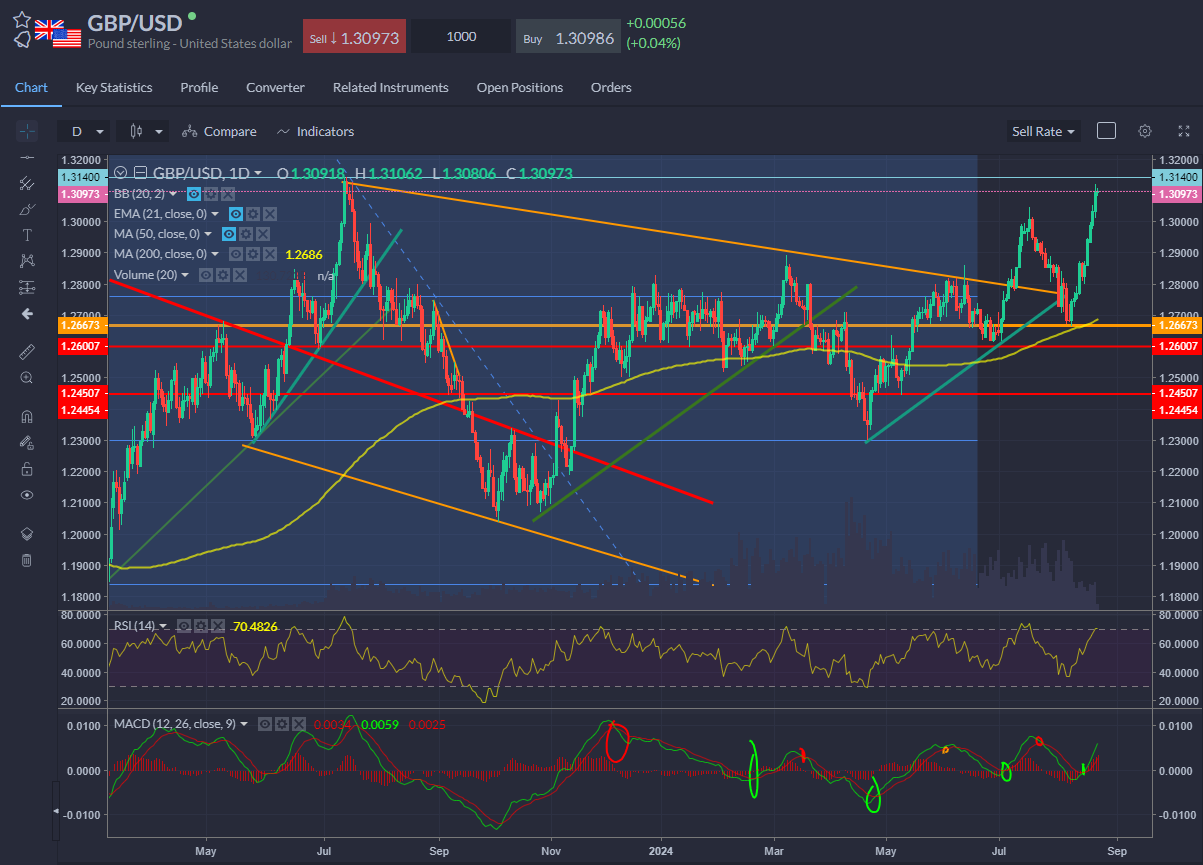
The softer dollar saw sterling rise on an air pocket. GBPUSD eased back a touch after breaching 1.31 but bulls look determined to push on through the July ‘23 peak at 1.3140. Watch for flows reversal should Powell sound more hawkish tomorrow. US PMIs and weekly unemployment figures are due later.
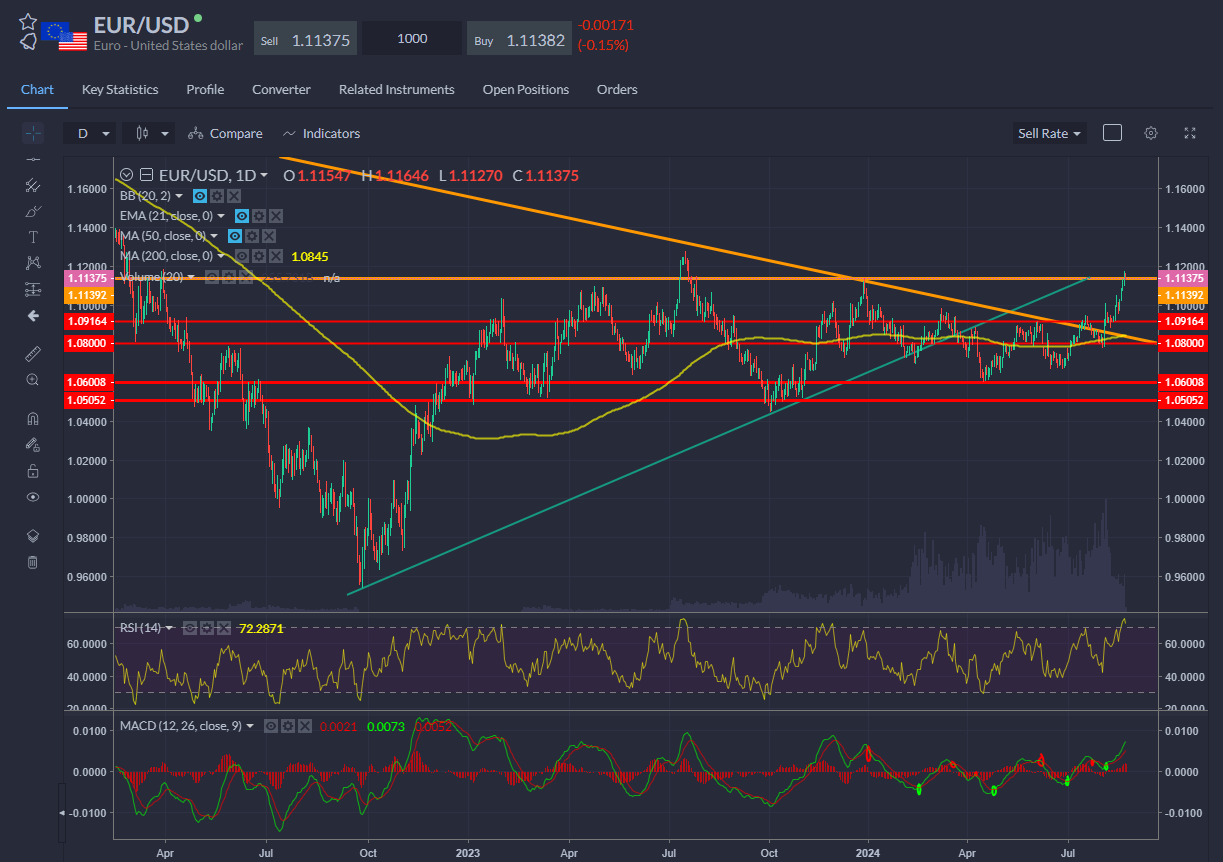
EURUSD also broken free and eyeing Jul ‘23 high at 1.1275 to take out 1.13 eventually - the ECB today publishes accounts of its last monetary policy meeting in July, when it cut rates by 25bps to 3.75%.
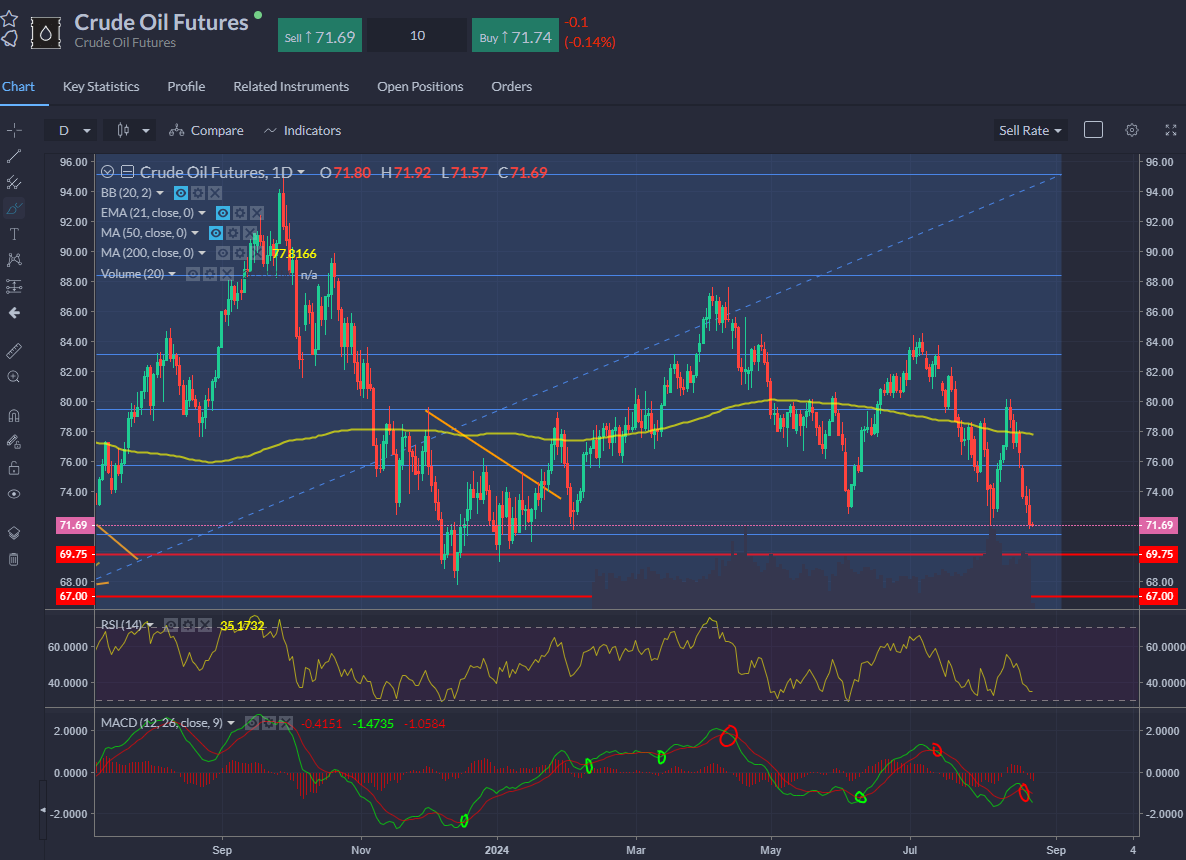
WTI front month futures fell despite bullish EIA inventory data, slipping to the lowest level since February. Crude inventories fell by 4.6 million barrels, but this big draw did little to assuage concerns that the US and Chinese economies are in a funk. Meanwhile more oil is coming on the market. BofA suggests non-OPEC+ oil production, particularly from Brazil, Guyana, Canada, and the US, is expected to rise by 1m bpd in 2024 and a further 1.6m bpd day in 2025. With OPEC+ also looking to reintroduce barrels to the market and lacklustre demand growth of about 1m bpd could leave a surplus of around 700k bpd.
Author

Neil Wilson
Markets.com
Neil is the chief market analyst for Markets.com, covering a broad range of topics across FX, equities and commodities. He joined in 2018 after two years working as senior market analyst for ETX Capital.