Fed still leans in the direction of cuts, but timing will be delayed

While the policy interest rate was left unchanged, Fed officials are still suggesting rate cuts are likely this year. However, we are doubtful that a majority will be convinced on the case for cuts before December, by which time they may feel the need to move by a more aggressive 50bp cut.
Fed still projecting rate cuts this year
Unsurprisingly there was no policy rate change from the Federal Reserve at today’s FOMC meeting. This leaves the Fed funds target rate range at 4.25-4.5%. The accompanying statement adds little, repeating that activity is expanding at a "solid pace" while inflation "remains somewhat elevated". It was a unanimous decision.
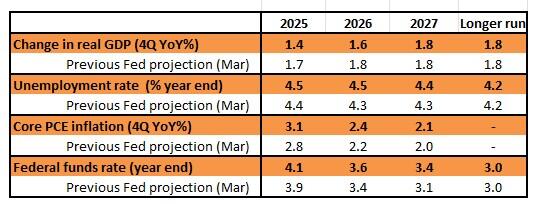
The interest was always going to be in the updated Federal Reserve projections and here the key story was that they keep two 25bp cuts in their projections for this year as they cut their fourth quarter 2025 GDP forecast from 1.7% year-on-year to 1.4% YoY and lifted the fourth quarter core PCE forecast to 3.1% YoY from 2.8% YoY. The previous projection in March was before any of the tariff announcements. It must be said that 7 of 19 individual member forecasts have no rate cut at all this year now, but in the great scheme of things these forecasts are pretty meaningless as there is so much economic and political uncertainty and the outlook for policy could change very rapidly. Chair Powell himself acknowledged that a wide range of possibilities exist. For what it is worth they also lowered fourth quarter 2026 YoY GDP growth forecast to 1.6% from 1.8% and raised core CPE to 2.4% from 2.2%, but now only have one 25bp cut in 2026 versus two previously. Note that their longer run assumption for where the Fed funds rate settles remains at 3%.
As such it all points to a Fed that is leaning in the direction of cutting rates, but isn’t particularly convinced of the case.
Federal Reserve projections
Source: Federal Reserve, ING
September may come too soon
Tariffs will mean higher goods prices with the latest Fed Beige Book commenting that “there were widespread reports of contacts expecting costs and prices to rise at a faster rate going forward. A few Districts described these expected cost increases as strong, significant, or substantial”. Tariff-induced price hikes could be amplified if the spike in energy prices in the wake of the Israeli attack on Iran is sustained. So, while recent benign inflation prints are welcome, we think investors should be braced for the month-on-month rates to pick up to 0.4% or possibly even 0.5% from July through to September.
The widespread market assumption is that tariffs lead to a one-off price adjustment and the month-on-month inflation rates will swiftly drop back to more benign readings. However, the Fed will be wary of accepting that as fact given the “transitory” inflation narrative following the pandemic supply shock was so wrong.
If we are correct to assume payrolls growth slows rather than collapses over the summer, Fed officials will want to see confirmation of benign MoM inflation prints returning in the October and November reports. Unfortunately, these are going to be released after the October FOMC meeting. October CPI is due out on 13 November and the November CPI data will be published on 10 December – the same day as the last FOMC meeting of 2025.
The market is anticipating two 25bp rate cuts this year, most probably September and December, but, we think the September FOMC will come too soon for the Fed to be comfortable cutting rates.
We forecast a 50bp cut in December
Nonetheless, the squeeze on spending power from higher goods and energy prices could lead to cuts to discretionary spending that impacts the service sector and slows inflation faster there. At the same time the jobs market is cooling and wage inflation is weakening. There is also evidence of softer housing-related inflation on the way with new tenant rents already turning negative. Housing accounts for around 40% of the core CPI basket by weight and that process will help inflation to return to 2% in 2026.
Consequently, we think December will be the likely start point, but that may well be a 50bp cut, especially if jobs and GDP growth slow as we anticipate. This would be a similar playbook to the Federal Reserve’s actions in 2024, where they waited until being completely comfortable to commit to a lower interest rate environment. Then they did a 50bp move in September followed by 25bp cuts in November and December.
Market rates distill a mild bearish tint from Chair Powell’s tone
The impact gap lower in market rates post the Fed announcement was not backed up by anything in particular. The dots were mixed versus what was expected by the market, but not dramatically deviant. The statement was not overly dovish. It was more balanced than the market was letting on. Clearly there is an intention to cut rates down the line, but we knew that ahead of time. At the same time, the inflation projections are higher than before.
The curve in consequence had snapped steeper, and before Chair Powell spoke, much of the initial push lower in the 10yr yield was reversed (to above 4.38%), while the 2yr also had with a tendency to edge back up again. The 10yr breakeven inflation rate also edged up (well clear of 2.3%), while the 10yr real yield broadly held steady to a tad higher (towards 2.05% area). The tone of the commentary was broadly in tune with an edge higher in market rates in net terms.
Effectively the Fed has acknowledged that the contemporaneous economy is doing reasonably well, with risks, and has batted the whole thing back to the macro data to come in the coming months.
EUR/USD to remain anchored at 1.14-1.15
The initial dollar reaction to the Fed event has been muted. That confirms our suspicion that the FX is currently too focused on geopolitical events and the oil price swings to read into the small nuances of the Fed communication. After all, the FOMC itself is signalling very little confidence on its dot plot projections or where the balance of inflation-unemplyoment risks will be in a few months. What will matter more for the dollar is probably Trump's reaction to the Fed's still cautious tone on cuts. We saw instances of major dollar sell-offs whenever markets felt the Fed's independence was seriously at risk.
As discussed in our June edition of FX Talking a Fed that retains independence and goes cautiously on cuts can help prevent a dollar capitulation from here. Our view is that the anchor for EUR/USD can be around the 1.14-1.15 in the coming months.
Read the original analysis: Fed still leans in the direction of cuts, but timing will be delayed
Author
ING Global Economics Team
ING Economic and Financial Analysis
From Trump to trade, FX to Brexit, ING’s global economists have it covered. Go to ING.com/THINK to stay a step ahead.

















