Fed meeting to impact Dollar’s multi-year low?

The Dollar Index closed Friday higher, buoyed by rising tensions in the Middle East. However, this late surge couldn’t offset a weekly loss of 1.51% (ActivTrades data), leaving the dollar at its weakest level since March 2022 against major peers. All eyes are now on the upcoming Federal Reserve meeting. Will its outcome extend the dollar’s decline, or could it trigger a trend reversal? Let’s take a closer look.
US Dollar Index technical outlook
The US Dollar Index measures the value of the U.S. dollar relative to a basket of six major currencies: the euro, Japanese yen, British pound, Canadian dollar, Swedish krona, and Swiss Franc.
Created in 1973, the index has only been adjusted once—in 1999—to account for the introduction of the euro. As a result, the current composition may not fully reflect modern U.S. trade relationships. Notably, the euro has the largest weight in the index (over 57%), which means that fluctuations in the US Dollar Index are often heavily influenced by movements in the euro.
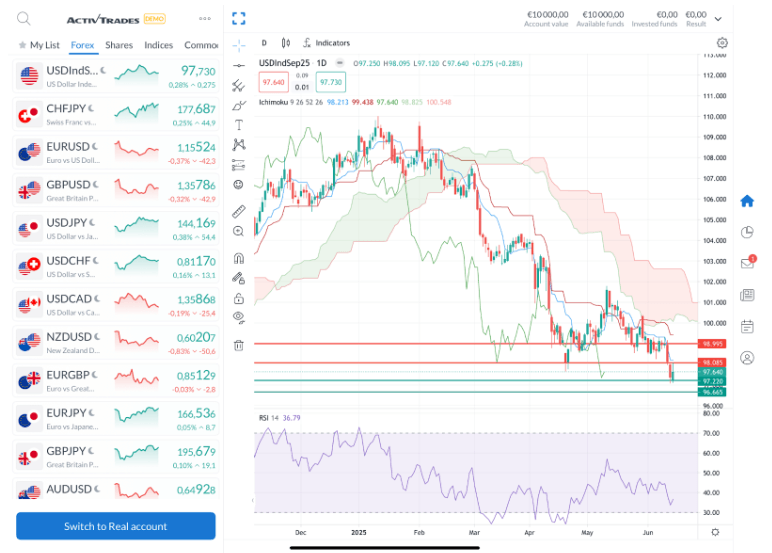
Daily USD Index (Futures September 2025) - Source: ActivTrades
A rising index indicates a strengthening U.S. dollar against this basket of currencies, while a declining index signals a weakening dollar. With a base value of 100, a current reading of around 98 suggests that the dollar has depreciated by approximately 2% relative to the index’s reference point.
Since late February 2025, the Index has been trading below the Ichimoku cloud, signaling a persistent bearish trend. As of mid-June, the index is hovering near its lowest level since February 2022, recently touching 97.09 on June 12. Momentum indicators confirm the negative sentiment, with the Relative Strength Index (RSI) sitting below the 50 threshold, around 36, suggesting ongoing bearish pressure.
Although the index had entered oversold territory—according to ING analysts—renewed geopolitical tensions in the Middle East provided a short-term bullish catalyst, reinforcing the dollar’s role as a safe-haven asset. If this upward momentum persists, traders will likely eye resistance levels around 98.08 and 98.99. Conversely, a continuation of the bearish trend could push the index toward key support zones near 97.22 and 96.66.
How are Middle East tensions, Trump’s policies, and Fed uncertainty influencing the US Dollar?
The US dollar has faced considerable downward pressure in recent months, driven largely by expectations of weaker economic growth, upcoming Federal Reserve rate cuts and growing political uncertainty. However, recent events—both geopolitical and domestic—are beginning to complicate that outlook and could reshape the dollar’s trajectory in the second half of 2025.
In this environment, where economic signals are mixed and political interference looms, the dollar is highly left vulnerable to policy-driven volatility. Markets will be watching closely not just inflation data, but also any signs of evolving Fed communication or shifts in Trump’s trade rhetoric, both of which could significantly influence the greenback’s direction. As the conflict between Israel and Iran entered its 4th day, market participants are also following the evolution of the tensions in the Middle East,
Middle East tensions and Oil prices
Until recently, financial markets were pricing in a few interest rate cuts by the Federal Reserve in 2025, largely in response to softening inflation data and early signs of labor market weakness. These expectations contributed to sustained downward pressure on the U.S. dollar, as lower interest rates typically reduce the appeal of dollar-denominated assets by narrowing the yield advantage over other currencies.
However, the surge in geopolitical risk has driven oil prices sharply higher—raising immediate concerns about a potential second wave of inflation.
Because energy costs are a foundational input for nearly all sectors of the economy, elevated oil prices tend to filter through to transportation, manufacturing, and consumer goods, eventually pushing up headline inflation. This has forced market participants to reassess their assumptions about the Fed’s policy trajectory.
A more inflationary environment reduces the likelihood of aggressive monetary easing, as the central bank remains committed to bringing inflation sustainably back to its 2% target. Consequently, expectations for imminent rate cuts have been dialed back, giving the dollar a short-term boost, especially on Friday, when safe-haven flows also intensified.
Trump’s trade policy volatility
At the same time, market participants are contending with renewed political uncertainty stemming from Donald Trump’s public stance on monetary policy and his trade agenda.
Trump has openly criticized Federal Reserve Chair Jerome Powell—most recently calling him a “numbskull”—and has signaled that he may attempt to pressure the central bank into cutting interest rates if inflation continues to trend lower. In a recent statement, Trump even suggested he might “have to force something” if Powell does not act, underscoring a potential shift toward more potential politicized monetary policy intervention.
These remarks come as the May Producer Price Index (PPI) showed weaker-than-expected inflation, with prices rising 2.6% year-over-year, only a slight uptick from April. The combination of softer inflation data and Trump’s vocal push for rate cuts is unsettling investors who are trying to assess how independent the Fed’s policy decisions will remain under growing political pressure.
Complicating matters further is Trump’s trade policy, which remains ambiguous but potentially inflationary. Should large tariffs be enacted, they would likely raise input costs for businesses and consumer prices across key sectors, adding upward pressure to inflation at a time when the Fed is attempting to guide it back to its 2% target.
On one hand, higher tariffs could stoke inflation, justifying a delay in rate cuts or even further tightening. On the other hand, tariffs also risk undermining consumer confidence, reducing spending, and slowing economic growth—conditions that could eventually warrant policy easing. This conflicting impact is at the heart of the uncertainty now surrounding the Fed’s path forward.
So far, inflation appears to remain contained.
Headline CPI rose just 0.1% in May, bringing the year-over-year increase to 2.4%. Meanwhile, the core CPI—which strips out volatile food and energy prices—has risen at an annualized pace of just 1.7% over the past three months, the slowest since inflation spiked in early 2021. But economists warn that tariff-related price pressures have yet to be fully felt and could begin filtering through to consumer goods and services in the second half of the year.
Labor market cracks
The U.S. labor market—long viewed as very resilient—is now beginning to show signs of strain, raising fresh concerns about the sustainability of growth.
After an extended period of low unemployment and steady job creation, the latest data points suggest that momentum may be slowing. Initial jobless claims have increased for two consecutive weeks, a signal that layoffs may be picking up, particularly outside the federal government sector. While the overall unemployment rate remains relatively low by historical standards, it has edged higher—rising incrementally each month since January—indicating that labor market slack may be gradually emerging.
Even though hiring seems steady, a closer look reveals a more hesitant underlying trend. Employers are increasingly reluctant to add headcount, and sectors previously driving job growth—such as tech, logistics, and manufacturing—are either freezing hires or trimming their workforce. Combined with subdued wage growth and declining job openings, these indicators suggest the labor market is losing steam, even if it hasn’t fully turned yet.
While inflation remains a core concern, a visibly deteriorating labor market could push the Fed to consider earlier or more aggressive rate cuts to cushion the economy against a sharper slowdown. However, acting too soon could risk reigniting inflationary pressures—especially if commodity prices remain elevated due to geopolitical factors like the Middle East conflict.
This week’s Fed policy: Still holding, but tone may shift
The Fed is widely expected to keep its benchmark rate unchanged between 4.25% and 4.5%. However, the tone of Chair Powell’s press conference and the central bank’s updated economic projections could offer critical clues about the path forward.
With other major central banks, such as the ECB and Bank of England, already cutting rates in response to global disinflationary trends, the Fed is under pressure to justify its tighter stance—especially if domestic inflation continues to ease.
Stay up to date with what's moving and shaking on the world's markets and never miss another important headline again! Check ActivTrades daily news and analyses here.
Stay up to date with what's moving and shaking on the world's markets and never miss another important headline again! Check ActivTrades daily news and analyses here.
Author
Carolane de Palmas
ActivTrades
Carolane graduated with a Masters in Corporate Finance & Financial Markets and got the AMF Certification (Financial Markets Regulator in France). Afterward, she became an independent trader, investing mostly in European and American stocks/indices.