Fed Lie of the Day: "Low Inflation is One of the Major Challenges of Our Time"


Fed Chair Jerome Powell is preaching economic nonsense regarding inflation. His worry is the US becomes Japan.
Bloomberg reports Powell Aims to Dodge Japan Deflation Trap With Dovish Fed Tilt.
Declaring that too-low inflation was “one of the major challenges of our time,’’ Powell left open the possibility on Wednesday that the Fed’s next interest-rate move might be a cut after four increases last year.
The world’s most powerful monetary policy maker also sketched out a harmful scenario in which consumers and companies lose faith in the Fed’s ability to hit its 2 percent inflation target.
“If inflation expectations are below 2 percent, they’re always going to be pulling inflation down and we’re going to be paddling upstream’’ to keep prices up, he told reporters after the Fed unexpectedly scrapped its forecast of any rate hikes this year.
“I don’t feel we have kind of convincingly achieved our 2 percent mandate in a symmetric way,’’ Powell said after the Fed left its benchmark policy rate in a range of 2.25 percent to 2.5 percent.
Powell confessed that there is “no easy answer’’ to explain why price rises have been so subdued. Two possible reasons he cited were that the labor market might not be as tight as policy makers believe or inflation expectations might have slipped lower.
Absurd Discussion
The entire discussion is so absurd it's hard to know where to start, but let's start with a simple translation.
Powell: Inflation is one of the major challenges of our time.
Translation: One of the major problems of our time is your dollar is worth too much. The dollar buys too many good and services.
The Fed would be very pleased if your dollar was worth less and less each and every year.
Make no mistake. That is precisely what Powell is saying.
Easy Answers
The Fed has no easy answers as to why it cannot destroy the purchasing power of the dollar as much as he would like.
Since Powell does not know, I will tell you:
- Every central bank in the world is out to debase their currency.
- When central banks all do the same or similar things, not much happens. The market looks at deficits, budgets, overall debt, and interest rates and concludes the dollar is worth increasingly more than the Euro and Yen.
- A strong dollar holds down import prices counteracting some of the inflationary trends of excessive US deficit spending.
US Dollar Index
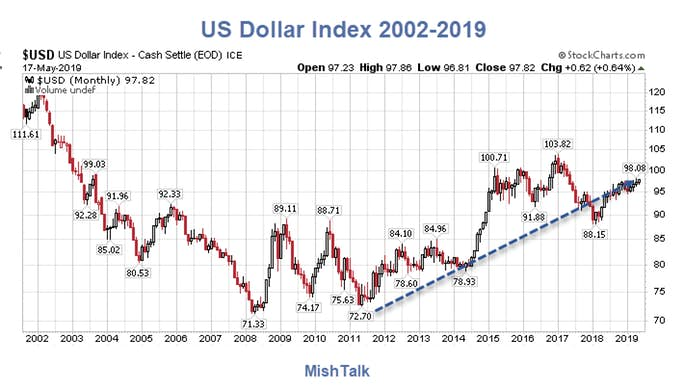
The dollar is up 21% since mid-2011.
You might agree or disagree whether or not that should be happening, but it is.
I suggest it's warranted. The Fed is the only central that that was hiking. Then, just as the ECB was ready to taper asset purchases, which would have boosted the Euro, the ECB backed off.
The modest rise of the dollar in 2019 even counteracted some of Trump's tariffs.
Phillips Curve
Why the Fed cannot figure out the obvious is not a mystery either.
The Fed places absurd faith in the discredited Phillips Curve which suggests there should be a wage price spiral in place.
Phillips Curve Curiosities
- Fed Study Shows Phillips Curve Is Useless: Admitting the Obvious
- Yet Another Fed Study Concludes Phillip's Curve is Nonsense
- Economic Stupidity and Fed Groupthink Remain "Well-Anchored"
Despite numerous studies proving the Phillips Curve is nonsense, including two by the Fed, the Fed governors have not abandoned the idea.
Also consider Rethinking the Fed's 2% Inflation Target: Spotlight On an Absurd Debate.
Hello Jerome Powell
Powell cited "inflation expectations" as the second possible reason for lack of inflation.
That notion is equally absurd, if not even more absurd.
I addressed inflation expectations in Hello Jerome Powell, We Have Questions.
If you have not done so, or if you need a refresher course, please give that a look.
The bottom line is the Fed has three bad economic models: regarding Deflation Group-Think, Inflation Expectations, and thePhillips Curve.
I sent my question list to the Fed. They did not respond or even acknowledge my email.
With three bad economic models, it is no wonder the Fed is puzzled.
By the way, there is plenty of inflation, in assets, but the Fed doesn't count that. But as part of its asymmetric policy, the Fed is guaranteed to respond to a sinking stock market.
Author
Mike “Mish” Shedlock's
Sitka Pacific Capital Management,Llc