Fed decision and technical outlook: Opportunities in EUR/USD, S&P 500, and WTI [Video]
![Fed decision and technical outlook: Opportunities in EUR/USD, S&P 500, and WTI [Video]](https://editorial.fxsstatic.com/images/i/eur-usd-002.jpg)
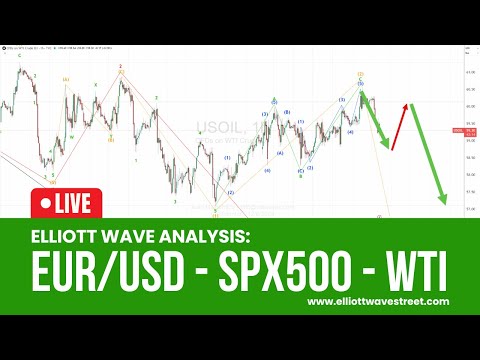
Volatility takes center stage this week as the Federal Reserve prepares to announce its interest rate decision—an event that could reshape global market sentiment. In this report, I combine technical analysis, liquidity concepts, and Elliott Wave Theory to help you identify high-probability trading scenarios while avoiding common mistakes and preparing your portfolio for sudden market swings.
Fundamental overview: Volatility after the Fed decision
The market is pricing in a 25-basis-point rate hike from the Federal Reserve. However, any unexpected move—especially a larger 50-basis-point increase—could produce violent shifts across the U.S. dollar, equity indices, and commodity markets.
As risk appetite returns, strategies this week tend to favor long positions in the S&P 500, the Euro, and WTI Crude, while the U.S. dollar remains vulnerable. In this environment, monitoring liquidity and volume becomes essential to avoid market traps and anticipate corrective pullbacks.
S&P 500: Buying pullbacks within a strong bullish structure
The S&P 500 maintains a solid bullish outlook supported by Elliott Wave counts and accumulation signals at key price levels. The highest-quality opportunities tend to emerge during orderly pullbacks, where institutional participation becomes visible.
How to identify buyable pullbacks
- Look for corrective ABC structures.
- Confirm that liquidity indicators suggest the Market Maker is accumulating.
- Validate the setup using momentum and pattern analysis on 5M, 30M, and 4H charts.
Keys to managing entries effectively
- Place stops below high-liquidity zones often defended by institutional order flow.
- Use active trade management: partial profit-taking and dynamic stop adjustments.
- Reassess open positions during high-volatility events—especially the Fed announcement.
EUR/USD: Buying retracements in a strong trend
EUR/USD continues to show bullish behavior supported by persistent U.S. dollar weakness. Elliott Wave projections maintain targets near 1.0885, assuming a steady sequence of healthy retracements.
Familiar mistakes traders should avoid in forex
- Entering trades within congestion zones without liquidity or momentum confirmation.
- Selling against the trend—both fundamentals and technicals currently favor the Euro.
Intraday signals and trading ideas are shared every morning in our Discord channel.
WTI Crude Oil: Opportunity after completing wave two
Crude Oil remains highly volatile, yet the projected Wave Three structure presents clear opportunities. Once Wave Two completes, new ABC corrective pullbacks often become valuable entry points aligned with the broader trend.
Guidelines for managing Crude Oil trades
- Monitor price interaction with institutional liquidity levels.
- Add to positions only after new corrections that align with the bullish trend.
- Avoid trading when the structure becomes unclear or when volume fails to confirm direction.
Author

Juan Maldonado
Elliott Wave Street
Juan Maldonado has a University degree in Finance, and Foreign trade started his trading career in 2008. Since 2010 has been analyzing the markets using Elliott Wave with different strategies to spot high probability trades.