Fed day: Central bank maintains target rate at 4.25-4.50%
The first meeting of the year observed the US Federal Reserve (Fed) put the brakes on policy for the first time since July 2024. In a unanimous vote, the central bank kept the target rate at 4.25-4.50%, which triggered a moderate bid in the US Dollar Index and US Treasury yields, with a dip witnessed across US equity indices and spot gold (XAU/USD).
The move to keep rates unchanged unlikely raised many eyebrows. Not only has nothing materially changed since December’s meeting, but markets were also widely pricing in a no-change decision. You will likely recall the Fed surprised markets in December, and it was about as hawkish as you could hope for. While the Fed reduced its policy rate by 25 basis points (bps) for a third consecutive meeting – concluding 2024 with 100 bps of cumulative cuts – the decision to cut or pause was a close call, and members echoed the need for ‘caution’, according to the meeting minutes. Adding to the hawkish tone, the December Summary of Economic Projections (SEP) highlighted a slower pace of easing (2 cuts versus 4 in the previous SEP), a downward revision in unemployment and upward revisions in inflation and growth.
Modestly hawkish rate statement
Today’s accompanying rate statement delivered a couple of changes, hence the immediate market reaction:
- In terms of the jobs market, the recent statement added: ‘The unemployment rate has stabilised at a low level in recent months, and labour market conditions remain solid’, replacing December’s sentence: ‘Since earlier in the year, labour market conditions have generally eased, and the unemployment rate has moved up but remains low’. With the Fed noting that the labour market remains strong along with resilient economic activity, this demonstrates why, in part, the central bank has the confidence to reduce policy this year, albeit at a more gradual pace. However, from my point of view, the issue is that recent gains in jobs have come from part-time openings; it might also be worth remembering that hiring rates have plunged.
- Regarding inflation, the latest update kept the phrase: ‘Inflation remains somewhat elevated’ and removed: ‘Inflation has made progress toward the Committee’s 2 per cent objective’. This aligns with the cautious narrative from the Fed: the central bank seeks more progress on inflation to justify further policy cuts.
- Interestingly, nothing was in the statement about the newly-elected US President Donald Trump or his administration’s policies.
Fed Chair Powell: ‘We do not need to be in a hurry’
Following the rate announcement, Powell took centre stage and clarified that the Fed does not need to rush regarding rate adjustments. The Fed Chief added that the central bank’s stance on policy was ‘very well calibrated’; he also commented that the central bank is ‘not on any pre-set course’.
In his opening remarks, Powell reiterated that if the labour market weakens or inflation subsides, the Fed could resume easing policy. Notably, Trump and his policies were not referenced. Yet, when the press was invited to ask questions, the first was predictably about Trump and his recent ‘demand’ for lower rates. Powell swiftly dismissed that question and refrained from commenting. He also stated that the Fed is uncertain about the new administration’s policies and indicated that evaluating their potential effects is premature. Powell also took the opportunity again to remind us that the Fed is an independent actor.
Regarding what I believed to be one of the most important changes in the rate statement’s language, Powell was asked why the Fed removed the sentence: ‘Inflation has made progress toward the Committee’s 2 percent objective’, to which he responded that this was not supposed to send a signal and that they ‘decided’ to shorten that part. Let’s be frank: they could have condensed that sentence and maintained the previous message. I do not buy his response. Powell, however, reiterated that the Fed needs to see more progress on inflation.
What’s next?
Markets are now fully pricing in a 25 bp cut for June’s meeting (though May is still on the table) and another 25 bp reduction in December. A May cut would be my baseline scenario should inflation or jobs demonstrate signs of cooling off. However, Trump’s policies could influence this outlook and is a risk to consider as we move forward. The Fed’s new wait-and-see approach has tilted the pendulum more on the hawkish side. Consequently, this should benefit the USD, particularly if data surprises to the upside.
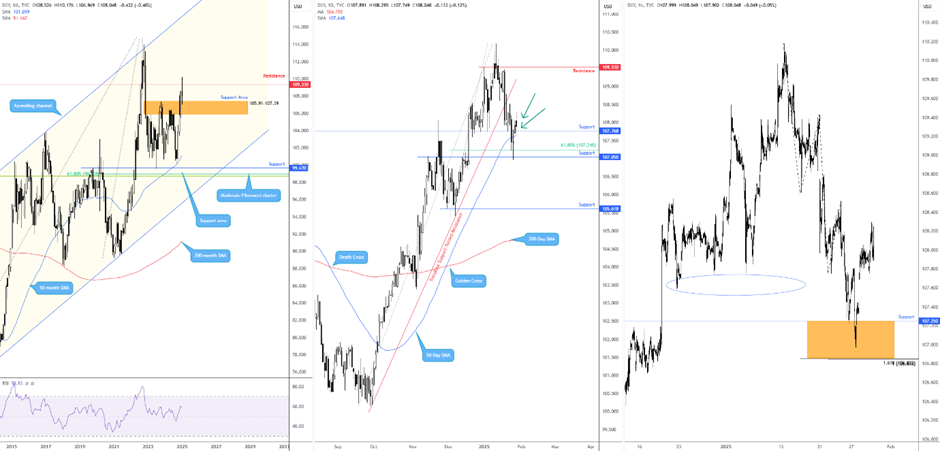
For those who regularly read our blog, you will note that I released a technical view of the USD via the US Dollar Index, consisting of monthly, daily and H1 timeframes. The charts showcased evidence supporting a bullish USD bias. I will not go into detail here, but we are now north of daily resistance from 107.77, which is important and perhaps unlocks the door for further buying towards monthly resistance at 109.33.
Author

Aaron Hill
FP Markets
After completing his Bachelor’s degree in English and Creative Writing in the UK, and subsequently spending a handful of years teaching English as a foreign language teacher around Asia, Aaron was introduced to financial trading,

















