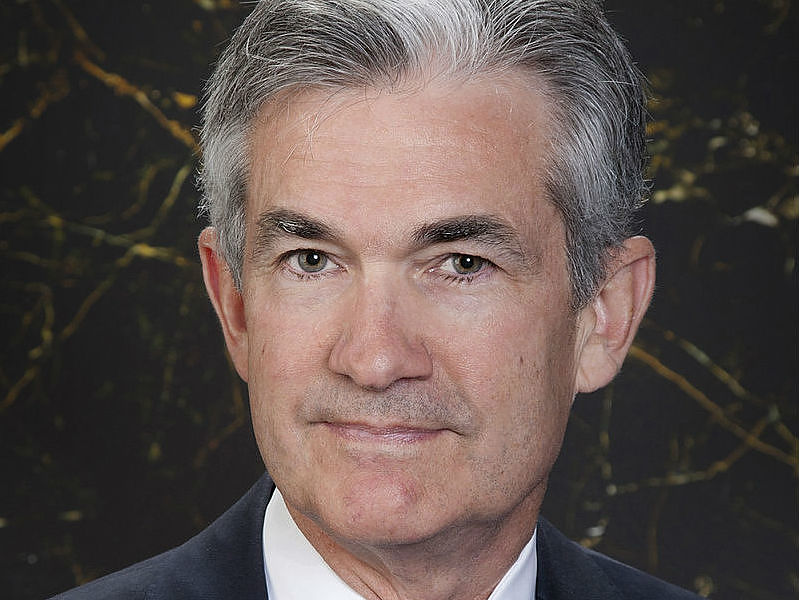
Fed Chairman: “We’re not even thinking about thinking about raising rates

Market volatility has suddenly spiked in recent days came after the Federal Reserve vowed last Wednesday to keep its benchmark rate near zero through 2022.
That’s an unusually long period for the Fed to be projecting rate policy. It reflects the fact that it will take many months and perhaps years for the tens of millions of jobs that were recently lost to return.
During his press conference, Chairman Powell stumbled and stammered his way into stating that he would be happy to let inflation continue to rise until the economy approaches full employment.
Jerome Powell: We'd be looking to get inflation back up and we'd be prepared to tolerate, uh, pretty low, welcome in fact, not tolerate, but welcome very low readings on unemployment, just based on what we saw in the last, uh, in the last expansion. So, um, we're not thinking about raising rates. We're not even thinking about thinking about raising rates.
So, what we're thinking about, is, providing, uh, support for this economy. We do think this is going to take some time. There are just a lot of people that are unemployed, and it seems quite likely that there'll be a significant group, uh, at the end of, even after a lot of strong job growth, that'll still be struggling to find jobs and we'll still be providing strong accommodation for that.
As is often the case, the stock market initially reacted one way to the Fed only to have second thoughts after a deeper reading of the central bank’s policy stance. On the one hand, monetary planners are committed to being ultra-accommodative into 2022. On the other hand, they seem convinced that the recovery will be slow – and are likely worried about another devastating wave of coronavirus infections.
Some parts of the country are experiencing a rise in reported COVID-19 cases right now. However, that is due in large part to a massive increase in testing.
Alarmists had predicted a spike in deaths as a result of beaches and swimming pools reopening. But that does not appear to be happening.
When Georgia became the first state to reopen a few weeks ago in defiance of the federal government’s guidelines, the media warned it would be catastrophic. And yet Georgia seems to be faring no worse than states that remained locked down.
We will see in the days ahead if illegal protesting and rioting in major cities across the country translates into a surge in coronavirus hospitalizations.
The demonstrations which were initially sparked by outrage over police brutality are now taking on the character of a Maoist cultural revolution. The mob demands we all kneel before it in submission, issue ritualistic apologies for any transgressions against its orthodoxy, and demonstrate our commitment to the cultural revolution by agreeing that we need to erase our history in the name of progress.
A full-scale war on history is being waged on statues, monuments, street names, military bases, and even classic movies such as Gone with the Wind. The vandals want us to forget who and what came before us to make us who we are today.
Strangely, corporate America seems to be fully on board with this revolution and is providing hundreds of millions of dollars in funding for it. Big Business is going all-in for globalism and a digital future that breaks down traditional mom-and-pop business practices.
It’s in the interest of banks and tech giants to redirect people’s anger away from their own financial plight in this new economy. These companies together are worth trillions of dollars thanks in part to the unlimited digital printing press of the Federal Reserve and the lack of a sound money standard.
Of course, there was a time when U.S. currency explicitly stated it was redeemable in precious metal.
It’s a history most people today know little about. Those who were around as recently as 1963 may remember when paper dollars were also silver certificates – redeemable in silver coins.
Most politicians, bankers, and business titans today quite prefer digital dollars redeemable in nothing. They would prefer the public to not be tangibly connected to its history.
There is a war on cash and a war on history being waged in this country. They go hand in hand.
If politically incorrect historical landmarks aren’t allowed to exist, then the past can’t speak to us directly anymore. Every generation will want to apply some new politically correct filter for determining whose history can stand. Some historical figures will be demonized for their words and actions. Others will be dismissed as no longer relevant, their ideas obsolete for modern times.
Similar attacks were launched on gold and silver to shift America’s monetary system to a purely fiat one. Gold is outmoded, they said. It’s been rendered useless in the modern economy. It’s a “barbarous relic”…and so on.
This is what central bankers and their ideological allies want us to believe. But if gold were truly obsolete as a monetary asset, then central banks would sell all their gold reserves. They certainly wouldn’t be buying.
But in recent years central banks have been accumulating gold in increasing quantities. And for good reason.
Gold’s history as money spans far longer than the timeline of any fiat currency. Gold’s history gives people confidence in its future as a store of value.
Yes, history still matters. Those who fail to learn its lessons will be caught completely unprepared when history repeats itself and the U.S. dollar plunges toward worthlessness – just like all the other fiat currencies that have come before it.
To receive free commentary and analysis on the gold and silver markets, click here to be added to the Money Metals news service.
Author
Mike Gleason
Money Metals Exchange
Mike Gleason is a Director with Money Metals Exchange, a national precious metals dealer with over 500,000 customers.

















