|

Faster consumer spending lifts Q2 GDP growth to 3.0%

Summary

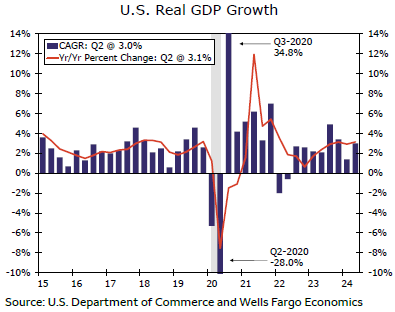
Consumer spending propelled the economy to a 3.0% annualized growth rate in Q2, an upward revision that exceeded expectations. A rebound in profits growth recouped all the prior quarter's decline and then some to restore profits to a record high.

Consumer to rest of economy: I got this

With the benefit of additional data, the Commerce Department upwardly revised the annualized growth rate for the U.S. economy to 3.0% in the second quarter (chart). Most of the upward revision can be attributed to a more robust pace of consumer spending, which is now reported to have grown at a 2.9% annualized rate, up from 2.3% previously (chart). There is plenty of evidence that restrictive policy is weighing on the labor market and on construction, where revisions today revealed a more measured pace of structures investment and an outright decline in residential investment.
fxsoriginal

But with +1.95 percentage points of the overall 3.0% growth rate coming from consumer spending, it is less clear that higher-for-longer is posing a major impediment to household spending, no matter how much sentiment and confidence measures may say otherwise.

Download The Fulll Economic Indicator

Author

More from Wells Fargo Research Team
Share:

Editor's Picks

AUD/USD sits at two-month lows near 0.6950 after Australian CPI data

AUD/USD is sitting at two-month lows near 0.6950 in the Asian session on Wednesday, as below-expectations August Australian underlying CPI data pours cold water on expectations for further RBA interest rate hikes. Chinese PMI data also fail to inspire the Australian Dollar, despite a pause in the US Dollar advance.

USD/JPY stays weak below 157.00 amid Japanese intervention risks

USD/JPY keeps losses below 157.00 in the Asian session on Wednesday, as hawkish BoJ expectations, along with intervention risks, underpin the Japanese Yen, countering dismal domestic factory output and retail sales data. Meanwhile, a broad US Dollar retreat also collaborates to the pair's downside.

Gold returns below $4,200 after a short-lived recovery

Gold tested $4,220 early in the American session after softer-than-expected US inflation figures. Encouraging US data weighed on the odds of a Federal Reserve rate hike in October, as employment and growth data beat expectations. Still, the precious metal was unable to retain its momentum and trades flat around $4,180

Crypto Today: Bitcoin holds $83K as Ethereum remains below $2,700 and XRP consolidates

Bitcoin trades lethargically on Wednesday, with bulls battling to defend the immediate $83,000 level as immediate support. Ethereum trades in tandem with Bitcoin, holding below key levels of $2,700 on the upside and $2,600 on the downside. Ripple, meanwhile, hovers near $1.50,

The Euro is near a one-year low: Inflation could trigger its rebound, not its fall

EUR/USD has fallen to its lowest level since May 2025, but a fresh inflation shock in the Eurozone could give the Euro an unexpected lifeline. The pair hit 1.1312 on Wednesday and trades well below the January peak of 1.2082. The decline reflects a powerful combination of US Dollar strength, geopolitical uncertainty and renewed concerns about Europe's exposure to higher energy prices.

The Euro is near a one-year low: Inflation could trigger its rebound, not its fall

EUR/USD has fallen to its lowest level since May 2025, but a fresh inflation shock in the Eurozone could give the Euro (EUR) an unexpected lifeline. The pair hit 1.1312 on Wednesday and trades well below the January peak of 1.2082.
















