EURUSD Weekly Forecast: Roles invert with US Federal Reserve and EU Gross Domestic Product coming up next
- The United States Gross Domestic Product beat the market expectations in Q3.
- The European Central Bank’s dovish stance overshadowed an upcoming aggressive tightening path.
- European growth and the US Federal Reserve monetary policy taking the scenario next week.
- EURUSD failed to retain parity, a red flag for those hoping for an interim bottom.

The EURUSD pair is up for a second consecutive week, finishing it at around 0.9950. The American Dollar (USD) started the week on the back foot, extending the previous weekly decline amid speculation the US Federal Reserve (Fed) will soon slow the pace of quantitative tightening. At the same time, the battered Euro remained subdued, as recent European data showed the economic downturn keeps steepening. Things changed on Thursday, as first-tier events from Europe and the United States left market players with a sour taste in their mouths.
European Central Bank drops forward guidance
Central banks remained in the eye of the storm, with the European Central Bank (ECB) announcing its monetary policy decision on Thursday. President Christine Lagarde and co. hiked the main three rates by 75 bps each and introduced changes to the Targeted Longer-Term Refinancing Operations (TLTRO) III program to further tighten the financial system. The ECB also said that policymakers would turn their back on forward guidance as it fuels the already-high uncertainty.
President Christine Lagarde also repeated that inflation is far too high while noting that economic activity has likely slowed significantly in the third quarter of the year and is likely to slow further in the upcoming quarters. Her words were read as dovish, putting pressure on the Euro and pushing EURUSD further away from its recent peak at 1.0093.
Upbeat US Gross Domestic Product
The United States (US) did not stay behind. The country published the preliminary estimate of the third quarter Gross Domestic Product (GDP), which brought a positive surprise. The report showed that the economy grew at an annualized pace of 2.6% in the three months to September, better than the 2.4% expected and reverting the negative trend for the two previous quarters. The US Dollar came under mild selling pressure with the headlines, as stock markets found the headline encouraging. At the same time, US government bond yields retreated sharply from multi-year highs, adding pressure on the American Dollar.
The news shocked financial markets ahead of the US Federal Reserve monetary policy decision, scheduled for next Wednesday, November 2. Europe will publish its Gross Domestic Product figures ahead of the Fed, and the EU economy is expected to have grown 0.7% QoQ in the third quarter of the year.
Market players have to find trading opportunities in quite a messy scenario. Inflation soared to record highs in major economies after the early stages of the COVID-19 pandemic put a halt to global economic activity. Soaring prices caught governments and policymakers off guard, and flooding their respective financial systems with liquidity, which add to skyrocketing prices. Most central banks quickly changed course, with the Federal Reserve leading as always, and quick-started quantitative tightening. The downturn of drying liquidity is an increased risk of slowing economic growth. As the year went by, inflation gave no signs of easing, but the economic activity clearly contracted. At this point, the US GDP report is much more relevant than the actual market reaction, as it shows the country could resist more rate hikes.
US Federal Reserve coming up next
The Fed, as usual, led the path of quantitative tightening, while the European Central Bank was among the latest to react. And while the first is thinking it has already done enough, the second has a long way to go. Growth in the United States has proved resilient, while European Union authorities are painting a gloomy picture ahead. The Fed could slow the pace of tightening and hope a benchmark rate of 3.25% will cool inflation without harming growth. The ECB, on the other hand, has to deal not only with record inflation and slowing growth but also with the energy crisis.
In the meantime, financial markets are being bombarded with US earnings reports and mounting tensions between the EU and Russia, with the latter always ready to menace with a nuclear war.
On Friday, the United States published the core Personal Consumption Expenditures (PCE) Price Index, which edged higher in September, reaching 5.1% YoY from 4.9% in August. The core PCE price Index is the Federal Reserve's preferred gauge of inflation, and clearly, this is not good news ahead of the central bank announcement.
The Fed is expected to hike rates once again by 75 bps next week and pave the way for smaller rate hikes afterwards. Market players are anticipating a 50 bps hike in December, and another similar one in the first 2023 meeting.
The imbalance between central banks has been one of the reasons EURUSD collapsed to an over-two-decade low of 0.9535 in September. The subsequent recovery was related to the speculation that the Federal Reserve will slow the pace of tightening but also to firmer equities. About the latter, big-cap names collapse at the end of the week gave the US Dollar a chance to come back, with EURUSD trading again below parity, not looking good for the future of the Euro.
Beyond the Fed decision and EU GDP, the macroeconomic calendar will bring next week the United States October ISM Manufacturing PMI and the ISM Services PMI for the same month. Next Friday, the US will release the October Nonfarm Payrolls report, expected to show that the economy added 200,000 new job positions and that the Unemployment Rate ticked higher from the current 3.5% to 3.6%. It is also worth adding that the Reserve Bank of Australia (RBA) and the Bank of England (BoE) will also announce their monetary policy decisions. The RBA and the Bank of Canada (BoC) had been the first to slow the pace of quantitative tightening.
Hopefully, next week's updates will help speculative interest make up its mind and put EURUSD is a certain path.

EURUSD technical outlook
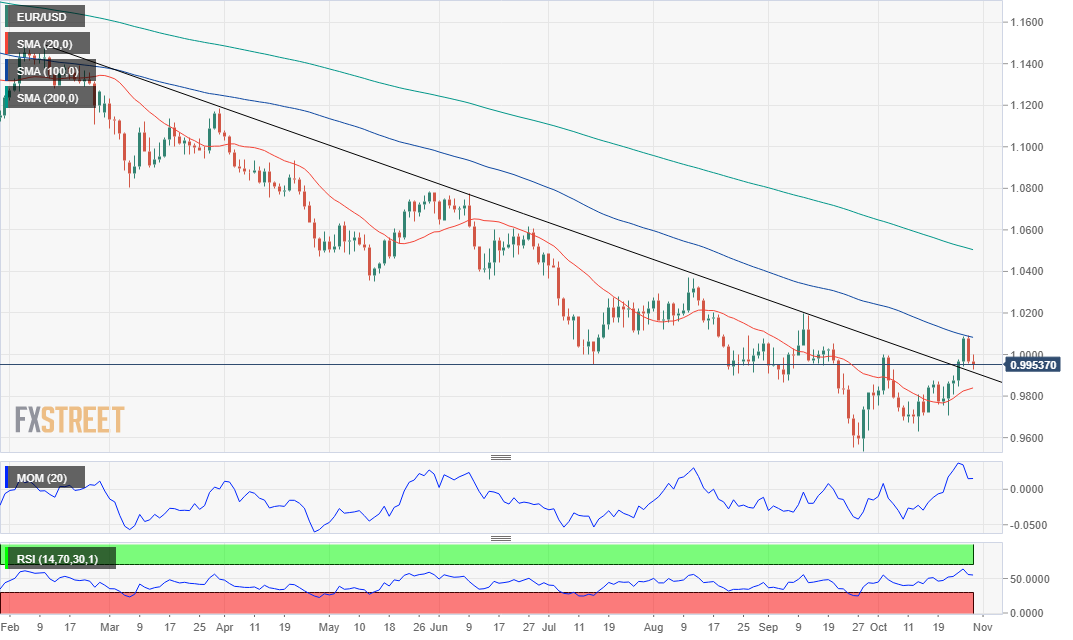
The EURUSD pair broke above a long-term descendant trend line coming from the year high at 1.1494 on Tuesday, and spent the week above it. It even completed a pullback to the trend line on Friday, from where it bounced back, an encouraging sign for bulls. However, a sustained advance over the mid-term is still unclear.
The weekly chart shows that the pair met sellers after flirting with a firmly bearish 20 Simple Moving Average (SMA), which is currently in the 1.0090 price zone. At the same time, the 100 SMA accelerated its decline and aims to cross below the 200 SMA, both around 1.1280, too far away from the current level to be relevant. Finally, technical indicators have extended their recoveries from extreme oversold readings, although the Momentum indicator turned flat below its 100 level while the Relative Strength Index (RSI) indicator heads north, but around 41.
The daily chart provides more encouraging signs to bulls, although there are some hurdles in the way. The pair topped around a bearish 100 SMA for two consecutive days, with the moving average now standing at around 1.0080. The 20 SMA struggles to advance but stands below the current level and grinds north, reflecting increased buying interest. Finally, technical indicators stand near overbought readings, lacking clear directional strength.
If EURUSD slides below the trend line, the pair could fall initially towards 0.9840 and later decline to the 0.9700 price zone. Further declines below the latter should put the pair on its way to retesting the year low at 0.9535. The 1.0080/90 area seems critical, as an advance beyond it would be a hit to those betting for the US Dollar. The EURUSD could then reach the 1.0200 price zone, where it topped in mid-September.
EURUSD sentiment poll
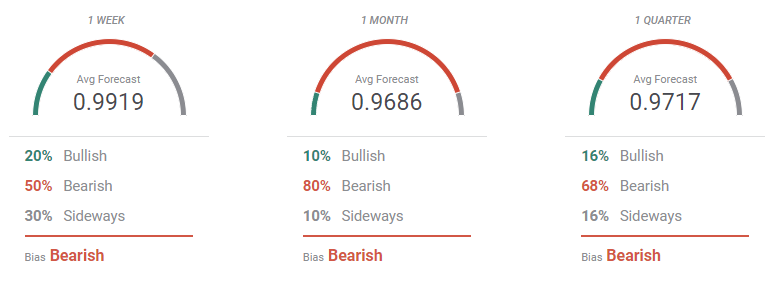
The EURUSD pair FXStreet Forecast Poll suggests that the pair will remain under pressure in the coming weeks. In the weekly perspective, the pair is seen averaging 0.9919, with 50% of the polled experts looking for a slide and only 20% betting for higher levels. In the monthly perspective, bears account for 80%, while in the quarterly one, they stand at 68%. Despite averages fluctuating, the pair is hardly expected to run past 1.000.
The Overview chart shows that the near-term moving average picked modestly up, while the monthly and quarterly ones have turned flat. In all cases, most targets remain below the critical 1.0000 threshold, while there are still some bets on a test of the 0.9000 mark. Finally, in the quarterly view, chances of a break below the 2022 low at 0.9535 remain quite high.
Author

Valeria Bednarik
FXStreet
Valeria Bednarik was born and lives in Buenos Aires, Argentina. Her passion for math and numbers pushed her into studying economics in her younger years.