EUR/USD advances but ECB lurks


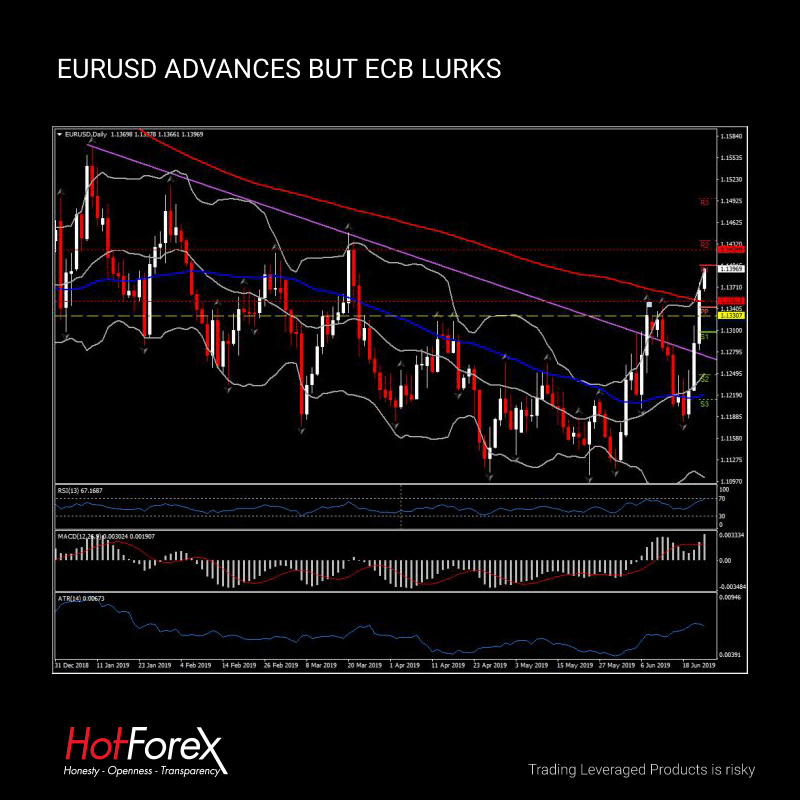
The Dollar has started the week on a soft footing, which drove EURUSD to a new 3-month high at 1.1395, with buying picking up steam on the break over the 200-day Moving Average at 1.1352, despite the sub-forecast German Ifo data. EURJPY also saw a new 11-day peak, while the common currency has remained buoyant against other currencies.
The German Ifo business survey produced a Q2 headline reading of 98.2, down from 99.4 in Q1, although at least part of the headline weakness was due to one-off distortions created by the relatively late timing of Easter this year and stock building ahead of the original Brexit deadline. EURUSD’s gains today build on gains seen last week following more-dovish-than-expected Fed guidance and forecast-beating flash June Eurozone Composite PMI data.
The upwards trend following trading the past 4 days is not looking to ran out of steam yet, as RSI is at 67 (not overbought yet) and MACD presents a bullish crossing, suggesting that positive bias is increasing.
From the fundamental perspective, the FOMC’s dovish outcome continues to have impact on the Dollar overall, with a July FOMC rate cut fully prices into the futures market. On the other hand, the ECB has been sounding very dovish lately, with Draghi last week saying further rate cuts and QE could be on the table should conditions deteriorate further. Eventhough the ECB is not expected to act immediately, but clearly the chances that Draghi will deliver one last parting gift before his departure at the end of October, clearly are pretty high.
Hence, EURUSD rally could be fundamentally affected by the central bank, given the potential for ECB dovishness to counter Fed dovishness.
Bigger picture, EURUSD has been in a bear trend since early 2018, though downside momentum has abated markedly in recent months, with the pairing looking to have found a rough equilibrium. Support comes in at 1.1347-1.1350. Resistance is set at March high area, at 1.1424-1.1440.
Nevertheless, the rising US-Iran tensions, and circumspection in market narrative about the chances of a significant improvement in US-China relations, appear to be curtailing optimism fuelled by the recent dovish policy pivots of major central banks.
Author
Having completed her five-year-long studies in the UK, Andria Pichidi has been awarded a BSc in Mathematics and Physics from the University of Bath and a MSc degree in Mathematics, while she holds a postgraduate diploma (PGdip) in