Eurozone Third Quarter GDP Preview: The best view may be to the rear
- GDP expected to rise 9.4% in the third quarter after -11.4% in the second.
- Annual CPI and core CPI forecast to be unchanged at 0.2% and -0.3%.
- ECB fears for slowdown and recession sink euro to near three-month lows.
- Weaker than forecast EMU GDP will undermine euro.

The eurozone economy recovered from its pandemic closure in the third quarter but a second wave of infections and partial shutdowns in Germany and France have reignited fears that the 19-member monetary union and the 27-member EU may be headed for a second recession.
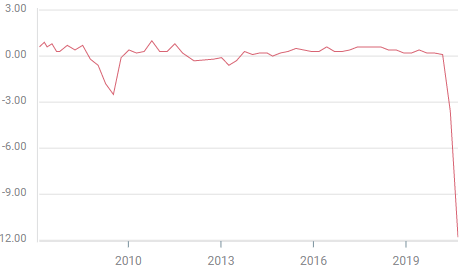
Gross domestic product (GDP), the most encompassing measure of economic activity, is projected to rise 9.4% on the quarter in July August and September after falling 11.4% in the lockdown marred second quarter and 3.6% in the first.
Inflation is expected to be unchanged with the annual consumer price index at 0.2% on the year in October and the core yearly rate at -0.3%.
Eurozone GDP (QoQ)
EU and shutdowns
Rising COVID-19 case rates in many European countries and their own, have prompted the French President Emmanuel Macron and the German Chancellor Angela Merkel to announce new partial closures of their economies in an effort to damp the spread of the virus.
Germany, the EU's largest economy, is expected to have its third straight negative quarter when the July to September GDP figures (YoY) are released on Friday at -5.3%, following -2.2% in Q1 and -11.3% in Q2.
Germany has not had two consecutive negative quarters since the financial crisis and recession of 2008 and 2009 when it suffered five negative quarters in a row (Q4 2009-Q4 2010).
France the second largest economy is forecast to return to expansion in the third quarter at 15.4% (YoY) after two -13.8% and -5.3% in the first six months of the year.
If the closures are prolonged or extended to larger portions of their economies France and the EU would likely see a second recession beginning in the fourth quarter and Germany a year of negative growth.
ECB and the EU economy
The European Central Bank left its policy rates and bond purchase program untouched at its meeting in Frankfurt on Thursday.
It was President Christine Lagarde's pessimistic assessment of the eurozone economy in her press conference afterwards and the likelihood that the bank will have to increase its economic support in December that sent markets hurrying to the safety of the US dollar.
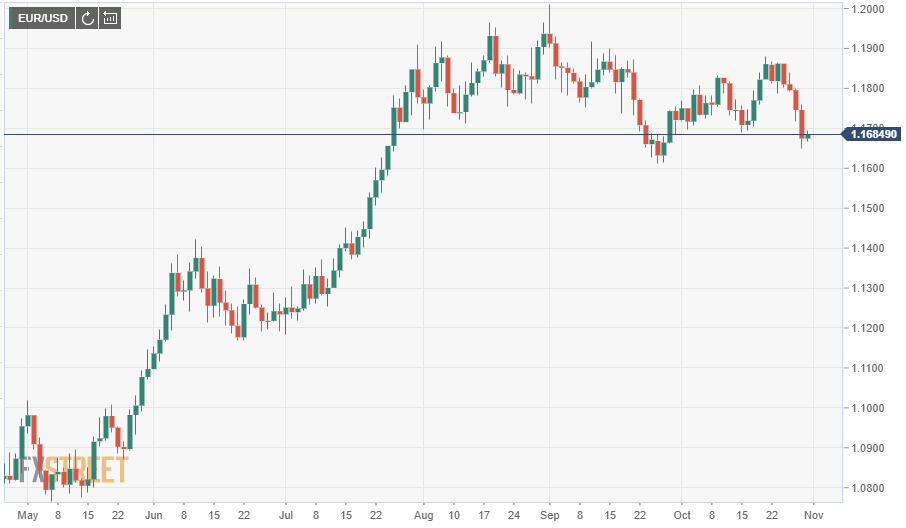
The euro closed at 1.1674 on Thursday , its lowest finish since September 28 and is not just above the three-month low of 1.1632 set close of 1.1632. The greenback rose in all seven major pairs as markets grappled with the potential damage from the European closures and the rising viral counts in the United States.
Ms Lagarde has already warned markets that the EU economy is likely to slow enough in the fourth quarter to require additional monetary support. She also made it clear that national governments must raise their fiscal contributions if the economy is to weather the building pandemic impact.
That scenario is now front and center for the euro.
If third quarter GDP is weaker than forecast it will confirm Ms Lagarde's hypothesis and send the euro lower. If it is stronger, the fourth quarter will be worse. The euro can't win.
Author

Joseph Trevisani
FXStreet
Joseph Trevisani began his thirty-year career in the financial markets at Credit Suisse in New York and Singapore where he worked for 12 years as an interbank currency trader and trading desk manager.
















