Currencies and jobs

Trades update
While the current views are doing well overall, the sidebar has become a bit of a letter/number salad, so it’s time to think through the trades one by one to make sure they all still make sense.
Long USDBRL. The timing on entry yesterday was bad, but these things happen sometimes. Stronger USD overall helps; let’s see how it goes.
Short EURJPY still makes sense. The trade has been doing nothing for a long time, but each time USDJPY gets above 160.00 in Asia time, it gets smacked down. There is a possibility that GPIF or other Japanese real money have decided to rotate out of foreign assets and into JGBs using 160 as a motivating level.
This could be part of the coordinated plan to stabilize the yen using domestic agents. Some analysts like to pooh pooh the GPIF thing, but remember they can already do massive rotation within the current bands. The discussion is only whether to increase the domestic bond band even more. They are currently able to rotate quite significantly, so any increase is just more ammo to protect the JPY.
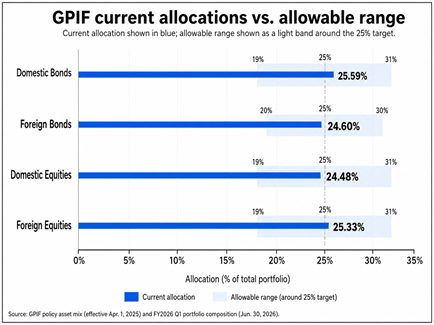
The Bloomberg clip I sent in the body of the email yesterday made the rounds in Asia and of course uber-hawk Takata said overnight a hike of more than 25bps is possible. That does not seem realistic—Takata is way ahead of the rest of the BOJ with his hawkishness and his comments are probably not representative. He’s just a hawk.
The USDCNH long was principally a carry trade with a bit of a “the PBoC has had enough CNY appreciation for now” kicker. It is stale, and I will run it to expiry. The short CNH carry trade hasn’t really worked out, though there is still some modicum of hope with a full week remaining.
The CHFJPY put spread that I entered in July has been volatile inside the spread, and I continue to believe that holding to expiry has the highest EV despite some zippy mark to market. I went into the weeds to discuss the perils and upside of put spread P&L accrual in general. I will ride this until expiry and hope we are through the bottom next week.
The AUDNZD got a big boost from a dovish RBNZ last night. While I wouldn’t say the central bank’s message was anything particularly shocking, the market took it as a green light to add to long AUDNZD. The dovish view is working out well and the next RBNZ meeting is on October 28. That meeting is precariously close to the November 7 election in New Zealand—there is no logic to a hike ten days before a potential new government comes in. That potential new government, not incidentally, plans to return the RBNZ employment mandate at a time when the UR is at multi-year highs. October RBNZ is priced at 30% and should fade to zero over time.
A strange fact: The OIS market has the October RBNZ priced at 30% for a hike (8bps out of 25), while Polymarket has it priced at 6%. Sure, there’s barely any liquidity, but there’s some liquidity—it’s trading 1% wide.
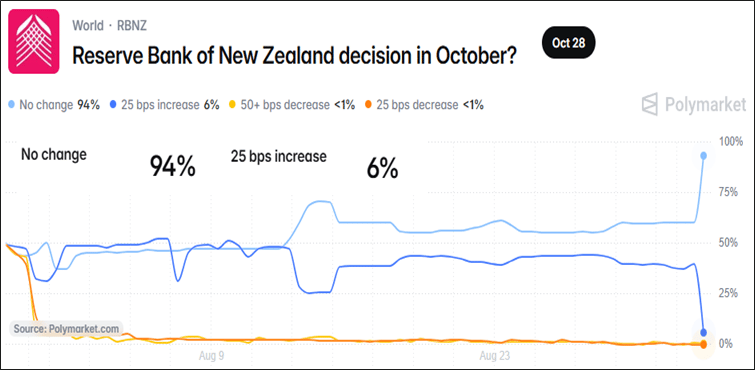
Even at small amounts, it’s strange to see pricing for the same event so dramatically different on crypto vs. tradfi.
I suppose the ability to trade NZ OIS vs. Poly might not yet be a thing for anyone on planet Earth, but still. I think the Polymarket price is much more rational than OIS pricing.
For comparison, the September Fed meeting is 59% for a hike on Poly, while U.S. tradfi (OIS) has it around 66%. That’s more of a usual spread between two things like this.
And finally, the 1-week short vol trade in EURUSD and USDJPY is TBD with the EUR leg OTM but the USDJPY side likely to make some profit. It all depends where we are at 10:00 a.m. NY.
Jobs
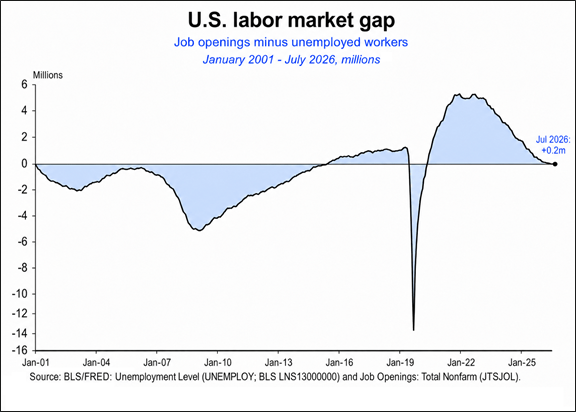
I am off for the next two days, so here’s a brief comment on Friday’s jobs data. The U.S. labor market is currently in perfect balance if you look at Job Openings vs. Unemployed Workers. Sure, there are skill mismatches, but with one job opening for every unemployed person in the U.S., it’s hard to argue that the labor market is extremely tight or loose.
Due to collapsing labor supply, estimated breakeven jobs growth in the United States is now around 20k as you can see here.
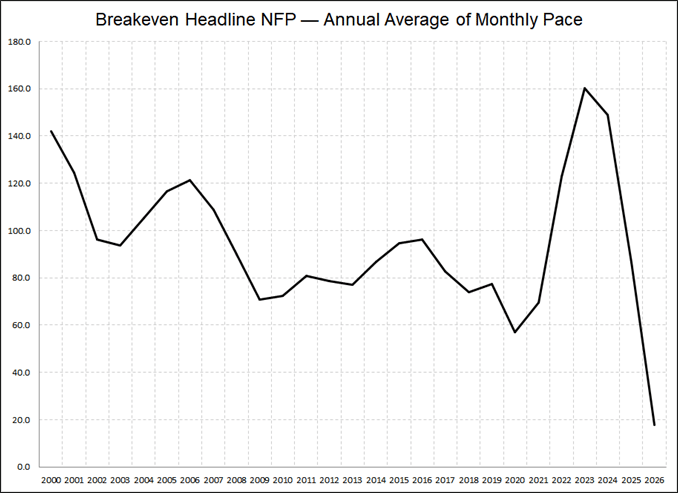
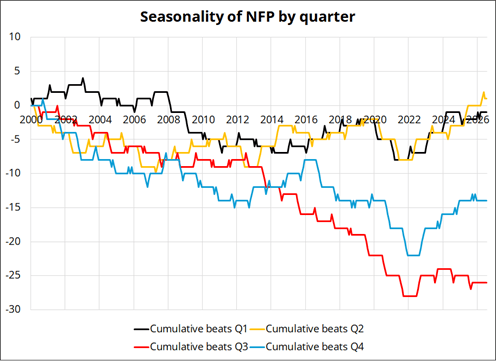
If you have been trading for 20+ years, this collapse in breakeven headline NFP is important to keep in mind because an NFP release of +20k used to be a disaster and now it’s pretty okay. Recall that Q3 tends to see the most NFP misses and August misses the most of any month.
Anything above zero keeps the rate hike in play and we wait for PPI and CPI. A UR of 4.2% or 4.3% makes it easier for Warsh to keep talking hawkish, and pass again in September. As I have been saying, though, I feel like next week’s inflation data is much more important than NFP. That said, above or below zero and above or below 4.1% are the key psychological hurdles. You could conceivably see a negative headline print and a 4.0% UR for maximum confusion.
Final thoughts
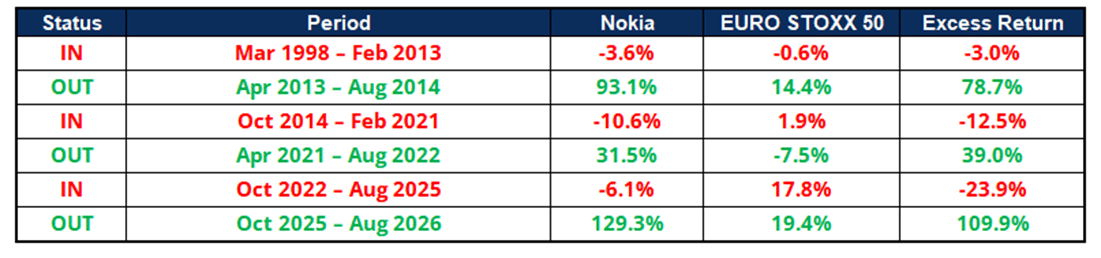
1. Nokia has been added to the EURO STOXX 50 again! Great news, right?1.
2. Gavin Baker says Grok Bot is another ChatGPT moment. Baker tends to be ahead of the curve and not super hyperbolic so I find this interesting. Learn, adapt, or be left behind.
Have a super average day
Author

Brent Donnelly
Spectra Markets
Brent Donnelly is the President of Spectra Markets. He has been trading currencies since 1995 and writing about macro since 2004. Brent is the author of “Alpha Trader” (2021) and “The Art of Currency Trading” (Wiley, 2019).