Eurozone PMIs preview: Upbeat expectations seem justified, opening the door for EUR/USD gains
- Markit's preliminary PMIs for January are set to show a modest improvement.
- The manufacturing sector's contraction and services expansion compete with each other.
- EUR/USD is expected to react strongly to any outcome.

Is weak German manufacturing still set to drag the whole continent down? Or has the services sector kept Europe running strong and the worst is already behind us?
These are the questions for euro investors are hoping that Markit's Purchasing Managers' Indexes can answer. The forward-looking business surveys are published one day after the European Central Bank's decision.
While manufacturing is still growing in France – any score above 50 represents expansion – it is contracting in Germany and the continent as a whole. The slump – caused by the Sino-American trade war among other factors – raised fears of an outright recession. However, robust shopping in the continent's "locomotive" and other places helped Europe weather the storm.
The danger of slipping into a recession is still in the air but has receded of late. The signing of the Phase One deal in Washington implies a potential increase in Beijing's imports of German goods. The dose of clarity of Brexit after the Conservatives' victory in the UK elections also helps.
Expecting further recovery
In France – which kicks off the PMI reports – while President Emmanuel Macron has succumbed to some of the pressures on his pension reform, the economy is chugging along.
As this snapshot from the economic calendar is showing, French figures are set to remain mostly unchanged.
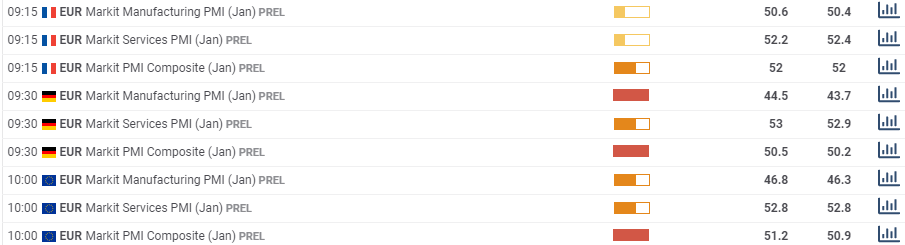
In Germany, economists forecast a substantial increase in the Manufacturing PMI – arguably the most significant data point of the day.
Are these expectations justified? Yes is the answer. Apart from the US-Sino detente, this indicator has beat expectations in the past four publications. While the estimated score of 44.5 is still considerably below 50, it would mark an improvement and match other upbeat figures.
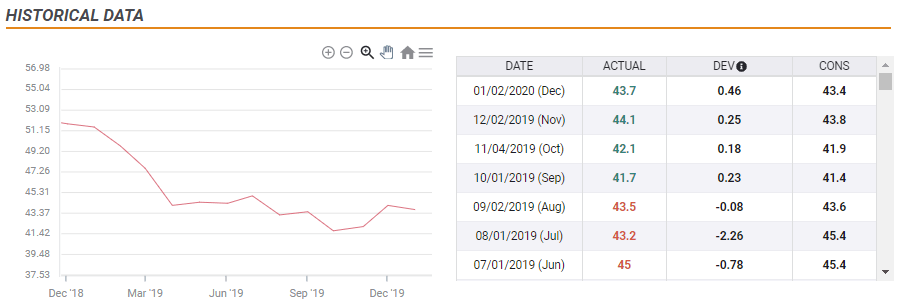
For the whole euro-zone, a moderate improvement is likely. It is essential to note that the publication of German figures takes some of the stings out of the all-European statistics.
Overall, markets expect the upbeat services sector to hold its ground while manufacturing digs itself – with or without the other sector's help – out of the hole.
Three Scenarios
1) Within expectations: If the German Manufacturing PMI and other indicators are broadly within estimates, EUR/USD has room to rise. It would diminish the chances of further action by the European Central Bank.
The probability is high as these projections seem justified.
2) Above expectations: If the main figure tops 45 or even hits 46 points, the common currency would have room to rally. It would indicate greater confidence with the recent trade calm.
The probability is medium, with an upbeat figure supported by the recent strong ZEW Economic Sentiment read.
3) Below expectations: A German PMI of below 44 would likely send EUR/USD to new 2020 lows, as it would come as a shock and vaporize the notion that the old continent is enjoying green shoots.
The chances are low as the recent trend and news have all gone in the other direction.
Conclusion
There are good reasons to believe that Germany and Europe are extending the economic recovery in the first month of 2020. Markit's forward-looking PMIs may keep the euro bid. A more robust recovery would send the common currency shooting higher, while a shocking disappointment could hurt it.
Author

Yohay Elam
FXStreet
Yohay is in Forex since 2008 when he founded Forex Crunch, a blog crafted in his free time that turned into a fully-fledged currency website later sold to Finixio.

















