|

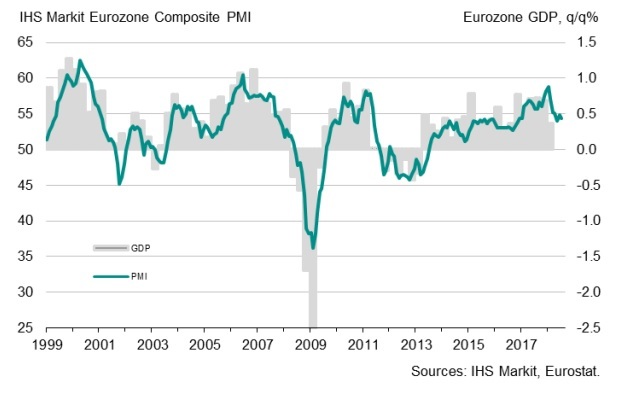
Eurozone PMI points to GDP slowdown of 0.4%

  • The Eurozone manufacturing PMI rose to 55.1, the highest in last 2 months while services PMI decelerated to 54.4 and composite PMI fell to a 2-month low of 54.3 in July.
  • Faster growth in Germany contrasted with a slight slowing in France. 

The early estimate of the economic activity in the Eurozone combining the purchasing managers' indices (PMI) in both manufacturing and services slowed down to 54.3  in July compared with 54.9 in June, representing a 2-month low.

While activity picked up in Germany it slowed in France resulting in overall decline. Elsewhere, growth was the weakest for 21 months, slipping lower in both manufacturing and services.

The third-quarter started on the softer footing, with the July reading for composite PMI consistent with quarterly GDP growth of 0.4%, down from a 0.5% expansion indicated by the surveys for the second quarter.

According to Chris Williamson, the chief economist at IHS/Markit and the author of the PMI report: “the renewed slowdown comes as a disappointment, confirming suspicions that June’s
rebound was temporary, largely due to businesses in some countries making up for an unusually high number of public holidays in May.”

There are are signs that improving domestic demand in many countries of the Eurozone that are expected to drive robust service sector expansion and support the manufacturing sector as the big picture for exports is deteriorating in light of escalating trade wars with a detrimental
effect mainly on manufacturing.

The Eurozone PMI and GDP


Author

Mario Blascak, PhD

Mario Blascak, PhD

Independent Analyst

Dr. Mário Blaščák worked in professional finance and banking for 15 years before moving to journalism. While working for Austrian and German banks, he specialized in covering markets and macroeconomics.


More from Mario Blascak, PhD
Share:

Editor's Picks

AUD/USD falls to near 0.7100 after slipping below 50-day EMA

AUD/USD depreciates after registering minor gains in the previous day, trading around 0.7120 during the Asian hours. The technical analysis of the daily chart shows the pair consolidating sideways within a rectangle pattern, as neither bulls nor bears gain control. The AUD/USD pair is holding a slight bearish tone however as it sits beneath both the nine-day and 50-day EMAs.

160.00: USD/JPY back near intervention territory after upbeat US jobs report

US Nonfarm Payrolls beat expectations by a wide margin in May, with 172K jobs added. The US Dollar rebounds after the release, helping USD/JPY recover from its intraday lows. Warnings from Japanese authorities continue to limit upside potential near the 160.00 threshold.

Gold remains offered below $4,500 following US Payrolls

Gold prices trade with a bearish bias and still remain below the key $4,500 mark per troy ounce at the end of the week. The slighlty softer tone in the US Dollar alongside mixed US Treasury yields across the curve also keep the yellow metal’s downside somewhat contained.


Cardano hits five-year low even as Hoskinson clarifies "break" isn't an exit

Cardano (ADA) price is down 10% at press time on Friday, extending losses over 30% so far this week amid Charles Hoskinson's clarification that "break" isn't an exit.

Week ahead – Fed countdown begins amid US inflation data and geopolitical risks

Fed Chair Warsh’s first meeting approaches as key US inflation data could reshape expectations. Oil prices remain elevated as US-Iran talks continue; tariffs also return to the spotlight. ECB is expected to hike; will it be a one-off move or is July live?

The US economy defies the rules: 100 days into the Oil shock and the recession signal is still missing

More than three months after the start of the Iran war and the resulting disruption to global energy markets, the US economy continues to display remarkable resilience. The conflict has triggered a sharp rise in Oil prices, reignited inflationary pressures and fueled widespread concerns about a potential economic slowdown.















