European GDP: Who is Usain Bolt of Europe?

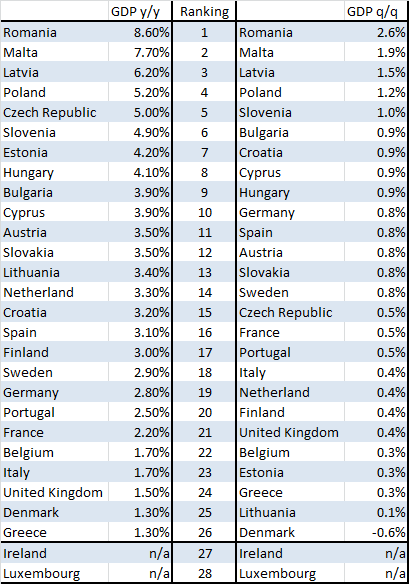
If you wonder what country is the fastest growing economy in Europe, you might be surprised. Ranking countries of European Union based on their GDP growth rate measured either quarter-to-quarter or year-on-year lines up four emerging market countries at the top four positions, Romania, Malta, Latvia, and Poland.
Romania leads the ranking with 8.6% y/y growth rate with enormous momentum in economic growth rate documented by 2.6% q/q growth rate. Malta, small Mediterranean island, comes second in ranking with 7.7% y/y and 1.9% q/q growth followed by Latvia that rose 6.2% and Poland with GDP growth of 5.2% and 1.2% q/q.
GDP growth rates in European Union member countries
Source: Eurostat, ranking adjusted by FXStreet
Top performers
Looking at the ranking of the European 26 countries (because data for Ireland and Luxembourg were not available for Q3 2017) gives a clear picture of emerging Europe coming out as the top performer.
Top ten fastest growing countries based on GDP growth rate over the year are former communist emerging markets with Austria being the top performer of traditional “Old Europe” that is benefitting from geographical proximity to fast-growing countries like Czech Republic, Slovakia, Hungary and Slovenia.
Laggers
Bailout Greece is on the opposite side of the ranking with mere 1.3% y/y GDP growth rate concluding the list together with Denmark that is actually the only country to has recorded negative GDP growth rate in Q3 2017.
Above the laggers are big European economies of United Kingdom and Italy with 1.5% y/y and 1.7% y/y GDP growth rate respectively. Both countries have specific reasons for lagging behind. The case of the UK is pretty straightforward. Brexit related uncertainty lowered investment and Sterling depreciation resulted in higher inflation and negative real, inflation-adjusted wage growth that keeps household spending capped. In Italy, the slow GDP growth rate is a combination of structural problems with high unemployment and relatively high public and corporate debt with a burden of non-performing loans that weigh on economic performance.
Author

Mario Blascak, PhD
Independent Analyst
Dr. Mário Blaščák worked in professional finance and banking for 15 years before moving to journalism. While working for Austrian and German banks, he specialized in covering markets and macroeconomics.