European contractors stuck in neutral as growth stalls in 2025


Although Europe faces significant housing shortages, residential construction is unlikely to rise this year. Permits for new homes are increasing, but growth remains slow. The infrastructure sector continues to grow, but significant gains from the new NATO agreement are unlikely.
2025 growth on pause
We expect zero growth in the EU construction sector this year. This is a small downgrade compared to our previous forecast. While some modestly positive signals are beginning to surface, they are nothing to write home about. Contractors remain pessimistic, though the situation appears to have bottomed out.
No real improvement in EU construction confidence yet
Development confidence indicator EU construction sector.

Source: European Commission, ING Research
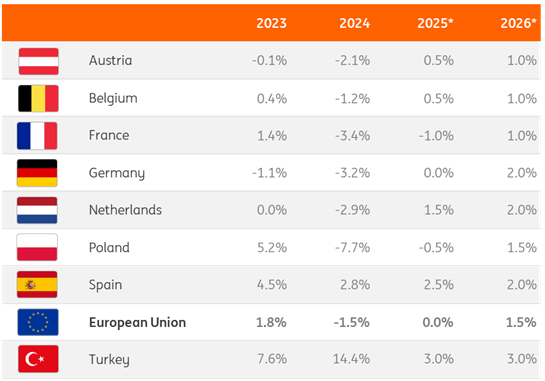
Production levels in the EU construction sector showed no meaningful growth during the first half of 2025. For Austria and Poland, we have downgraded our forecasts, with Poland experiencing another decline in construction volumes following a sharp fall in 2024.
Infrastructure activity has been slow due to delays in Poland's implementation of the Recovery and Resilience Fund, which was frozen for two years due to a rule of law dispute with Brussels. A forecasted decrease in interest rates may lead to a potential recovery in Poland's new residential sector by 2026.
EU construction forecast
Volume output construction sector, % YoY.
Source: Eurostat, *forecasts ING Research
For the Netherlands, we have revised our forecast downward as the number of building permits, which increased in 2024, has fallen this year. For Belgium, the forecast remains unchanged despite a decline in building permits, as we expect some offset from a recent legislative change that could provide support to the sector. A reduced VAT rate of 6% now applies to renovation and the demolition and reconstruction of homes. This measure is expected to provide some counterbalance next year.
On a positive note, Spain is particularly noteworthy within the European Union. The Spanish construction sector has benefited from strong GDP growth, with construction confidence reaching its highest level since 2006.
Building permits for new houses are bottoming out
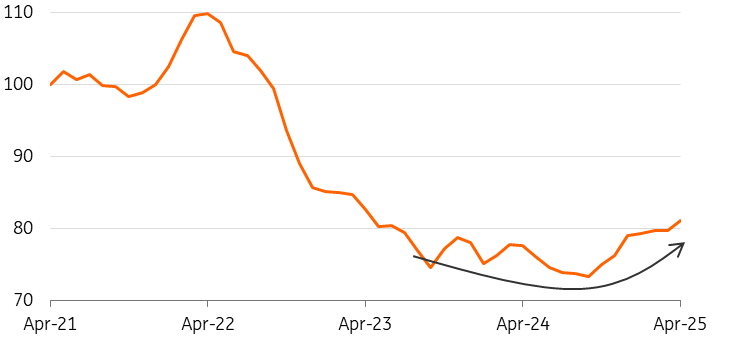
The issuance of building permits for new houses in the EU has reached its lowest point and is displaying slight improvement. Yet, the granting of permits is still very low compared to 2021, especially in Germany and Austria. In these countries, issuance has fallen by more than 40%. To speed up the building process, the German government has announced the ‘housing construction turbo (Bau-Turbo)’ to speed up the planning and authorisation of new projects in popular living areas. However, there may be a delay before this translates into increased permit issuance and new construction activity.
A positive outlier is Spain (again). The housing market in Spain is heating up and house prices are surging. This has created a strong business case for new developments, resulting in a sharp rise in building permits in recent years.
In the Netherlands, there was an upswing in issued permits in 2024, yet during the first half of 2025 it looks like this increase has ended. Like other European countries, there are several bottlenecks: a shortage of (affordable) building land, complex project development, and legal delays.
Small recovery in the number of issued building permits
EU building permits for new dwellings, (Index 2021=100 3-months moving average).
Source: Eurostat, ING Research
Housing scarcity
Housing shortages persist across most European countries, prompting governments to ramp up efforts to increase the supply of new homes.
However, these initiatives frequently fall short of targets due to both structural challenges – such as lengthy approval processes and limited availability of suitable land – and cyclical headwinds like rising interest rates and escalating construction costs.
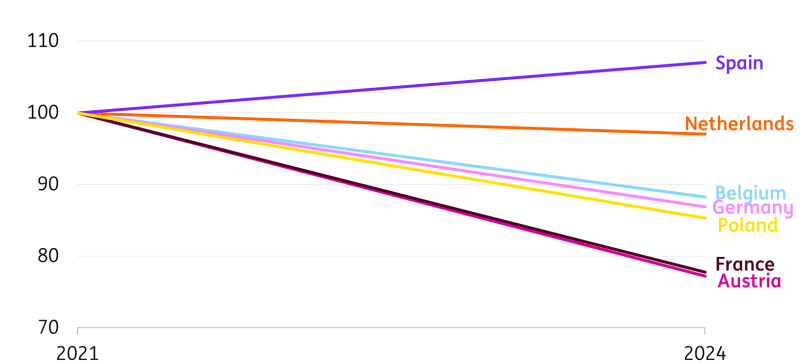
Only Spain shows growth in new housing completions
New housing completions, Index 2021=100.
Source: Euroconstruct, ING Research
Drop in housing completions
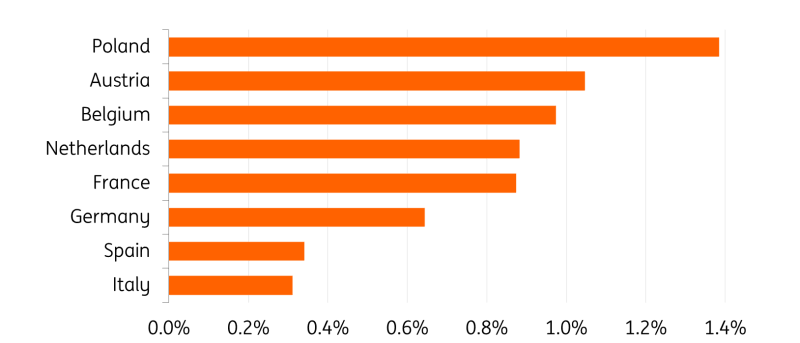
Due to fewer building permits being issued, most counties have seen a decline in new housing in recent years. Reductions in France and Austria have been the greatest. As of early 2025, French prices for existing homes remain about 5% below levels two years ago, whereas EU house prices overall have increased by 6%. Lower house prices in France present challenges for new developments due to elevated building material costs, as low sales prices don’t make new projects profitable. Spain is the exception (again), experiencing growth in newly constructed houses. However, this increase contributes only modestly to Spain’s overall housing stock, with a rate of 0.3% new houses per existing stock in 2024, which is far lower than in other countries.
High percentage of developments in Poland and Austria, low in Spain and Italy
Poland has added the highest percentage of new residences to its stock in 2024 (1.5%). Yet, Poland still has a high rate of overcrowded households. Polish households continue to have the fewest rooms per person compared to 10 other large EU nations, indicating persistent housing density. Nevertheless, Poland’s elevated construction activity has contributed to a decline in its overcrowding rate over the past decade, while in many other EU countries it has increased.
Polish new-build volumes are relatively high
Average yearly new house rate (2022-24) as a % of total housing stock.
Source: Euroconstruct, ING Research
No substantial price increases expected
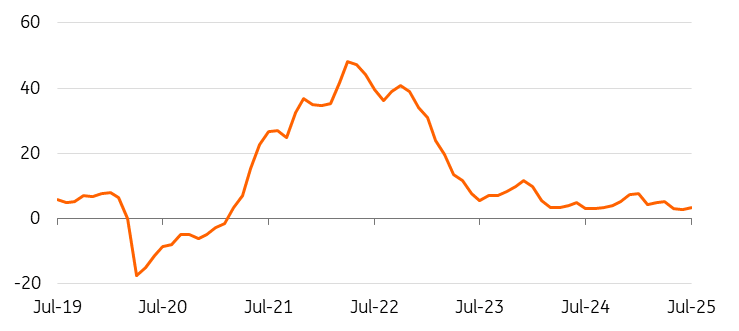
Few contractors are planning to increase their sales prices in July 2025. Contractors don’t have to pass on higher input prices and are still encountering strong competition due to the production decline in 2024 and expected zero growth in 2025. The balance of EU contractors who plan to increase sales prices even decreased from 8% in January to 3% in July.
Few contractors plan to raise sales prices
Balance of EU construction companies that expect to increase -/- decrease output prices (over next 3 months).
Source: European Commission, ING Research
In France, the majority of building firms are even planning to decrease sales prices, due to sluggish demand. By comparison, high price increases are expected in the Netherlands, Poland and Turkey. In Turkey, inflation is still high, resulting in steeper construction prices. In the Netherlands, demand is improving, allowing builders to increase prices.
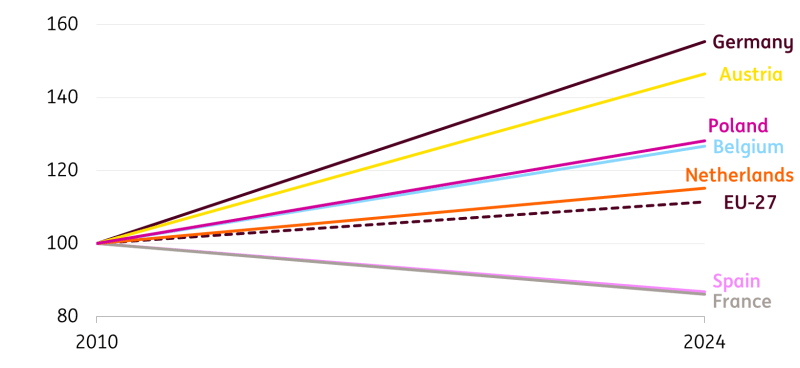
Highest infrastructure growth in Germany, decline in France and Spain
Development production volumes in civil engineering.
Source: Eurostat, ING Research
Continuous growth in the infrastructure sector
The infrastructure sector is more resilient to the economic cycle as investment mainly comes from local or central governments. EU infrastructure investments grew in 2023 (4.7%) and 2024 (0.6%), supporting total construction production volumes. The subsector benefits from much-needed investment in the energy transition, especially for new power grids and digital infrastructure. At the same time, challenges are emerging in the area of drinking water, as population growth and climate change contribute to increasingly frequent dry spells across many regions.
Spanish civil engineering benefited from Next Generation EU funds in 2023. It led to the launch of numerous ready-to-go infrastructure projects, which had been delayed by resource constraints. In 2023, Spanish infrastructure volumes rose by almost 10%. Yet, in 2024, volumes started to decline again by 6%. As a result, Spanish infrastructure investment remains below 2010 levels. Additionally, France has lower infrastructure levels compared to 2010, due to budgetary constraints. French infrastructure builders had the lowest economic confidence in July 2025 since the beginning of 2021.
In Germany, investments increased by more than 55% between 2010-24. That is needed because German infrastructure is in a patchy state, and investments in roads and digital infrastructure are driving some growth in this subsector. Germany launched a €500bn infrastructure and climate investment plan last year, which will result in further growth in the coming years.
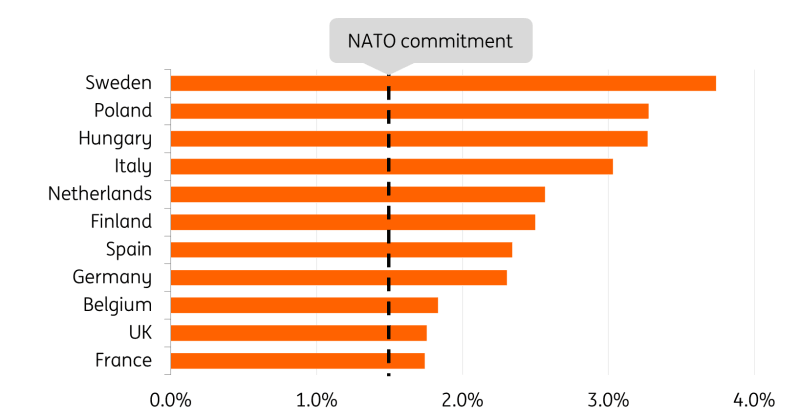
All European NATO countries spend more on infrastructure than the NATO target
Infrastructure output as a share of GDP, 2024.
Source: Euroconstruct, ING Research
No real boost expected from the NATO agreement for infrastructure
In June, NATO countries agreed to increase their defence budgets by 3.5% of GDP annually and an additional 1.5% to broader resilience, such as infrastructure and cyber defence. Member states have to comply with these goals by 2035.
However, most European NATO countries already invest more than 1.5% of their GDP in infrastructure. While not all infrastructure spending is defence-related, the broad definition of resilience allows for flexible interpretation, potentially leading to “infrawashing.” For instance, Italy plans to classify its proposed bridge to Sicily as strategic military infrastructure under this framework.
Read the original analysis: European contractors stuck in neutral as growth stalls in 2025
Author
ING Global Economics Team
ING Economic and Financial Analysis
From Trump to trade, FX to Brexit, ING’s global economists have it covered. Go to ING.com/THINK to stay a step ahead.