Euro, S&P 500, and Oil: The bias has shifted — Here's the new playbook [Video]
![Euro, S&P 500, and Oil: The bias has shifted — Here's the new playbook [Video]](https://editorial.fxsstatic.com/images/i/EURUSD-bullish-chart.png)
Volatility hasn't gone anywhere, but the map has changed. After a week dominated by aggressive selling aligned with hostile risk fundamentals, the key data points are starting to turn: the cost of capital is coming down, the smart inflation reading is no longer as negative, and commercial activity is showing early signs of returning risk appetite.
In this weekly analysis, we'll break down how to interpret that bias shift across three key assets — euro, S&P 500 futures, and WTI crude — using Elliott Wave theory, institutional fundamental analysis, and disciplined risk management. The goal is simple: walk away with a clear, actionable plan for the week, aligned with the direction of those who actually move the market.
The Big picture: When the macro context shifts, your plan must follow
The backdrop remains complex: Middle East conflict, inflationary pressures, and violent swings across risk assets. However, if you're just reacting to headlines and social media, you'll end up entering late, exiting poorly, and making impulsive decisions.
The right approach is the opposite: turn the noise into a structured edge. A fundamentals dashboard that combines commercial activity from major participants, an S&P-style risk thermometer, a smart inflation reading, dollar behavior, and the evolution of the cost of capital allows you to build a clear, actionable macro preparation in a matter of minutes.
Last week, that framework pointed to a clear bearish bias: cost of capital rising, inflation in toxic mode, commercial activity with zero risk appetite. Every bounce was a selling opportunity. If you followed that framework, you traded with the current and had a clear statistical edge.
This week, the picture has changed. Stubbornly selling every pullback out of habit would put you on a collision course with institutional flow. Adjusting the plan isn't optional — it's a necessity to protect your capital.
Euro: From aggressive shorts to looking for the long side
What's Changed
Last week, the euro offered a clean setup on the short side — repeated sells aligned with macro pressure. Trying to buy meant swimming against the current with a low probability of success.
In the current context, the fundamental flow is beginning to favor risk, which translates into a bullish bias on the euro. For disciplined traders, this means stepping away from systematic shorts and starting to design your plan around strategic long entries.
Two Operational Scenarios Using Elliott Waves
From an Elliott Wave perspective, the euro offers two main paths:
Completed five-wave impulse followed by a pullback buy. Price completes a five-wave structure to the upside. You wait patiently for the corrective pullback (Wave 4 or ABC structure). The correction zone overlaps with a recent liquidity area and relevant Fibonacci levels (38.2%–61.8%). Entry triggers only on clear rejection — wicks, absorption, or a failed breakout. This approach lets you buy with measured risk, placing your stop behind the liquidity structure and sizing the position to lose small if the scenario fails.
New marginal low followed by an extreme rejection buy. Price prints a new marginal low with a stop hunt below the prior swing. A sharp rejection — rapid recovery of the lost level — suggests that the big players are absorbing sells. In this scenario, you capitalize on the liquidity created by other traders' fear and position long with a potentially very attractive risk-to-reward ratio.
In both cases, the key isn't prediction — it's waiting for flow confirmation and price reaction at liquidity zones, aligned with the fundamental reading.
S&P 500 futures: The first consistent bullish signal
After a series of pullback sells supported by hostile risk fundamentals, S&P futures are beginning to show the first consistent bullish posture. The transition is clear: what was a market where every bounce was a bearish opportunity is starting to transform.
From an Elliott Wave perspective, the analysis follows three steps. First, identify the prior staircase-selling phase where every bounce was a shorting opportunity. Second, detect the point where that sequence exhausts itself and the first clear buy appears, backed by the shift in the cost of capital and improving risk appetite. Third, map out scenarios for a Wave 3 rally under construction, with internal pullbacks for entry, or ABC corrections where the "C" wave offers a pullback entry in favor of the emerging trend.
This framework allows you to stop forcing late shorts and focus on buying pullbacks, as long as fundamentals remain aligned. If they deteriorate, the plan reverts to sells. Flexibility isn't weakness — it's part of the edge.
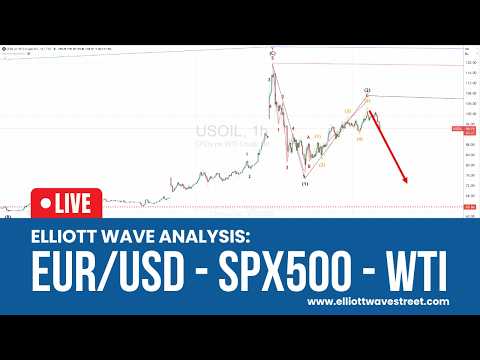
WTI Crude: High probability of a major top and a path to $70–60
For crude oil, the fundamentals tell a different story from the rest of the market: there's a high probability of a major market top. The combination of shifting global risk perception, evolving conflict dynamics and supply responses, and adjusting growth expectations creates a scenario where WTI could be initiating a significant bearish Wave 3, with technical projections targeting the $70–60 zone.
For traders, this means stepping back from chasing late longs near the highs and watching closely for a topping formation with rejection, accompanied by divergences, volume clusters, or exhaustion signals. Using Fibonacci extensions and Elliott Wave structures, you can project realistic targets and position yourself in the direction of the dominant flows, protecting capital with technical stops and avoiding getting trapped in a deep reversal.
Risk management and psychology: Lose small, win well
No scenario, no matter how solid it looks, is guaranteed. That's why this type of analysis only becomes a real edge when it's paired with controlled risk per trade, stops placed at logical Elliott count invalidation zones, prior acceptance of the possible loss, and the discipline to leave your stop alone when fear kicks in.
With the right combination of fundamentals, Elliott Waves, liquidity, and risk management, you can avoid the most common losses from over-leveraging and revenge trading, let winning trades run with confidence, and turn every volatile week into a structured opportunity rather than an emotional lottery.
Flexibility with atructure
The core message this week is straightforward: fundamentals have shifted, and the plan needs to shift with them. Moving from a bearish bias to a bullish one on the euro and S&P 500, while monitoring a potential top in crude oil, requires discipline, an up-to-date macro reading, and the ability to adapt without losing your structural framework.
At Elliott Wave Street, we continue to sharpen these concepts through our live sessions and VolWaves AI analysis, giving you the tools to trade with confidence — no matter what the headlines throw at you.
Author

Juan Maldonado
Elliott Wave Street
Juan Maldonado has a University degree in Finance, and Foreign trade started his trading career in 2008. Since 2010 has been analyzing the markets using Elliott Wave with different strategies to spot high probability trades.