EUR/USD Weekly Forecast: US Dollar rally stalls, but for how long?
- Oil prices at pre-war levels cooled fears of mounting inflationary pressures and rate hikes.
- United States employment-related data hinted at a loosening labor market.
- EUR/USD corrected higher, yet technical readings suggest sellers retain control.
The EUR/USD pair trimmed part of its recent losses and settled around 1.1450 as demand for the US Dollar (USD) cooled down. On the one hand, easing concerns about the Middle East war and its consequences pushed investors away from the USD's safety. On the other hand, tepid American data weighed on the local currency. At the end, the odds of interest rate hikes in the United States (US) dropped, making it easier for speculative interest to push the Greenback lower.
Middle East and Oil Price
Markets kicked off the week in a cautious mood amid headlines indicating some tit-for-tat attacks between the US and Iran over the weekend. The fragility of the ceasefire, however, is no news to the world and investors, while ships keep transiting the Strait of Hormuz.
Physical and verbal skirmishes continue, but as long as Oil prices come down, it seems market players are far from concerned about the war. And it has its logic: lower Oil prices mean easing inflationary pressures and, hence, decreased odds for economic turmoil. In the US, it also means that the Federal Reserve (Fed) may not need to hike interest rates.
By the end of the week, the barrels of Brent and West Texas Intermediate (WTI) crude trade at pre-war levels, reflecting the ‘normalization’ of vessels’ traffic through the critical sea passage. It seems that as long as the Strait is open, market participants will bet against mounting risk and hence move into higher-yielding assets.
As a note of color, there has been no clear progress in negotiations between the US and Iran, and Pakistani mediators were just able to inform that the next meeting between the two countries will be scheduled “at the earliest possible time.” Tehran is now focused on a massive funeral for the former Supreme Leader, Ayatollah Ali Khamenei, who was killed at the beginning of the war on February 28. His funeral will last until July 9, and talks are unlikely to resume before that date.
Cautious yet confident European authorities
European Central Bank (ECB) President Christine Lagarde started the week praising Europe’s resilience, noting it means rate hike effects on the economy are more contained, and that the ECB “can raise rates to address inflation without fear it becomes a source of financial stress.” Lagarde later noted that risks are more broadly balanced “than a few weeks ago” and that the European Union (EU) is not in stagflation, while speaking at a policy panel at the ECB Forum on Central Banking 2026 that took place in Sintra, Portugal.
Data somehow backed her words, as annual inflation in Germany, as measured by the change in the Consumer Price Index (CPI), softened to 2.3% in June, according to preliminary estimates, from 2.6% in May. The Harmonized Index of Consumer Prices (HICP) in the same period printed at 2.4%, down from the 2.7% posted in the previous month.
The preliminary estimate of the Euro area annual HICP came in at 2.8% in June, below the previous reading of 3.2% and lower than the anticipated 3%. Finally, the core annual HICP printed at 2.4%, lower than the prior 2.6%.
As Middle East tensions eased and inflation cooled, the odds for additional interest rate hikes in the Eurozone decreased, with market players now looking for a prolonged hold.
United States Federal Reserve
The US macroeconomic calendar revolved around employment, and news were not good. The ADP Employment Change report showed that the private sector added 98K new jobs in June, below the previous 122K. Also, US-based employers announced 45,849 job cuts in June, down 53% from the 97,006 cuts announced in May, according to the Challenger Job Cuts report. The big miss came from the Nonfarm Payrolls (NFP) report released on Thursday, as the country added a measly 57K new jobs in June vs the anticipated 110K and the previous May reading of 129K (downwardly revised from 172K). The report also showed that the Unemployment Rate declined to 4.2% from 4.3%.
Other than employment data, the country released the June ISM Manufacturing Purchasing Managers’ Index (PMI), which printed at 53.3, below the 54 expected but still indicating business expansion for the sixth consecutive month. The Price sub-index edged sharply lower, from the 82.1 posted in May to 73, a sign of easing inflationary pressures.
Meanwhile, Fed Chair Kevin Warsh participated in the ECB Central Banking forum and delivered some interesting comments. He reiterated that forward guidance is not in his book and that the focus is on price stability. US policymakers will decide on rates in four weeks’ time, according to Warsh. “When we get into that room and shut the door, we're going to have a good debate,” Warsh added.
A softer labor market, easing inflationary pressures, and the absence of any other clues on future monetary policy played against the Greenback, with odds of a rate hike edging sharply lower after the release of the NFP report.
What’s next in the docket
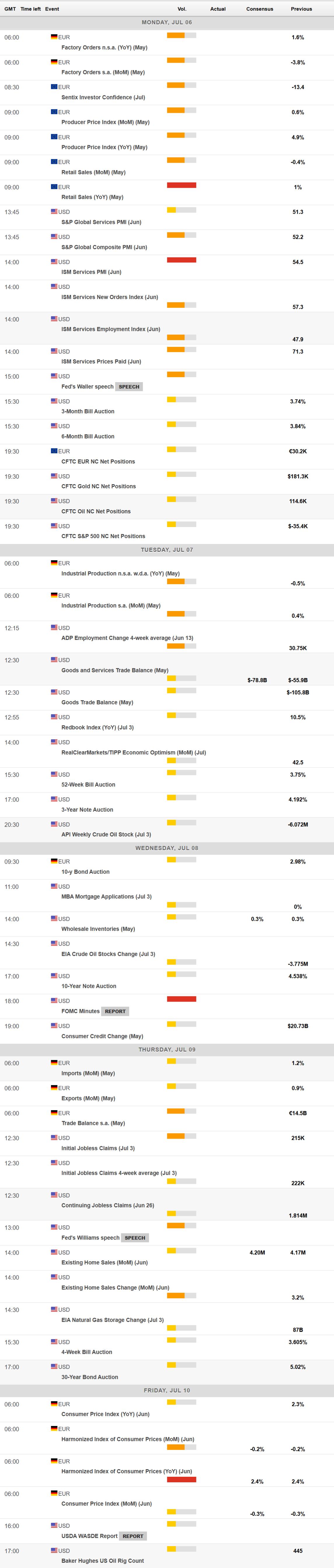
The new week starts with the EU releasing May Retail Sales and the US delivering the June ISM Services PMI. The Federal Open Market Committee (FOMC) will unveil the Minutes of the latest meeting on Wednesday, while Germany will publish the final estimate of the June HICP on Friday. The calendar also includes some other figures that could provide clues on the actual health of major economies.
Also, as central banks’ decisions are now one month away, policymakers from both shores of the Atlantic will hit the wires, and their words will be scrutinized in search of monetary policy clues.
EUR/USD Technical Outlook:
The weekly recovery is far from changing the EUR/USD pair's technical picture, which still shows that bears are in control. Furthermore, the advance met sellers around a long-term static resistance area near 1.1470, which is also an inflection point. As long as it is clearly below it, the odds are on sellers' side.
In the daily chart, EUR/USD maintains a bearish near-term bias as spot holds below the 20-day, 100-day and 200-day Simple Moving Averages (SMAs) at 1.1470, 1.1623 and 1.1654, respectively. The Momentum indicator lacks directional strength but holds below its midline, while the Relative Strength Index (RSI) indicator hovers around 43, suggesting downside pressure persists but has lost strength. Still, the moving averages setup is likely to contain attempts to advance further while suggesting lower lows are still possible.
Bigger time frames also reflect sellers' dominance, as in the weekly chart, EUR/USD maintains a bearish bias. The pair develops far above the 100- and 200-week SMAs at roughly 1.1296 and 1.1001, but remains capped by the 20-week SMA at 1.1611. The pair’s slide from recent highs, together with a 14-week RSI hovering near 42 and a negative 14-week Momentum reading, tilts risks toward further consolidation while leaving the door open for additional slides.
On the topside, initial resistance is at the 1.1470 area, reinforced by the 20-day SMA near it. The next significant resistance comes in a handful of pips above 1.1600, with the 100-day SMA around 1.1623 and the 200-day SMA at 1.1650. The EUR/USD would need to clearly break above this area to ease the broader bearish tone. The recent multi-week low at 1.1324 is the immediate support, closely followed by the 100-week SMA at 1.1296. An extension below the latter exposes the psychological 1.1000 threshold.
(The technical analysis of this story was written with the help of an AI tool.)
Author

Valeria Bednarik
FXStreet
Valeria Bednarik was born and lives in Buenos Aires, Argentina. Her passion for math and numbers pushed her into studying economics in her younger years.
















