Gold selloff over? Gold/tech ratio may hold the answer

Gold has spent the past three months being crushed by the US technology sector.
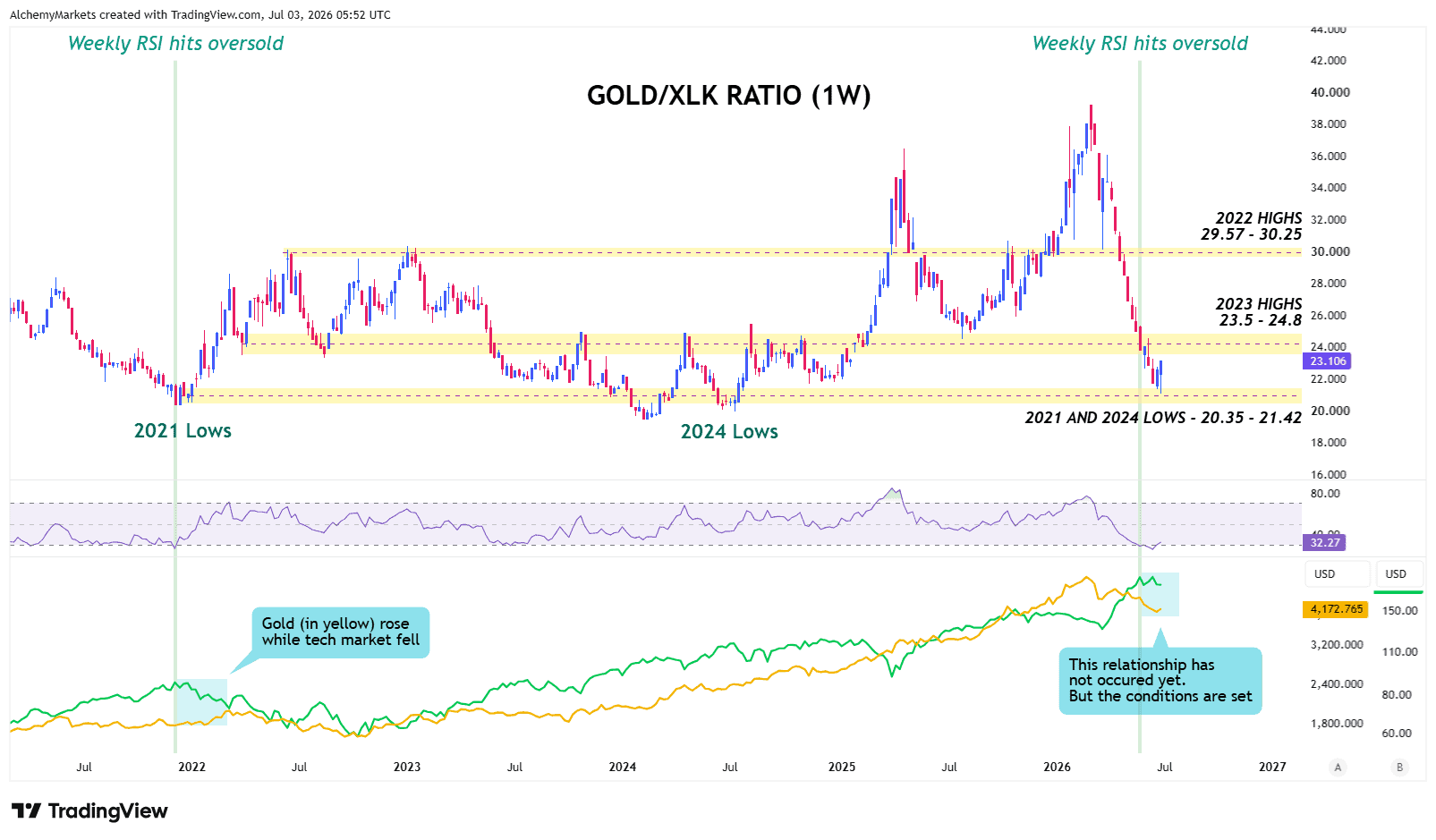
The Gold-to-XLK ratio has fallen by more than 32%, including a stretch of almost ten consecutive weekly declines. It has now returned to the same broad area that marked major relative lows in 2021 and 2024.
But now, Gold has received a fresh macro catalyst to potentially begin a recovery, while the most extended part of the technology trade is showing its first meaningful weakness in months.
That makes the Gold-to-XLK ratio chart highly interesting to watch.
Weak NFP gives Gold a reason to recover
June nonfarm payrolls increased by only 57,000 against expectations of roughly 110,000, a miss of around 48%.
April and May were also revised lower by a combined 74,000 jobs. Although unemployment fell to 4.2%, labour-force participation also declined, making the headline improvement less convincing than it initially appeared.
The report does not confirm a US recession. It does, however, make it harder for the Federal Reserve to become more hawkish without another strong inflation or employment report.
Following the release, the probability of a July rate hike fell below 20%, while expectations for a September hike also eased. The dollar weakened by roughly 0.5% and spot gold gained more than 2%.
The logic is straightforward. Lower rate expectations can reduce Treasury yields and the opportunity cost of holding gold, which does not produce interest.
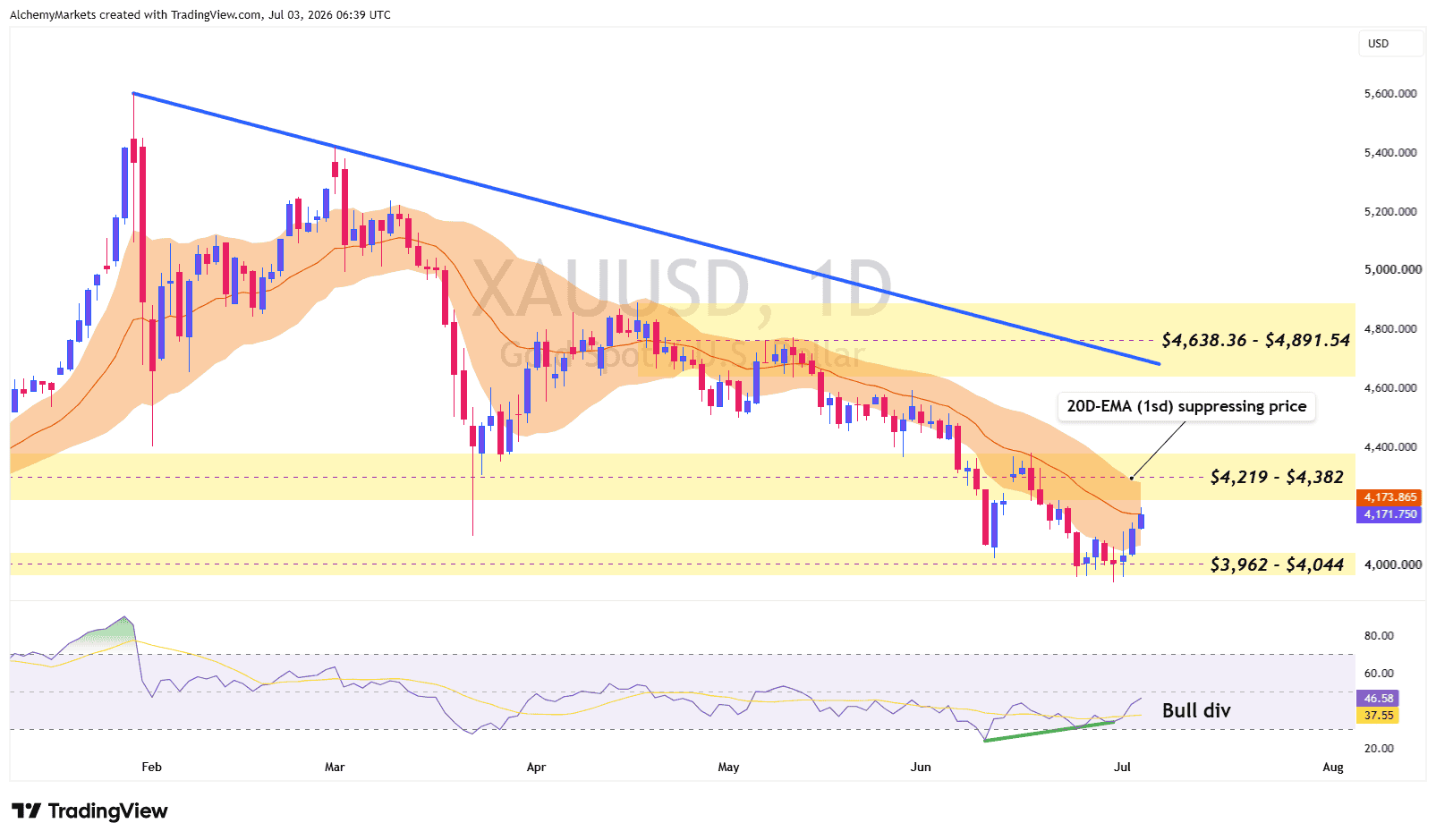
Gold is now attempting to recover above its daily 20-EMA band after responding from an important support area with a bullish divergence. This still remains an early technical signal, but after yesterday’s print, it now has a clearer macro reason behind it.
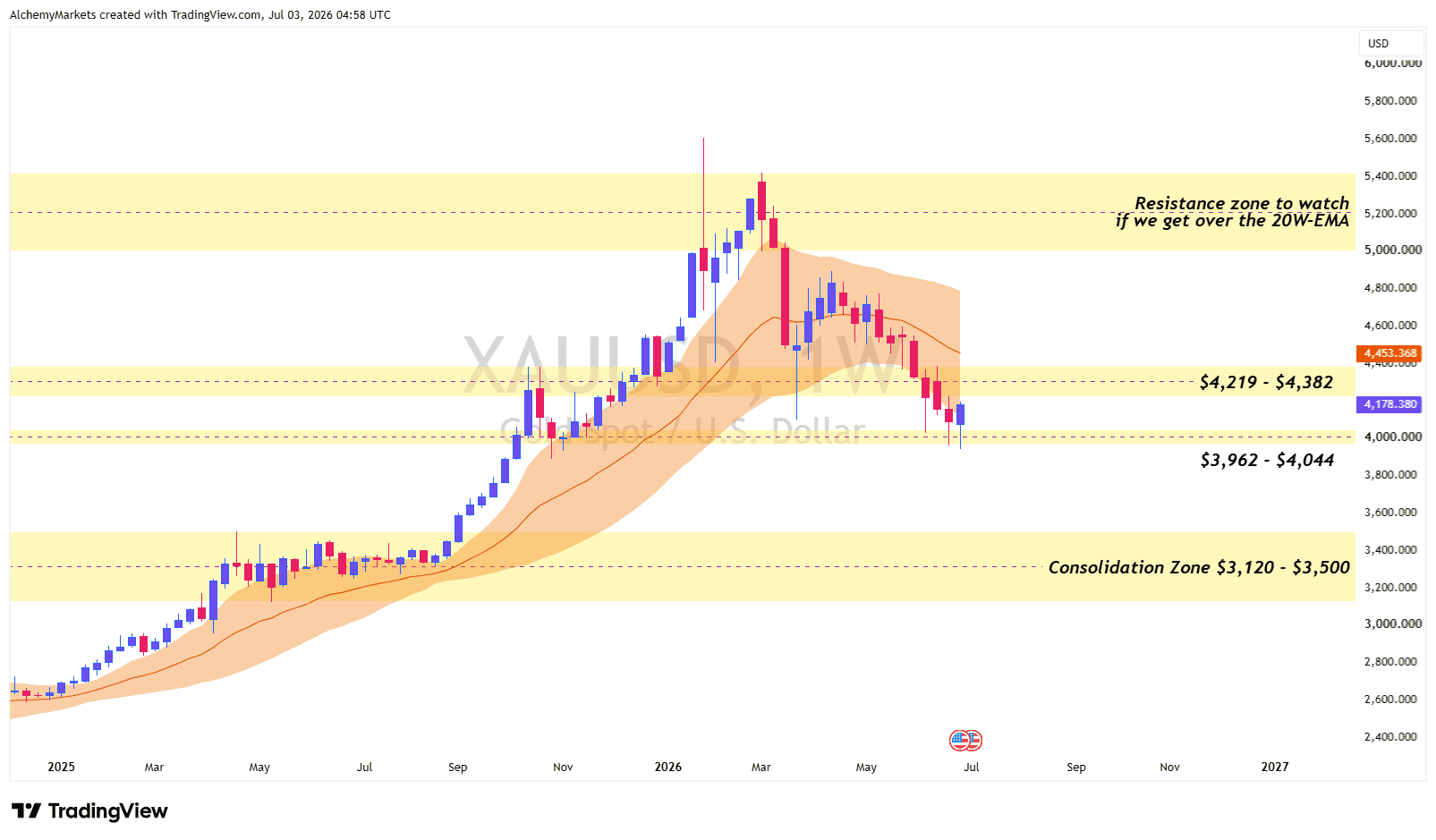
Gold is also attempting to form a bullish engulfing candle on the weekly chart. A confirmed close would strengthen the case for a near-term floor, although further follow-through would still be needed before calling it a major low.
Why technology matters to the ratio
XLK tracks the S&P 500 technology sector, but it is currently heavily influenced by AI hardware.
Semiconductors and semiconductor equipment account for almost half of the fund, followed by software and technology hardware. Major holdings include Nvidia, Apple, Microsoft, Micron, Broadcom and AMD.
This means Gold/XLK is not only measuring gold against software and mega-cap technology. It is also heavily exposed to the semiconductor cycle that previously drove much of the Nasdaq and S&P 500’s performance for the past year.
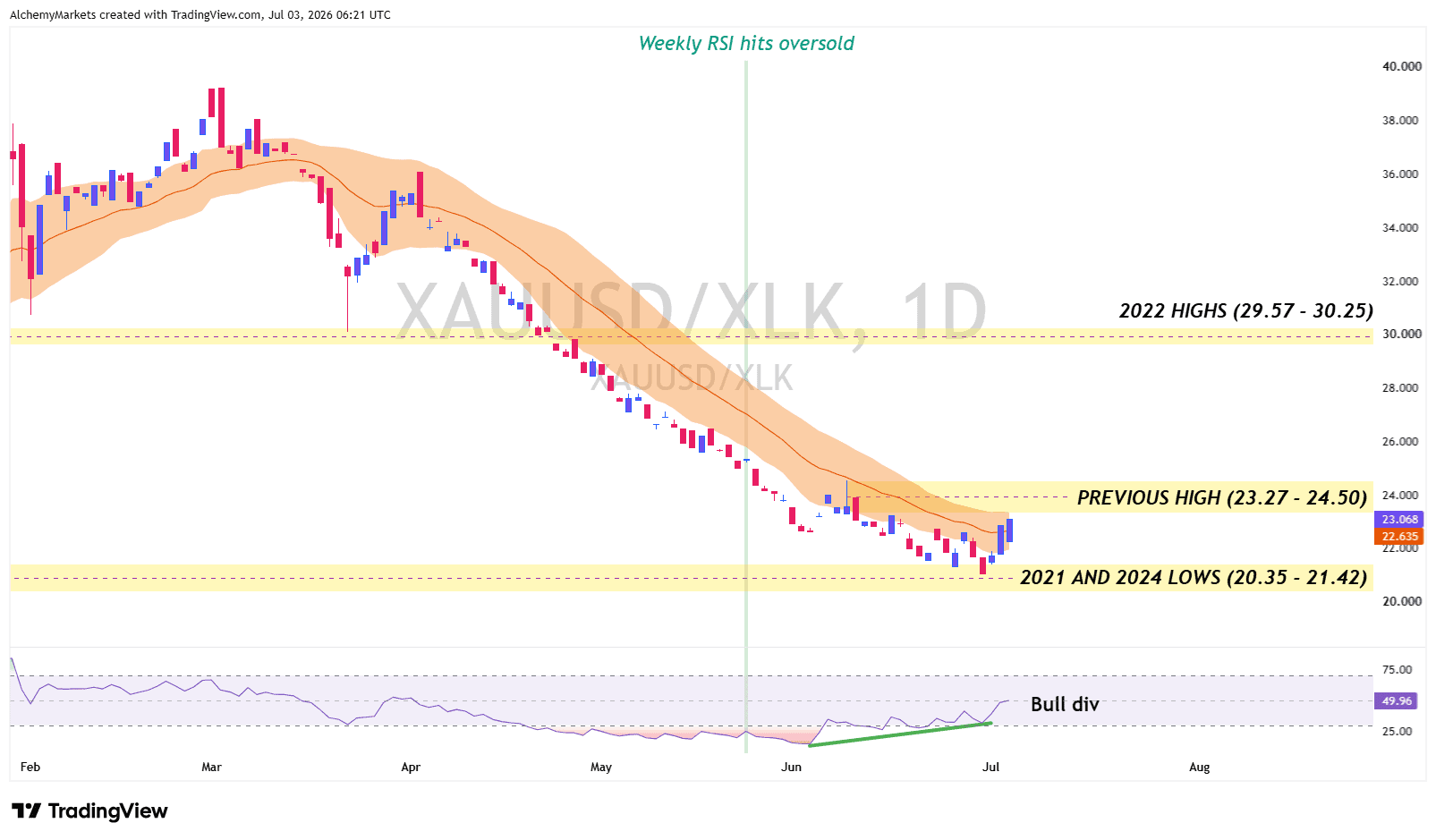
Now, that part of the market is now under pressure. Even on the daily timeframe, a bullish divergence can be observed on the Gold-to-XLK ratio.
If the ratio can reclaim its previous high and stay above that 20-EMA band, the following could be happening:
- Gold is beginning to bottom out.
- Gold is rising or moving sideways as the tech sector begins to pull back.
- Or, both assets are rising or falling together, but gold is outperforming the tech sector.
Either way, this makes for an interesting chart for goldbugs to watch. In every scenario, the common message is that gold is regaining relative strength.
A similar setup appeared in 2021, when Gold/XLK reclaimed its daily 20-EMA band as gold strengthened and technology weakened:
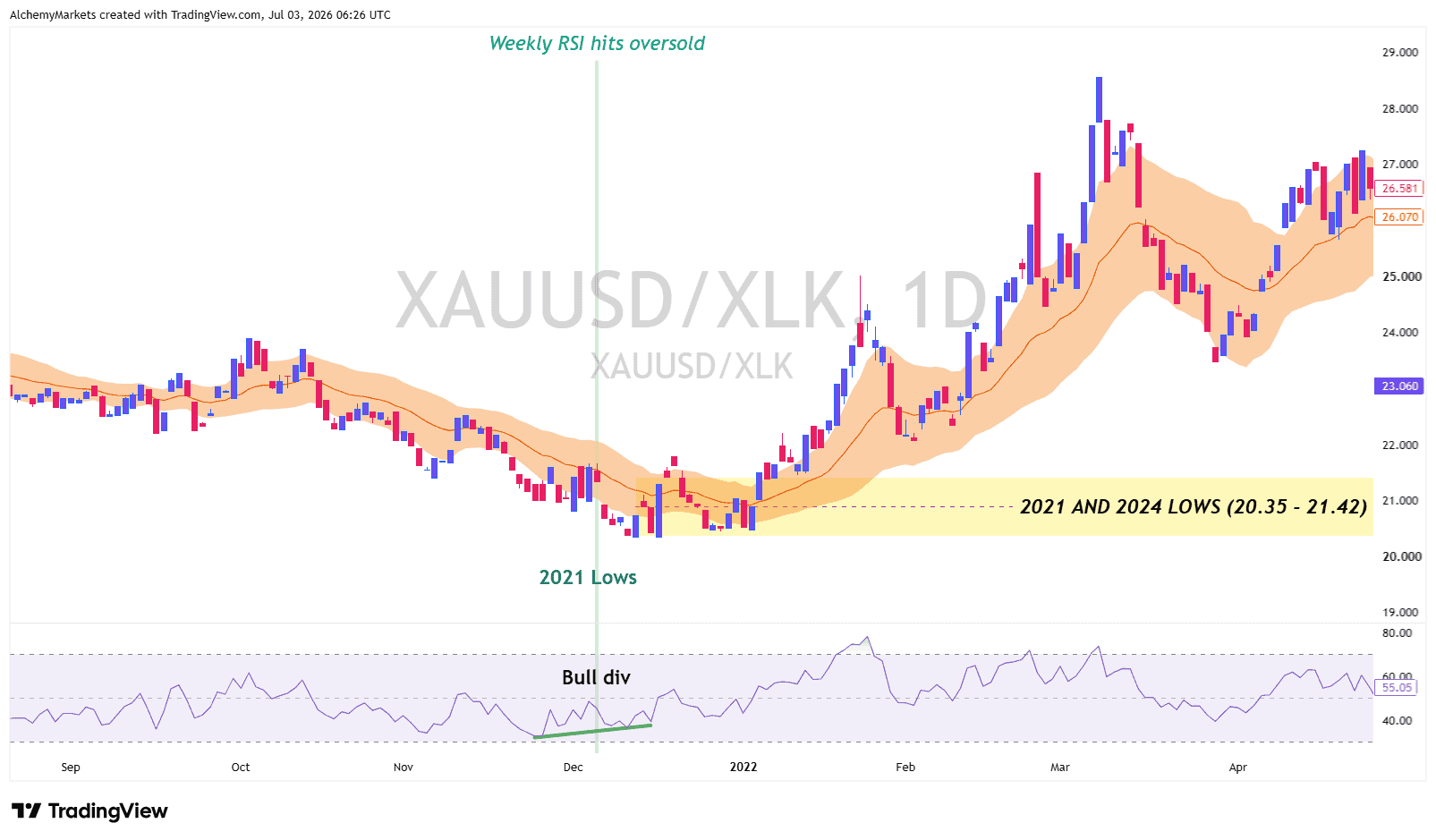
With yesterday’s shocking NFP print, one could argue that Gold is now better positioned for upside, rather than more downside – making this a possible outlook to consider.
The AI trade faces an expectations reset
Meta helped trigger the latest reassessment after reports that it was developing a cloud business to sell excess AI computing capacity.
While not an XLK holding, Meta raises a bigger set of questions around AI infrastructure demand:
- Has too much capacity been built too quickly?
- Are hyperscalers beginning to face weaker internal demand than expected?
- Could excess capacity pressure cloud pricing?
- Will future AI spending continue at the same pace?
- Have semiconductor stocks already priced in too much demand?
The bullish interpretation is that Meta has found a new way to monetise infrastructure it has already built. The bearish interpretation is that one of the world’s largest AI spenders may have more capacity than it currently needs.
For now, the market’s first reaction has been to sell AI semiconductors and hardware stocks. That does not confirm the AI cycle is breaking. Meta’s plans are still under development, and the company may simply be responding to strong outside demand.
Semiconductor fundamentals remain strong, but investors are beginning to question whether expectations have moved too far ahead of them. That uncertainty is arriving just as weak labour data limits the Fed’s room to become more hawkish, creating a potentially more supportive environment for Gold/XLK.
The latest sell-off may therefore be the start of a broader reset. It could also prove to be a knee-jerk reaction that is quickly recovered if chip stocks reclaim their broken structure and AI demand remains firm.
Gold is improving fastest against semiconductors
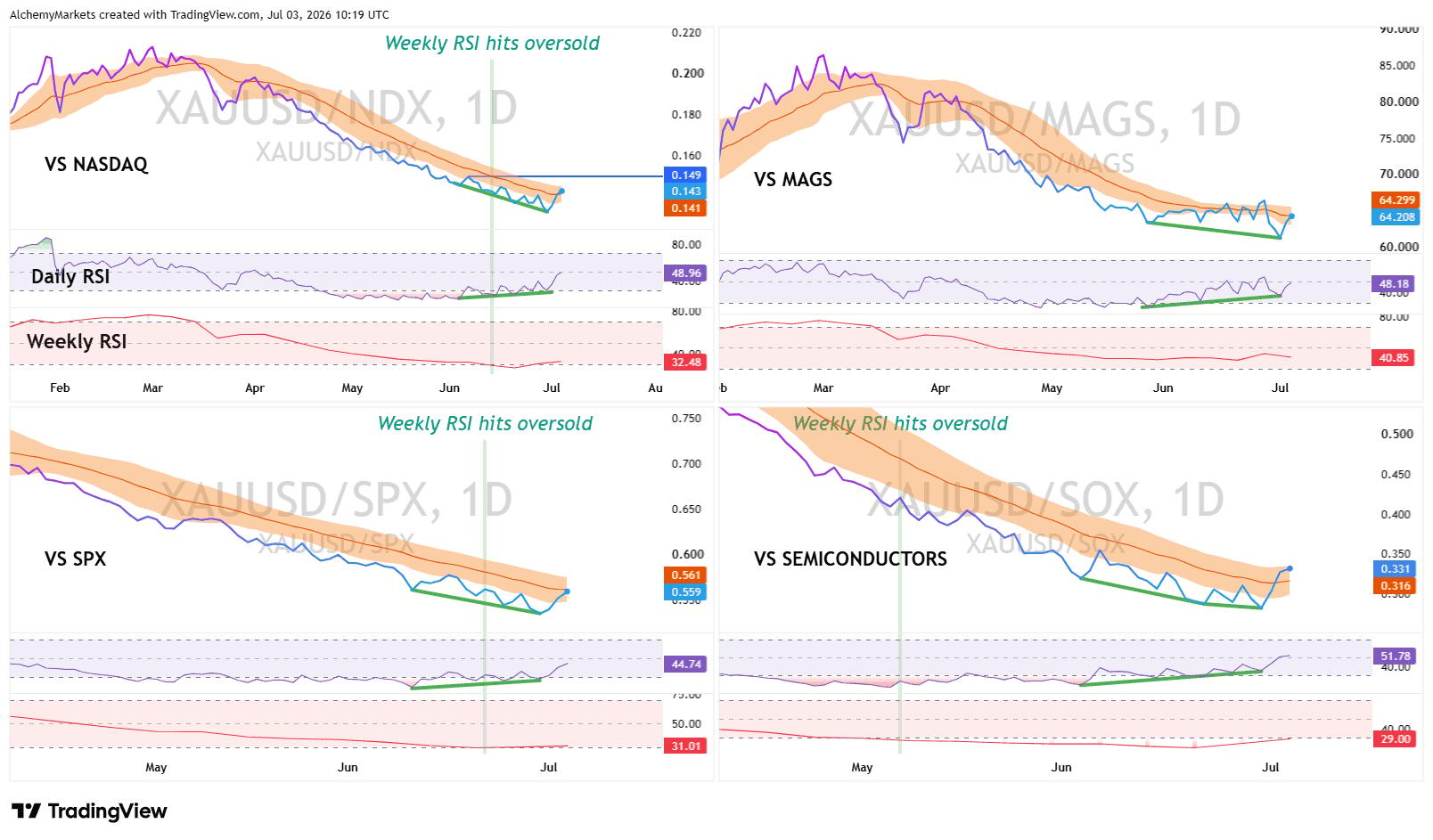
Gold’s relative recovery is also appearing against the Nasdaq-100, the Magnificent Seven, the S&P 500 and SOX.
However, the strongest signal is clearly Gold/SOX.
The ratio has moved furthest into its daily 20-EMA band, daily RSI has recovered above 50 and weekly RSI sits near 29. Gold is therefore beginning to outperform semiconductors more convincingly than it is outperforming the wider equity market.
Gold/Nasdaq is the next most developed setup, with daily momentum improving as the ratio approaches resistance near 0.149.
Gold/MAGS and Gold/SPX remain earlier-stage signals. Their momentum is improving, but neither has confirmed the same strength of reversal and could actually face some resistance at the EMA.
Bottom line: Gold is showing its clearest early improvement against the most stretched part of the technology trade. If that strength broadens from semiconductors into XLK and the Nasdaq, it would reinforce the possibility that XAUUSD is forming a more important low.
Author

Zorrays Junaid
Alchemy Markets
Zorrays Junaid has extensive combined experience in the financial markets as a portfolio manager and trading coach. More recently, he is an Analyst with Alchemy Markets, and has contributed to DailyFX and Elliott Wave Forecast in the past.