Gold Weekly Forecast: Buyers show interest as markets dial back near-term Fed rate hike expectations
- Gold snapped a four-week losing streak on renewed USD weakness driven by a disappointing US employment report.
- Markets reassess the Fed policy outlook, with immediate rate hike odds now in doubt.
- The near-term technical outlook suggests that Gold is on its way to a bullish reversal.

Gold (XAU/USD) gathered bullish momentum and closed the week in positive territory after posting four consecutive weekly losses. Investors could react to changes in technical outlook in the near term amid an economic calendar that lacks high-impact events.
Gold regains traction after weak US employment data
Markets started the week on a cautious note on news of the US and Iran exchanging fire near the Strait of Hormuz over the weekend and Gold lost more than 1.5% on Monday. Although a US official said that the US and Iran will stand down and added that technical talks are set to continue on all aspects of the Memorandum of Understanding (MoU) in Doha, Iran's Foreign Ministry delivered a conflicting explanation, noting that the delegation will follow up on the release of frozen funds and that they don’t have any plans to meet with US negotiators.
As safe-haven flows continued to dominate the action in financial markets early Tuesday, Gold extended its slide and touched its lowest level since November, below $3,950. With investors refraining from taking large positions ahead of Federal Reserve (Fed) Chairman Kevin Warsh’s highly anticipated participation in the European Central Bank’s (ECB) Forum on Central Banking, Gold managed to find its footing and ended the day virtually unchanged.
Fed Chair Warsh delivered a moderately hawkish message on Wednesday, with FXS Speechtracker assigning a score of 5.6/10. The refusal to provide forward guidance, coupled with a strong reaffirmation that inflation above 2% will disappoint the Fed and that the US is likely to be a big winner in the AI boom, underscored a focus on price stability. Warsh’s emphasis that it is up to the central bank to judge whether AI is inflationary signalled a willingness to “chart a new course” in policy frameworks without committing to a preset path. Gold struggled to gather bullish momentum midweek and registered marginal gains to close slightly above $4,000.
The USD came under heavy selling pressure on Thursday and paved the way for a decisive recovery in XAU/USD. In the early trading hours of the European session, the Japanese Yen gained more than 100 pips against the USD in a matter of minutes, fuelling speculations of a possible currency intervention and causing investors to stay away from the USD.
In the second half of the day, the USD continued to weaken after the US Bureau of Labor Statistics (BLS) reported that Nonfarm Payrolls (NFP) rose by 57K in June. This print missed the market expectation for an increase of 110K by a wide margin. Additionally, the BLS noted that the change in total NFP for April was revised down by 31,000, and the change for May was revised down by 43,000, showing that employment in April and May combined was 74,000 lower than previously reported.
According to the CME FedWatch Tool, the probability of a Federal Reserve (Fed) rate hike in July dropped to about 15% from nearly 30% before the release of the US employment data. In turn, Gold rose more than 2% on Thursday and posted its largest one-day gain since mid-June.
Still, there is no material change to the probability of the Fed opting for at least one interest rate increase by the end of the year, which currently stands at nearly 80%.
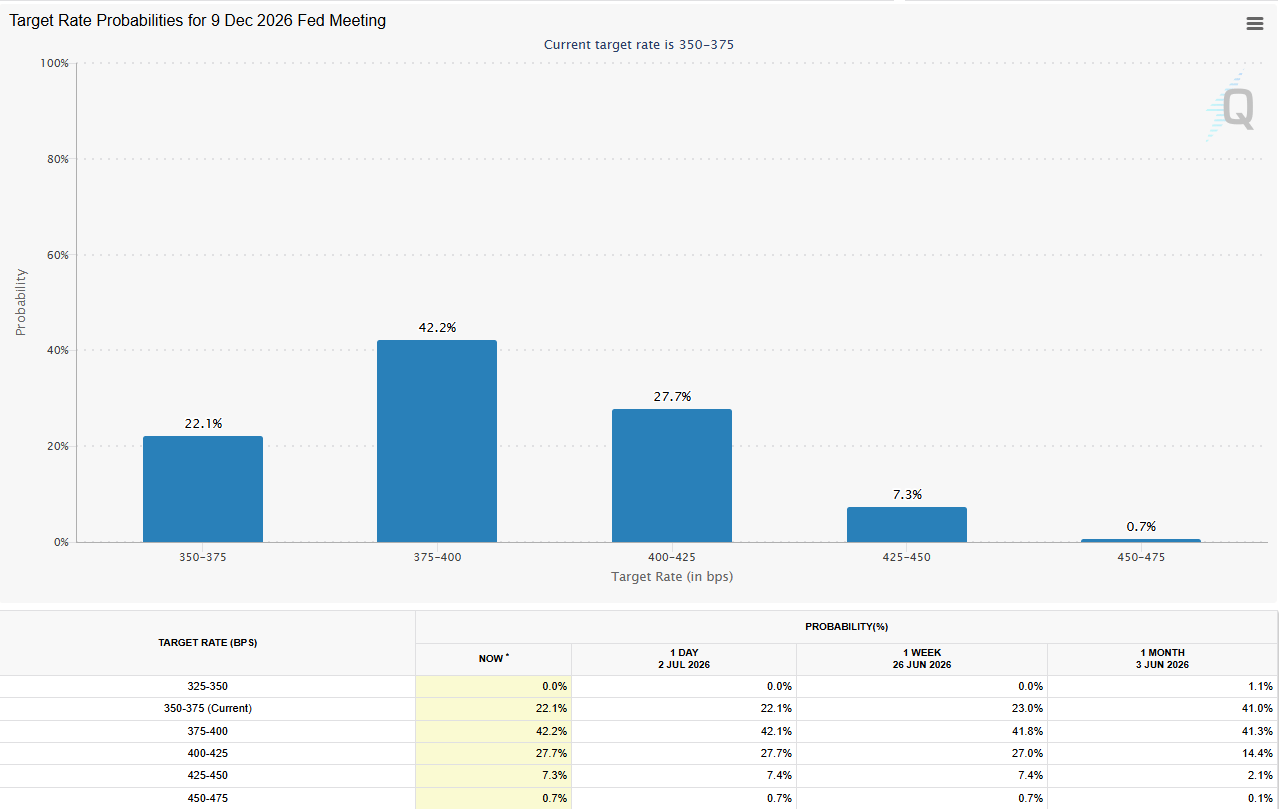
As the mood improved with markets dialing back Fed tightening expectations, the USD remained under pressure on Friday and XAU/USD extended its rebound to a fresh two-week high above $4,150.
In the World Gold Council’s Mid-Year Outlook 2026, authors Juan Carlos Artigas and Taylor Brunette argue that the context in which a rate hike occurs is key when assessing the potential impact on Gold.
“What matters more than the policy rate itself is how markets interpret the implications of tightening for growth, inflation credibility, financial stability and the US Dollar. If a hiking cycle materially improves the market's assessment of Fed credibility, Gold could face additional pressure,” they explain.
Gold investors await ISM Services PMI data and FOMC Minutes
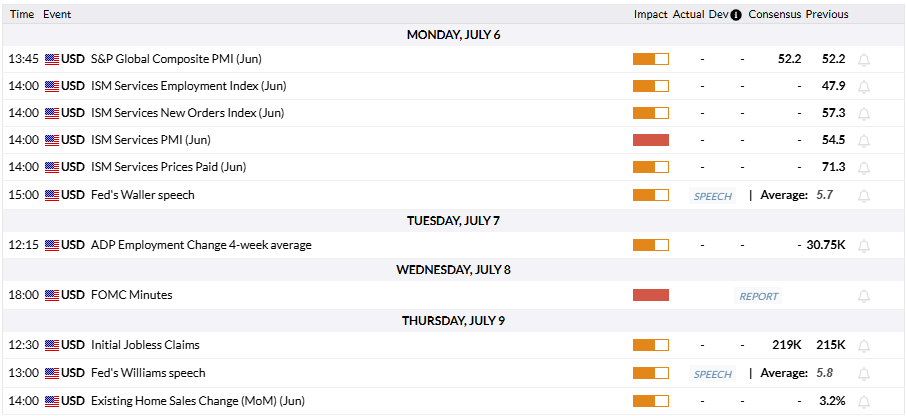
The Institute for Supply Management (ISM) will publish the Services Purchasing Managers’ Index (PMI) report for June on Monday. Following the weak NFP data, investors will pay close attention to the Employment Index of the survey. A noticeable decline in this component, with a reading below 45, would highlight an ongoing contraction in the service sector payrolls at an accelerating pace and probably weigh on the USD.
In this scenario, XAU/USD is likely to preserve its bullish momentum. Conversely, a rebound above 50 in the Employment Index, especially if combined with a headline print near May’s 54.5, could support the USD with the immediate reaction and drag Gold lower.
The Fed will publish the minutes of its June policy meeting on Wednesday. Comments surrounding the inflation outlook from policymakers will be scrutinized by market participants. In case the publication suggests that policymakers are willing to wait and see whether falling energy prices will help inflation come down before they raise the interest rate, the USD could remain under pressure and allow Gold to cling to its bullish stance.
On the other hand, XAU/USD could turn south if the report highlights that officials are likely to lean towards a tighter policy, hinting that they are still concerned about the inflation outlook even after Oil prices came down with tensions in the Middle East easing.
The economic calendar will not offer any other high-impact events. Hence, investors will focus on possible developments in the peace talks between US and Iran and comments from Fed policymakers throughout the week. If officials downplay the weak employment figures for June and reiterate the importance of the price stability mandate, Gold’s upside could remain capped.
TD Securities’ Bart Melek argues that Gold is unlikely to break below $3,900 as long as an early Fed funds rate hike remains off the table..
"We are increasingly convinced that Gold will trend up to $4,280 in the near term, with a low probability of breaching support near $3,900. At the same time, lingering oil-driven inflation risks will considerably delay the expected rally to $5,300,” Melek explains.
"While we are not yet super bullish on the yellow metal due to lingering inflationary pressures and the risk that interest rates could still move higher, albeit a risk that has diminished recently, we believe spot gold is likely to rally only toward resistance at $4,280," he adds.
Gold technical analysis: Signs of a bullish reversal
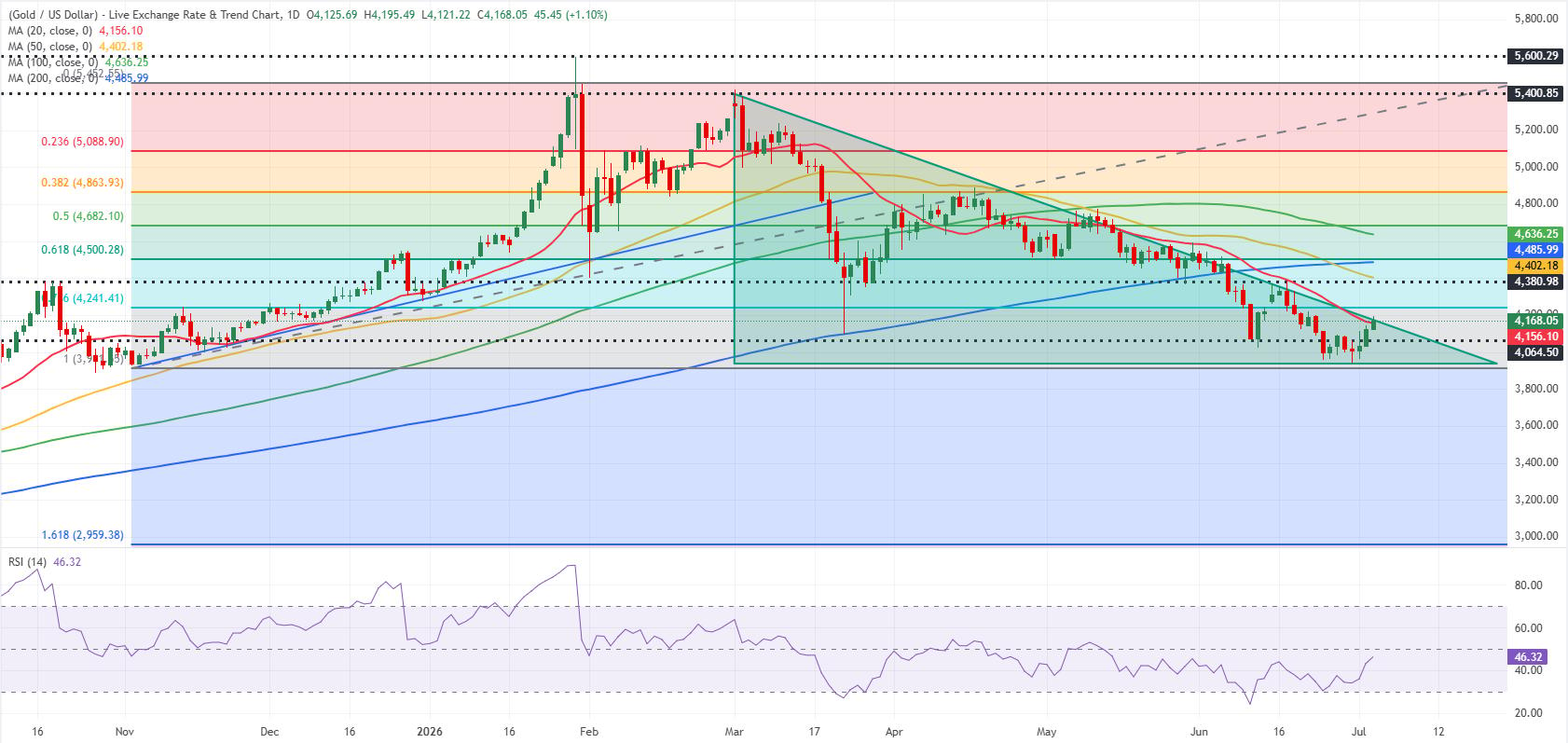
Gold trades near the descending March-July trend line slightly below $4,200, which is reinforced by the 20-day Simple Moving Average (SMA), and the Relative Strength Index (RSI) indicator on the daily chart recovers toward 50. In case Gold settles above $4,200 and the daily RSI climbs to 60, this could be seen as a sign of a bullish reversal.
In this scenario, $4,400 (50-day SMA) could be seen as the next resistance level ahead of $4,490-$4,500 (round level, 200-day SMA). This second hurdle will be a significant test for the precious metal. A clearance of the 200-day SMA could be seen as a confirmation of a new uptrend and attract technical buyers, opening the door to a leg higher toward $4,640 (100-day SMA).
On the downside, a strong support area seems to have formed at $4,000-$3,950. If buyers fail to keep Gold afloat above this region, technical selling pressure could gather strength and drag the yellow metal toward the next potential support levels at $3,800 (static level, round level) and $3,700 (static level, round level).
Gold FAQs
Gold has played a key role in human’s history as it has been widely used as a store of value and medium of exchange. Currently, apart from its shine and usage for jewelry, the precious metal is widely seen as a safe-haven asset, meaning that it is considered a good investment during turbulent times. Gold is also widely seen as a hedge against inflation and against depreciating currencies as it doesn’t rely on any specific issuer or government.
Central banks are the biggest Gold holders. In their aim to support their currencies in turbulent times, central banks tend to diversify their reserves and buy Gold to improve the perceived strength of the economy and the currency. High Gold reserves can be a source of trust for a country’s solvency. Central banks added 1,136 tonnes of Gold worth around $70 billion to their reserves in 2022, according to data from the World Gold Council. This is the highest yearly purchase since records began. Central banks from emerging economies such as China, India and Turkey are quickly increasing their Gold reserves.
Gold has an inverse correlation with the US Dollar and US Treasuries, which are both major reserve and safe-haven assets. When the Dollar depreciates, Gold tends to rise, enabling investors and central banks to diversify their assets in turbulent times. Gold is also inversely correlated with risk assets. A rally in the stock market tends to weaken Gold price, while sell-offs in riskier markets tend to favor the precious metal.
The price can move due to a wide range of factors. Geopolitical instability or fears of a deep recession can quickly make Gold price escalate due to its safe-haven status. As a yield-less asset, Gold tends to rise with lower interest rates, while higher cost of money usually weighs down on the yellow metal. Still, most moves depend on how the US Dollar (USD) behaves as the asset is priced in dollars (XAU/USD). A strong Dollar tends to keep the price of Gold controlled, whereas a weaker Dollar is likely to push Gold prices up.
Author

Eren Sengezer
FXStreet
As an economist at heart, Eren Sengezer specializes in the assessment of the short-term and long-term impacts of macroeconomic data, central bank policies and political developments on financial assets.

















