EUR/USD Weekly Forecast: United States inflation update follows Federal Reserve’s decision
- The Federal Reserve cut its benchmark rate by 25 basis points as expected.
- European Central Bank officials delivered mixed messages on future policies.
- EUR/USD retreated sharply after hitting fresh 2025 highs, steeper slide on the cards.

The EUR/USD pair peaked at 1.1918, a fresh four-year high on Wednesday, giving up most of its gains and settling at around 1.1750 by the end of the week. Central banks lead the way, with the Federal Reserve (Fed) monetary policy decision rocking the board and giving fresh impetus to the US Dollar (USD).
Federal Reserve delivers first 2025 rate cut
Whereas such USD strength would be sustainable in time, it depends on the upcoming macroeconomic data. The Federal Open Market Committee (FOMC) delivered a cautious cut, announcing the reduction of its benchmark rate by 25 basis points (bps) after the September two-day meeting. Even further, the Summary of Economic Projections (SEP) showed that Fed officials anticipate two more rate cuts in 2025, confirming the market’s speculation of additional cuts in October and December. However, the same SEP showed policymakers retain the view of just one cut in 2026.
Of course, there was one dissenter, the newly appointed by United States (US) President Donald Trump, Stephen Miran. Miran voted for a 50 bps interest rate cut, and aimed for a 150 bps trim before year-end.
The decision fell short of President Trump’s desire, but pointed in the right direction. Market players were pricing in more than one cut in 2026, and the less dovish delivery ended up benefiting the Greenback after the initial USD sell-off.
Wall Street, however, rallied with the news, with the Dow Jones Industrial Average (DJIA) reaching unexplored territory. Gold price, on the contrary, eased from record highs, all of which reflects mounting optimism.
Chair Jerome Powell made some relevant comments in the press conference that followed the announcement. He said that the overall effect on economic activity of President Trump’s tariffs “remains to be seen,” adding that the lower immigration is below the softening jobs market rather than tariffs. "There's very little growth, if any, in the supply of workers," he stated.
Of course, he reiterated that the Fed is not on a preset path. "Our obligation is to ensure that a one-time increase in the price level does not become an ongoing inflation problem,” he said, while repeating that monetary policy decisions will be made meeting-by-meeting.
US-China trade relationship returns to the limelight
Meanwhile, US President Trump and his Chinese counterpart, Xi Jinping, had a call on Friday to discuss the permanence of the TikTok app in the US. Investors hope both leaders also discussed their trade relationship, further softening tensions between Washington and Beijing.
Ahead of the call, Trump noted that he could also grant his giant rival an extension to the trade truce, maintaining financial markets in a good mood ahead of the weekly close. Additional headlines on the matter will likely come in the next few days.
Mixed message from European Central Bank officials
The European Central Bank (ECB) had little to offer these last few days, after announcing its decision to keep interest rates unchanged on September 11. ECB Vice President Luis de Guindos noted the central bank needs to follow a “very prudent” approach to monetary policy amid still high uncertainty, but added there was “very positive” news on inflation. Finally, he noted that the present policy stance is appropriate.
ECB Governing Council member Mario Centeno, on the other hand, had a more dovish approach and said that the “next move is still likely to be a rate cut.” He also noted that the central bank cannot tolerate inflation below 2% for too long, a level it's likely to reach in 2028, according to forecasts. Nevertheless, he still sees inflation risks to the downside.
Data to become more relevant
The positive news from the inflation front that De Guindos mentioned came from the Eurozone Harmonized Index of Consumer Prices (HICP). The final estimate of the August HICP was confirmed at 2% YoY, below the 2.1% previously calculated, while the monthly figure was downwardly revised to 0.1% from a flash estimate of 0.2%.
Other than that, the Eurozone calendar included the German ZEW Survey on Economic Sentiment, which improved in September to 37.3 from the previous 34.7. Economic Sentiment in the bloc was also upbeat, hitting 26.1 from the previous 25.1. Still, the German assessment of the current situation fell to -76.4, worsening from the -68.6 posted in August.
As for the US, the country published August Retail Sales, up 0.6%. The figure beat the 0.2% anticipated by market players while matching the July revised figure, previously calculated at 0.5%.
In the days to come, the macroeconomic calendar will be more active. S&P Global, alongside local banks, will release the preliminary estimate of the September Purchasing Managers’ Indexes (PMIs) for all major economies. The European figures, published by the Hamburg Commercial Bank (HCOB), are expected to show a modest uptick in business activity. US figures, in the meantime, are expected to confirm continued expansion.
The US will publish the final estimate of the Q2 Gross Domestic Product (GDP) on Wednesday, expected to confirm an annualized growth of 3.3% in the three months to June.
Finally, the US will release the August Personal Consumption Expenditures (PCE) Price Index on Friday. The Fed’s favorite inflation gauge will come after the release of a not-so-encouraging Consumer Price Index (CPI) for the same month, showing inflationary pressures remain.
Other than that, there will be plenty of central banks’ speakers, which could provide fresh hints on what’s next for monetary policy decisions.

EUR/USD technical outlook
From a technical point of view, the weekly chart for the EUR/USD pair shows that the current candle offers a long upward wick and a very limited body that falls within familiar levels. The bullish case remains supported by moving averages, which keep heading north below the current level. The 20 Simple Moving Average (SMA) maintains its upward slope far above the longer ones, providing relevant mid-term support at around 1.1580. The Momentum indicator, however, aims lower within positive levels, approaching its midline and hinting at easing buying interest. Finally, the Relative Strength Index (RSI) indicator heads nowhere at around 65, also suggesting buyers paused.
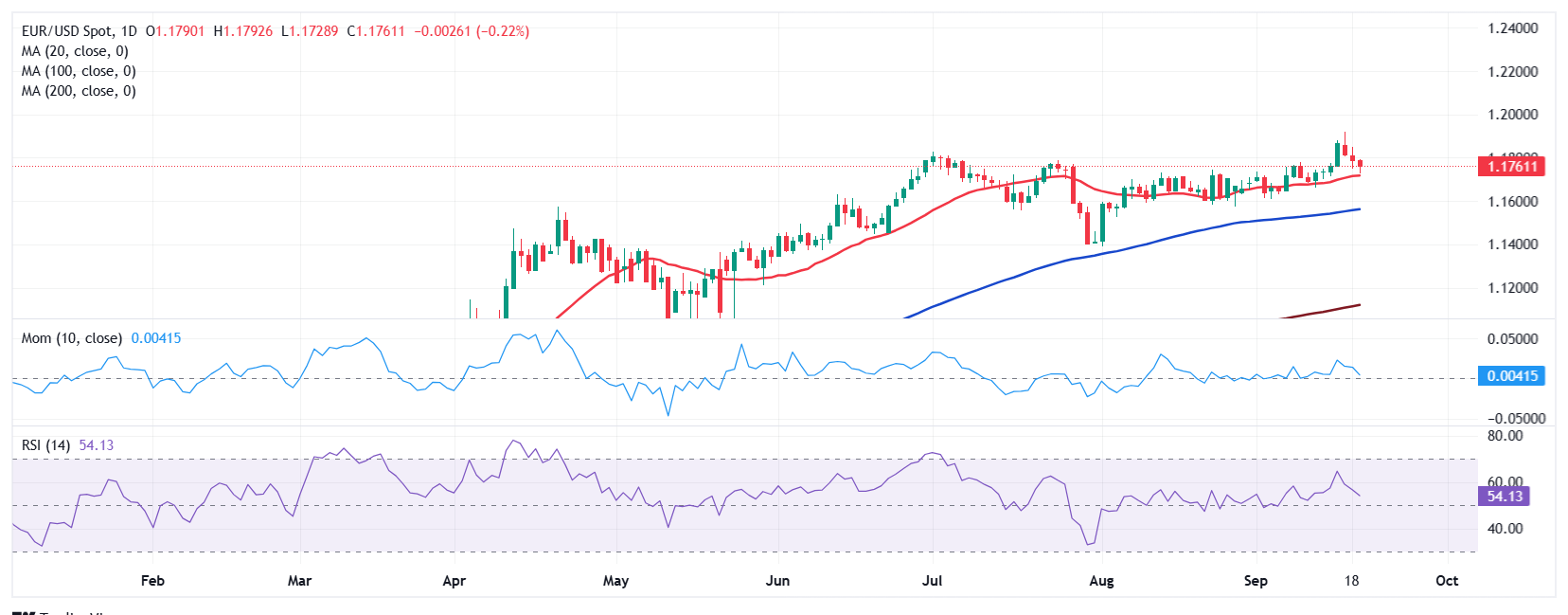
EUR/USD is at the brink of turning even lower according to the daily chart. Moving averages have steadily lost their upward strength, and a flat 20 SMA stands at 1.1710, while an also directionless 100 SMA lies in the 1.1560 region. In the meantime, technical indicators head firmly lower and are about to cross their midlines into negative territory.
Near-term resistance comes at 1.1830, followed by the recent peak in the 1.1920 area. Additional gains expose the 1.2000 figure, with a rally towards the latter quite unlikely in the near term. On the other side of the equation, the 1.1700 mark offers immediate support ahead of the more relevant 1.1590 region. A clear break below the latter would open the door for a more sustained decline.
Economic Indicator
Core Personal Consumption Expenditures - Price Index (YoY)
The Core Personal Consumption Expenditures (PCE), released by the US Bureau of Economic Analysis on a monthly basis, measures the changes in the prices of goods and services purchased by consumers in the United States (US). The PCE Price Index is also the Federal Reserve’s (Fed) preferred gauge of inflation. The YoY reading compares the prices of goods in the reference month to the same month a year earlier. The core reading excludes the so-called more volatile food and energy components to give a more accurate measurement of price pressures." Generally, a high reading is bullish for the US Dollar (USD), while a low reading is bearish.
Read more.Next release: Fri Sep 26, 2025 12:30
Frequency: Monthly
Consensus: -
Previous: 2.9%
Source: US Bureau of Economic Analysis
After publishing the GDP report, the US Bureau of Economic Analysis releases the Personal Consumption Expenditures (PCE) Price Index data alongside the monthly changes in Personal Spending and Personal Income. FOMC policymakers use the annual Core PCE Price Index, which excludes volatile food and energy prices, as their primary gauge of inflation. A stronger-than-expected reading could help the USD outperform its rivals as it would hint at a possible hawkish shift in the Fed’s forward guidance and vice versa.
Author

Valeria Bednarik
FXStreet
Valeria Bednarik was born and lives in Buenos Aires, Argentina. Her passion for math and numbers pushed her into studying economics in her younger years.