EUR/USD Weekly Forecast: Time to turn down? War and the Fed set to end recovery
- EUR/USD has recovered amid hopes for peace and higher European inflation.
- The war, and the Fed's meeting minutes stand out as significant market movers.
- Early April's daily chart is painting a mixed picture.
- The FX Poll is pointing to gains in all timeframes.


Doves of peace, not monetary ones – hopes for a ceasefire and higher eurozone inflation have been keeping EUR/USD bid. Can it continue higher? The economic focus shifts to the US, while the war remains prominent as well.
This week in EUR/USD: Inflation competes with war
Germans are known for their inflation aversion, which has worsened after the report that prices were up 7.3% YoY in March. The news from Europe's largest economy and also Spain – which has near 10% yearly inflation – has prompted European Central Bank members to mull raising rates this year. This has boosted the euro.
The common currency also received a tailwind from Russian-Ukrainian talks, as Moscow pledged to decrease military activity near Kyiv and focus on the east of Ukraine. At the time of writing, a ceasefire still seems elusive. Nevertheless, the relative calm and market wariness from horrific headlines have helped improve the mood. The safe-haven dollar has been on the back foot while the euro recovered.
Speculation about the Federal Reserve's next moves remains rife. After several calls for a double-dose rate hike in May, Atlanta Fed President Raphael Bostic surprised markets by striking a more cautious tone in a public appearance., citing the impact of the war as a growing risk. However, markets continue pricing a high chance of a 50 bps move in May.
The US economy gained 431,000 jobs in April, marginally below 490,000 expected, but on top of upward revisions, higher wages and a low unemployment rate of 3.6%. That keeps the Fed on track for aggressive monetary policy, further boosting the dollar.
Eurozone events: War critical for Europe's moves
The Russia-Ukraine war remains central to the euro, as hostilities happen on European soil – and Moscow may still cut the bloc off from Russian energy. If both sides finally agree on a ceasefire, it would send the currency surging, even though investors are aware that any deal is fragile.
Any intensification, such as a Russian attack on a NATO arms convoy to Ukraine, or the use of non-conventional weapons, would send the euro tumbling down. So far, European industry heavily depends on Russian energy imports, so any signal of a halt would also weigh on the common currency.
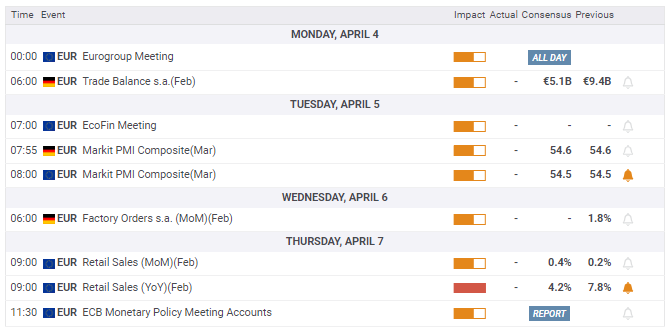
The economic calendar features Markit's final Purchasing Managers' Indexes, which have been relatively resilient in comparison to other business surveys. Revised data for March could reveal downgrades in expectations.
Here are the events lined up in the Eurozone on the forex calendar:
US events: Fed minutes in focus
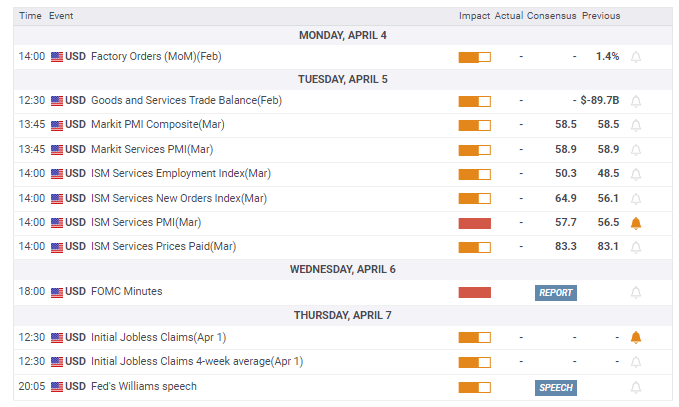
How eager is the Federal Reserve to raise rates by 50 bps points in May? That is the question investors are asking ahead of Wednesday's meeting minutes. The protocols from the bank's "lift-off" announcement in March may reveal anxiety to act quickly, perhaps showing that more members wanted a double-dose rate hike already in March.
James Bullard of the Saint Louis Fed was in the minority, while other voters backed a standard 25 bps increase of borrowing costs. Non-voting FOMC members, however, may have backed such an increase.
It is essential to note that Fed Chair Jerome Powell signaled a 25 bps increase some 10 days ahead of the decision, while the Consumer Price Index (CPI) shot to 7.9% while the Fed was deliberating its moves. Perhaps he and most of his colleagues opted for a standard increase to avoid shocking markets. If that is what the minutes show, the dollar would have room to raise rates.
The ISM Services PMI is also of interest. Contrary to most months, it is published after the NFP, standing out on its own and not as a hint toward the jobs report. Economists expect a small increase from February's 56.5 points, while the Prices Paid component, representing inflation, is set to remain elevated.
Here are the scheduled events in the US:
EUR/USD technical analysis
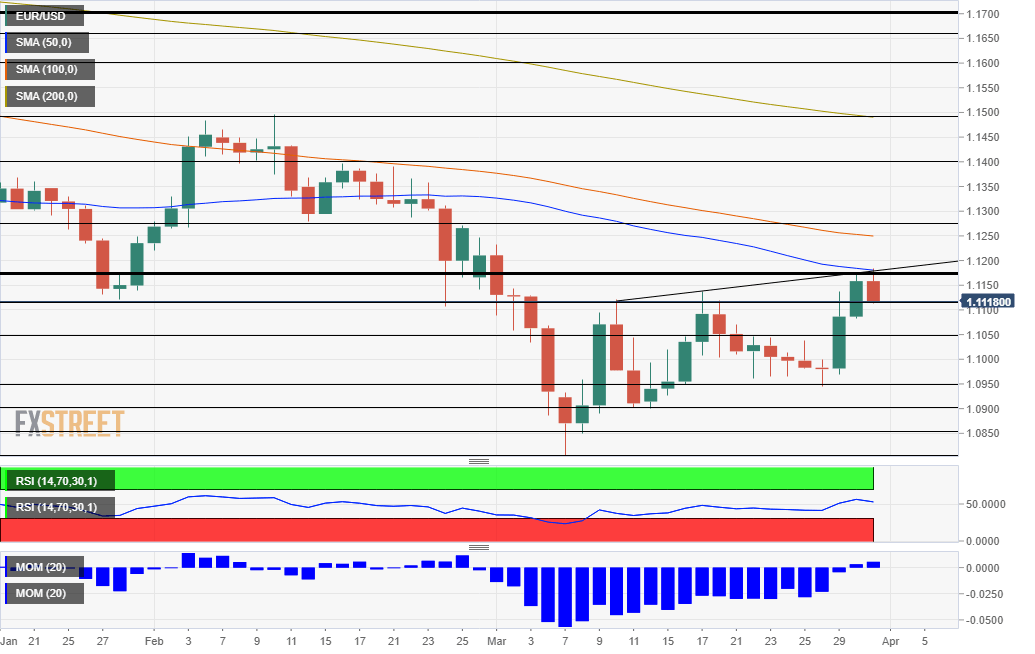
Euro/dollar momentum has turned to the upside after nearly a month of facing down – but the currency pair has been rejected at 1.1180. That is where the 50-day Simple Moving Average (SMA) converges with the uptrend resistance line dating back to early March. Breaking above that level is critical to further gains.
Beyond 1.1180, the 1.1250 level is where the 200-day SMA hits the price, and it is closely followed by 1.1280, which worked as support in February.
The 1.1050 level is a significant level after capping the pair twice in March. Lower, 1.0950 cushioned EUR/USD late in the month, and it is followed by 1.09, 1.0845 and finally by 1.0805.
EUR/USD sentiment
The recovery may have reached its limits – ongoing hostilities weigh on eurozone consumer and business sentiment, while the Fed's minutes are set to remind investors that the Fed has the edge when it comes to tightening its policy.
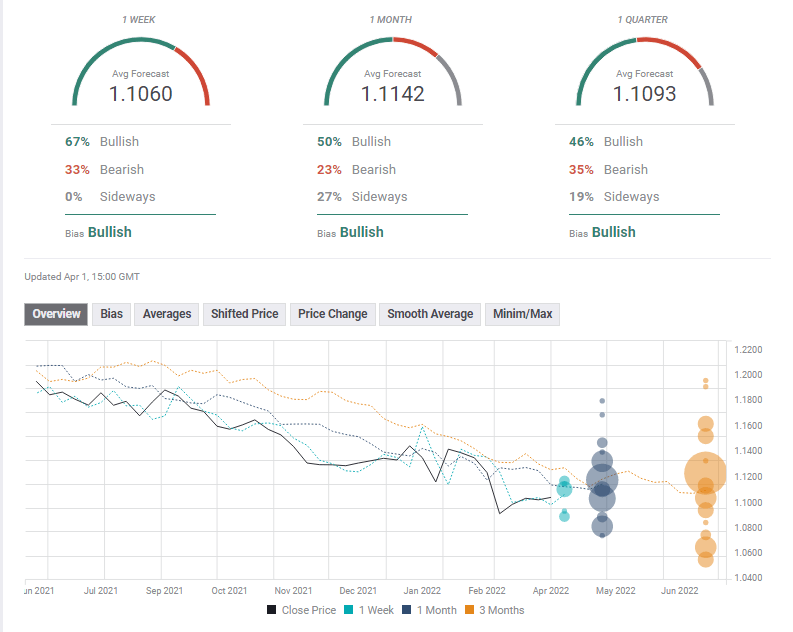
The FXStreet Poll shows a bullish outlook for all timeframe, yet experts doubt that the pair could go beyond the recent range. Moreover, the long-term outlook has barely changed.
Related Reads
Premium
You have reached your limit of 3 free articles for this month.
Start your subscription and get access to all our original articles.
Author
Yohay Elam
FXStreet
Yohay is in Forex since 2008 when he founded Forex Crunch, a blog crafted in his free time that turned into a fully-fledged currency website later sold to Finixio.