EUR/USD Weekly Forecast: Focus shifts from US growth to US employment
- The United States grew at a faster-than-anticipated pace in the three months to June.
- Solid US growth data precedes a week of employment-related releases.
- EUR/USD remains within familiar levels, but the risk now skews to the downside.


The EUR/USD pair turned south and closed the week below the 1.1700 mark, further retreating from the yearly peak set mid-September at 1.1918. The US Dollar (USD) surged amid words from Federal Reserve (Fed) Chair Jerome Powell and upbeat United States (US) data proving the American economy is in a good place.
Fed Chair Powell and growth
Federal Reserve (Fed) Chair Jerome Powell spoke about the US economic outlook at the Greater Providence Chamber of Commerce on Tuesday, pouring cold water on mounting speculation of steeper interest rate cuts. Powell delivered a balanced message and pretty much reiterated what he said in the press conference that followed the September monetary policy announcement, cautioning against moving too fast and risking an uptick in inflation. He also repeated that the job market is less dynamic and "somewhat softer." The market showed no immediate reaction to the headline, but the USD ended up strengthening on Wednesday, as the market still believed the Fed would continue to cut rates, but at a moderated pace.
Powell’s words followed a string of Fed officials vowing for more aggressive monetary action, which pressured the USD.
Further USD strength emerged on Thursday, driven by upbeat US data. The country reported that the economy grew at an annualized pace of 3.8% in the three months to June, according to the final estimate of the Q2 Gross Domestic Product (GDP). The result was much better than the 3.3% previously calculated. Additionally, Durable Goods Orders were up 2.9% in August, much better than the previous 2.6% slide and the anticipated -0.5%. Also, the Initial Jobless Claims for the week ended September 20 were up by 218K, beating the expected 235K and easing from the 232K posted in the previous week.
Finally, the US reported August Personal Consumption Expenditures (PCE) Price Index figures on Friday. The Fed’s favorite inflation gauge, as measured by the PCE Price Index, rose at an annualized pace of 2.7% in August from 2.6% in July, according to the US Bureau of Economic Analysis (BEA), in line with the market forecasts. Core annual inflation printed at 2.9%, matching the July reading and also expectations. The monthly increase of 0.3% also came as expected.
By the end of the week, the US economic resilience stands out. Regardless of political turmoil, the latest data explains why the country retains its global leadership. It may be too early to call for a sustained USD recovery, but the picture is about to change and the odds are rising: growth is solid, inflation stable, the labor market softened, and the Fed has set the path.
In line with expectations, inflation data was not enough to trigger market action, but the USD retained most of the ground gained in the previous trading days ahead of the weekly close.
Data focus shifts from growth to employment
Other than that, S&P Global released the preliminary estimates of the September Purchasing Managers’ Indexes (PMIs) for all major economies. Alongside the Hamburg Commercial Bank (HCOB), the survey showed that manufacturing output in the Eurozone contracted in August, contrary to expectations of a modest uptick. Services activity, on the other hand, improved by more than anticipated, resulting in a Composite PMI of 51.2, slightly better than the 51.1 expected and the previous 51. US data was pretty much in line with expectations, easing modestly from the August final readings but indicating persistent business expansion as the Composite PMI printed at 53.6.
The macroeconomic calendar will be pretty busy starting Tuesday, when Germany releases its August Retail Sales and the preliminary estimate of September's Harmonized Index of Consumer Prices (HICP) figures. The Eurozone will publish its own HICP on Wednesday, when the US will publish the September ADP Employment Change report and the ISM Manufacturing PMI for the same month. Finally, the US will release the September ISM Services PMI and the Nonfarm Payrolls (NFP) report on Friday for the same period. In the meantime, different central banks’ officials will be on the wires, including European Central Bank (ECB) President Christine Lagarde.

EUR/USD technical outlook
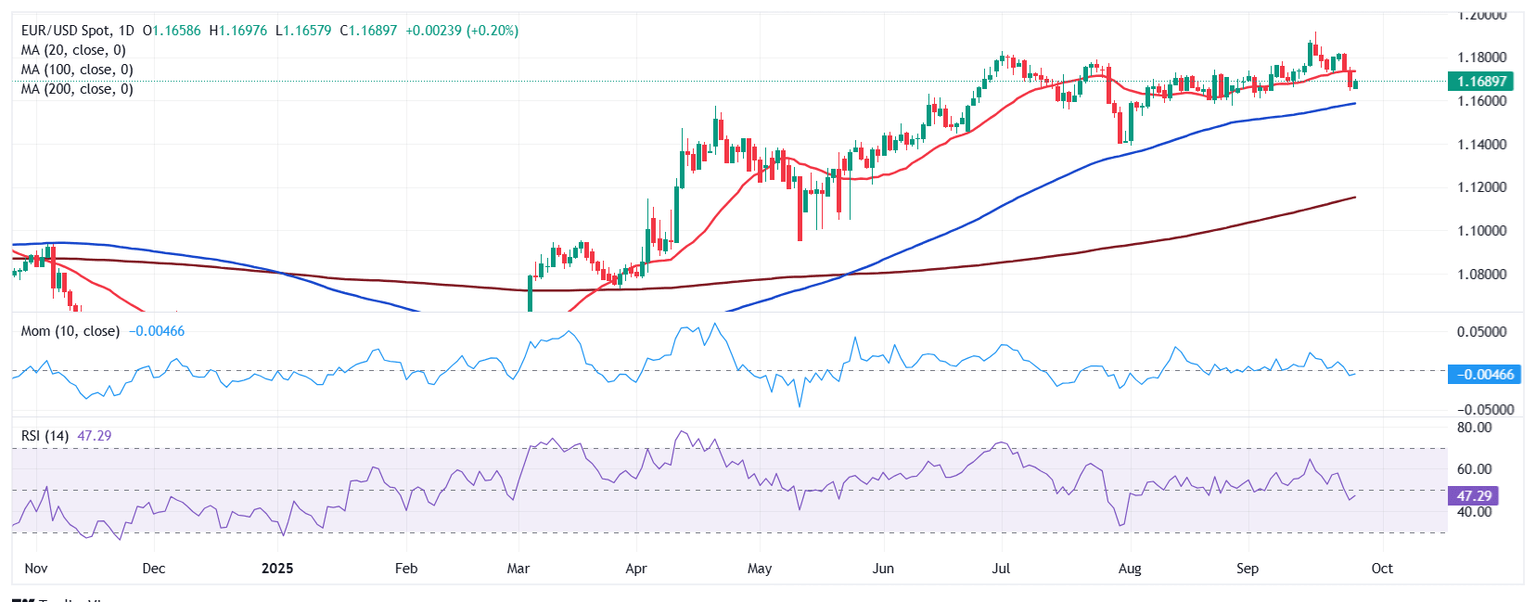
The EUR/USD pair trades just below the 1.1700 mark as some profit-taking and the better market mood limit demand for the USD. Still, technical readings in the weekly chart suggest the ongoing decline remains corrective. The pair remains above all its moving averages, with the 20 Simple Moving Average (SMA) providing relevant support at around 1.1600. Technical indicators, in the meantime, continue to head marginally lower within positive levels, still far from suggesting a steeper slide but skewing the risk to the downside.
The risk of another leg lower is clearer in the daily chart. The EUR/USD pair broke below its 20 SMA, now acting as dynamic resistance in the 1.1730 region. At the same time, the 100 SMA is located at around 1.1580. A bearish breakout could open the scope for a test of the July low at 1.1391. Technical indicators, in the meantime, turned after crossing their midlines into negative territory, anticipating additional slides without confirming it.
Beyond the 1.1730 level, resistance comes at 1.1830, followed by the year peak in the 1.1920 area. Further advances could result in a test of the 1.2000 mark. Below the 1.1580-1.1600 area, on the other hand, the downward momentum is likely to intensify, with interim support at 1.0450 ahead of the mentioned July low at 1.1391.
Economic Indicator
Nonfarm Payrolls
The Nonfarm Payrolls release presents the number of new jobs created in the US during the previous month in all non-agricultural businesses; it is released by the US Bureau of Labor Statistics (BLS). The monthly changes in payrolls can be extremely volatile. The number is also subject to strong reviews, which can also trigger volatility in the Forex board. Generally speaking, a high reading is seen as bullish for the US Dollar (USD), while a low reading is seen as bearish, although previous months' reviews and the Unemployment Rate are as relevant as the headline figure. The market's reaction, therefore, depends on how the market assesses all the data contained in the BLS report as a whole.
Read more.Next release: Fri Oct 03, 2025 12:30
Frequency: Monthly
Consensus: 39K
Previous: 22K
Source: US Bureau of Labor Statistics
America’s monthly jobs report is considered the most important economic indicator for forex traders. Released on the first Friday following the reported month, the change in the number of positions is closely correlated with the overall performance of the economy and is monitored by policymakers. Full employment is one of the Federal Reserve’s mandates and it considers developments in the labor market when setting its policies, thus impacting currencies. Despite several leading indicators shaping estimates, Nonfarm Payrolls tend to surprise markets and trigger substantial volatility. Actual figures beating the consensus tend to be USD bullish.
Premium
You have reached your limit of 3 free articles for this month.
Start your subscription and get access to all our original articles.
Author
Valeria Bednarik
FXStreet
Valeria Bednarik was born and lives in Buenos Aires, Argentina. Her passion for math and numbers pushed her into studying economics in her younger years.

















