EUR/USD Weekly Forecast: Could the Fed keep rates on hold despite Trump’s rage?
- After ECB on-hold decision, it is the Federal Reserve’s turn.
- Europe and the United States will release fresh inflation and growth estimates.
- EUR/USD resumed its bullish trend after correcting long-term overbought conditions.

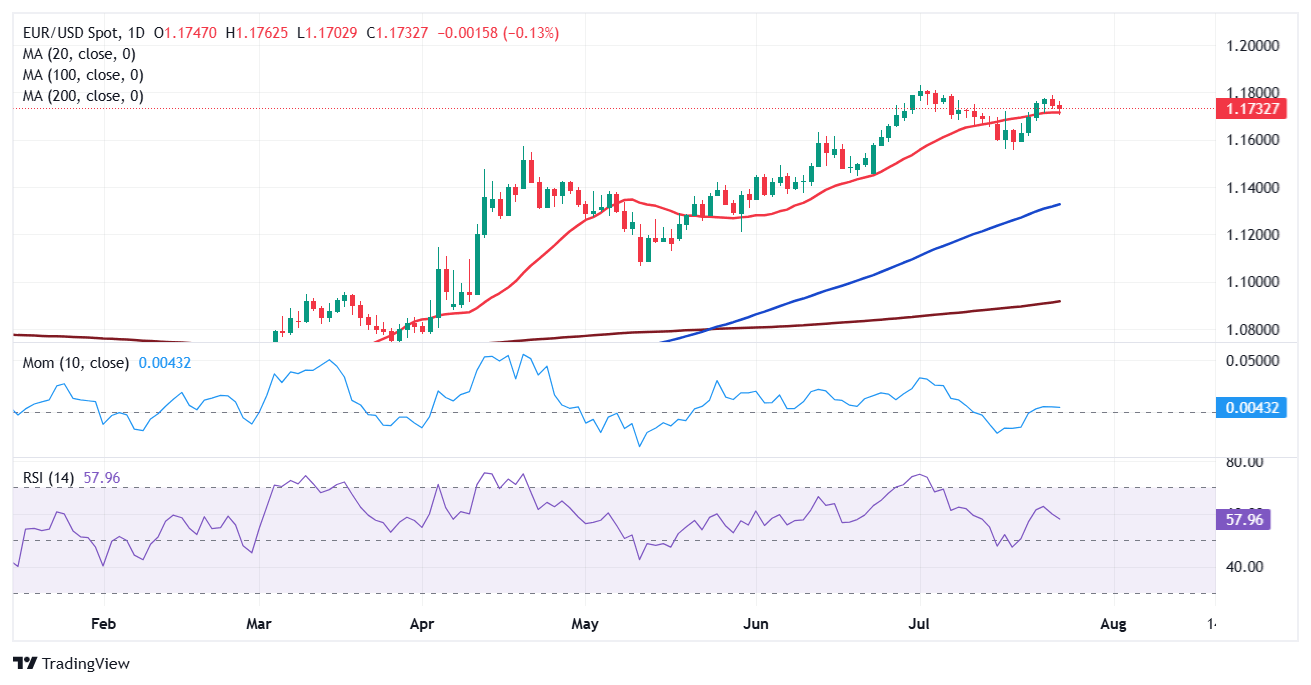
The EUR/USD pair resumed its bullish trend and settled at around 1.1730, extending its recovery from the monthly low set at 1.1555 on July 17. The pair peaked at 1.1789 amid mounting pressure on Federal Reserve (Fed) Chair Jerome Powell to resign and progress in trade negotiations.
Trade deals taking shape
The White House announced a trade deal with Japan on Tuesday, which includes Japan investing $550 billion into the United States (US). Both countries will face reciprocal tariffs of 15%, which benefits Japan, as other US rivals face a 25% levy on automotive-related exports. US President Donald Trump celebrated by calling it “the largest trade deal in history.”
Meanwhile, market talks suggest a deal between the US and the European Union (EU) is close, yet ahead of the August 1 deadline, the EU has prepared a retaliatory package worth roughly $100 billion of US goods. Also, US representatives keep talking with China, with President Donald Trump declaring a trade deal is near completion.
Trade deals with other economies like Vietnam, the Philippines and Indonesia were announced, but markets won’t find peace until agreements are reached with China and the EU.
Trump's rage on Powell mounts
Meanwhile, Trump’s personal war with Fed Chair Powell escalated. Trump demands that the central bank lower interest rates by at least 3 points, accusing the Fed of generating billions of dollars in losses amid its decision to keep rates near multi-year highs. Trump called for Powell to resign and threatened to replace him multiple times despite lacking the authority to do so.
Trump’s new strategy is going for the Fed from other sides. On the one hand, House Rep. Anna Paulina Luna referred Powell to the Department of Justice (DOJ) for criminal charges, accusing him of lying under oath on at least two occasions.
On the other hand, Trump visited the central bank’s headquarters in Washington amid accusations of cost overruns related to the renovation of some of the Fed’s buildings. The timing of the visit is also relevant as the central bank is meant to meet next week to decide on monetary policy.
European Central Bank adopts a wait-and-see stance
The European Central Bank (ECB) announced last Thursday that it had decided to keep interest rates unchanged following its July meeting, a move largely anticipated by market players. The ECB has been slowly but steadily trimming interest rates with the Deposit Facility Rate down to 2% from the post-pandemic peak of 4%. The accompanying statement showed that policymakers remain concerned about the uncertainties related to global trade disputes and reaffirmed that decisions will be made meeting by meeting on a data-dependent approach.
ECB President Christine Lagarde, however, sounded quite hawkish in the subsequent press conference, saying she is confident the worst of inflation is behind, while adding that long-term inflation expectations continue to stand near 2%. On a negative note, Lagarde warned that the risks to economic growth remain tilted to the downside, although adding data points to overall modest expansion.
Gearing up for plenty first-tier events
Other than the ECB announcement, the macroeconomic calendar had little to offer. The Hamburg Commercial Bank (HCOB) and S&P Global published the preliminary estimates of the July Purchasing Managers Indexes (PMI). EU business output improved with the Composite PMI rising to 51.0, up from 50.6 in June and surpassing the anticipated 50.8. Manufacturing activity held below 50, the line that separates contraction from economic expansion, yet improved on a monthly basis to 49.8 from the 49.5 posted in the previous month. Across the pond, the US Composite PMI in the same period printed at 54.6 from the previous month’s 52.9, indicating a faster pace of growth.
In the coming days, trade activity is expected to be quite busy due to the release of macroeconomic data. Wednesday will be quite a big day as Germany will release June Retail Sales and the preliminary estimate of the Q2 Gross Domestic Product (GDP). The EU will follow with the Q2 GDP flash estimate, and a couple of hours later it will be the US’ turn. Annualized growth in the world’s largest economy is foreseen at 2.5% in the three months to June, much better than the -0.5% posted in Q1.
The Fed will then take the stage and announce its decision on monetary policy in the American afternoon. The central bank is widely anticipated to keep the benchmark interest rate on hold, floating between 4.25% and 4.50%. The decision will be followed by a press conference from Chair Powell, but there will be no updates on economic projections.
On Thursday, Germany and the US will release inflation updates, while the EU will do so on Friday. Additionally, the US will release multiple employment reports throughout the week, including JOLTS Job Openings and the ADP survey on private job creation, ahead of the July Nonfarm Payrolls report.
Finally, the US will publish the final version of the July Michigan Consumer Sentiment Index and the ISM Manufacturing PMI for the same month on Friday.

EUR/USD technical outlook
The weekly chart shows that the EUR/USD pair is well-positioned to resume its advance after correcting overbought conditions. The pair keeps developing far above all its moving averages, with a bullish 20 Simple Moving Average (SMA) maintaining its strong upward slope at around 1.1350, far above directionless 100 and 200 SMAs. At the same time, technical indicators pared their latest decline and timidly resumed their advances. The Momentum indicator stands right above its 100 line, while the Relative Strength Index (RSI) flirts again with overbought readings, both hinting at additional gains ahead.
According to the daily chart, EUR/USD is in a consolidative phase. The pair showed little action in the last three trading days, while resting above a now flat 20 SMA. The latter acts as dynamic support at around 1.1710. The Momentum indicator, in the meantime, heads nowhere at around its 100 level, while the RSI indicator aims marginally lower at around 58. Finally, the 100 and 200 SMAs head firmly north, far below the current level, in line with the longer-term bullish trend.
Below the 1.1700 mark, the pair could ease toward the 1.1620 price zone, en route to its July low at 1.1550. Beyond the latter lies a critical long-term support area around 1.1470, a line in the sand for the current bullish trend. To the upside, 1.1830, the 2025 high, comes as immediate resistance en route to the 1.1900 mark.
US-China Trade War FAQs
Generally speaking, a trade war is an economic conflict between two or more countries due to extreme protectionism on one end. It implies the creation of trade barriers, such as tariffs, which result in counter-barriers, escalating import costs, and hence the cost of living.
An economic conflict between the United States (US) and China began early in 2018, when President Donald Trump set trade barriers on China, claiming unfair commercial practices and intellectual property theft from the Asian giant. China took retaliatory action, imposing tariffs on multiple US goods, such as automobiles and soybeans. Tensions escalated until the two countries signed the US-China Phase One trade deal in January 2020. The agreement required structural reforms and other changes to China’s economic and trade regime and pretended to restore stability and trust between the two nations. However, the Coronavirus pandemic took the focus out of the conflict. Yet, it is worth mentioning that President Joe Biden, who took office after Trump, kept tariffs in place and even added some additional levies.
The return of Donald Trump to the White House as the 47th US President has sparked a fresh wave of tensions between the two countries. During the 2024 election campaign, Trump pledged to impose 60% tariffs on China once he returned to office, which he did on January 20, 2025. With Trump back, the US-China trade war is meant to resume where it was left, with tit-for-tat policies affecting the global economic landscape amid disruptions in global supply chains, resulting in a reduction in spending, particularly investment, and directly feeding into the Consumer Price Index inflation.
Premium
You have reached your limit of 3 free articles for this month.
Start your subscription and get access to all our original articles.
Author
Valeria Bednarik
FXStreet
Valeria Bednarik was born and lives in Buenos Aires, Argentina. Her passion for math and numbers pushed her into studying economics in her younger years.