EUR/USD Weekly Forecast: Buyers gain confidence after hawkish Powell
- Concerns about US President Donald Trump’s trade war cooled down at the end of the week.
- Federal Reserve President Jerome Powell reaffirmed the central bank’s hawkish stance.
- European Central Bank officials see more rate cuts in the upcoming months.
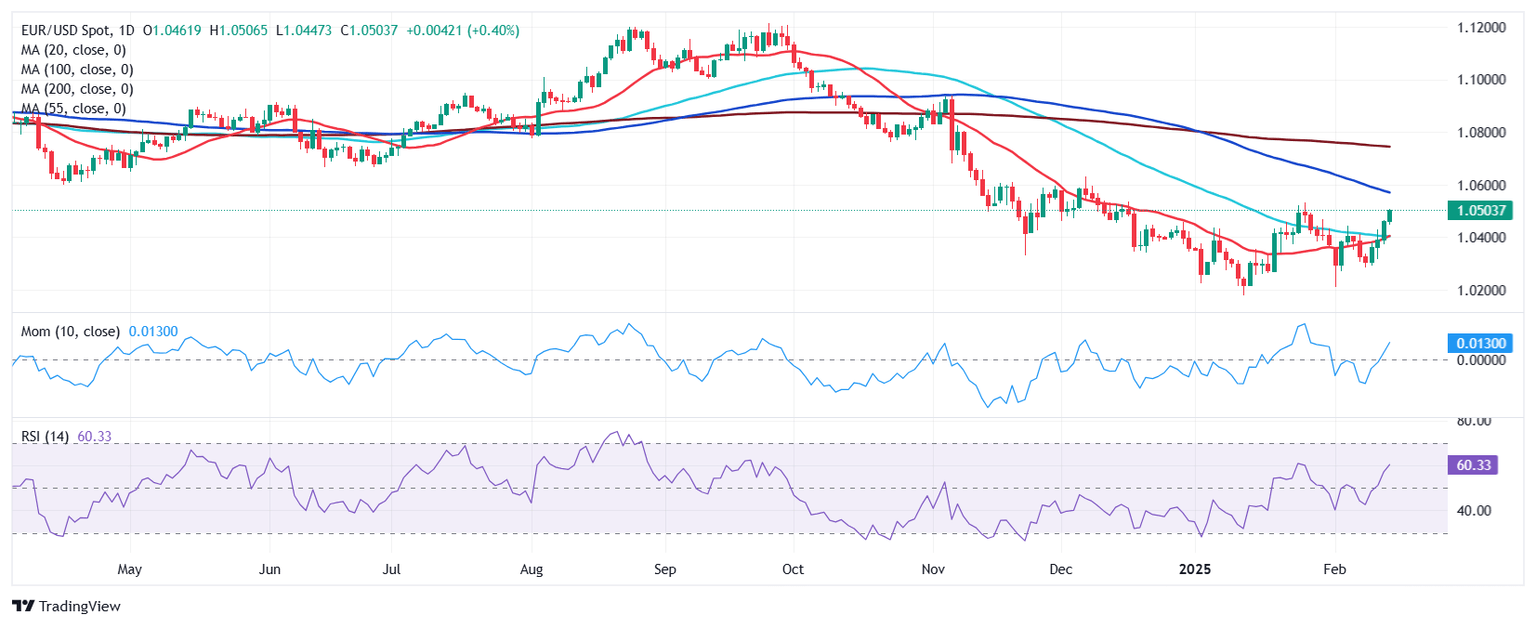
- EUR/USD flirts with the 1.0500 mark and has scope to extend its recovery.


The EUR/USD pair gapped lower for a second consecutive week, falling to 1.0276 on Monday, yet managed to change course mid-week, finishing it at around 1.0500 and near fresh two-week highs.
US President Trump shakes markets again
The US Dollar (USD) seesawed at the rhythm of sentiment, surging amid risk-aversion as United States (US) President Donald Trump anticipated a fresh round of tariffs ahead of the markets’ opening. The White House imposed a 25% tariff on all steel and aluminium imports into the US on Tuesday, with no exceptions.
Fears took over the FX board, spurring demand for the safe-haven Greenback, yet USD strength was short-lived, as tepid US data and encouraging headlines pushed it lower across the FX market.
The US reported that the Consumer Price Index (CPI) rose by more than anticipated in January, fueling speculation the Federal Reserve (Fed) will keep interest rates at current levels for longer. Inflation, as tracked by the CPI, rose by 3.0% in the year to January, while the core annual reading increased by 3.3%, above the previous 3.2% and the expected 3.1% reading, according to the Bureau of Labor Statistics (BLS).
Additionally, the mood improved following market talks, indicating a potential agreement between Russia and Ukraine with the help of the US.
Then, on Thursday, President Trump announced his plan for reciprocal tariffs against all major trading partners that impose tariffs on the US and non-tariffs on goods imported from the US. Additionally, he said his government is considering countries that charge a VAT on foreign goods as a form of tariff, and hence, could result in reciprocal levies.
Finally, he added that Commerce Secretary Howard Lutnick will be working on a reciprocal plan and announce the details moving forward.
Optimism took over markets
The absence of details, along with a delay in the imposition of new tariffs, kept financial markets in optimistic mode, helping EUR/USD reach the aforementioned high.
Other than that, Fed Chairman Jerome Powell testified before Congress about monetary policy and repeated that the central bank is in no rush to trim interest rates any time soon.
“With our policy stance now significantly less restrictive than it had been and the economy remaining strong, we do not need to be in a hurry to adjust our policy stance,” Powell said.
Additionally, Powell noted the US is in a “pretty good place” with the economy, but also that policymakers would want to make more progress on inflation. About the latter, he mentioned progress while adding it is still “somewhat elevated.”
His hawkish words were no surprise, as Powell delivered the same message after the Fed’s January monetary policy meeting.
Finally, on Friday, the US released January Retail Sales, which fell by 0.9% in the month, much worse than the -0.1% anticipated. December's figure, in the meantime, was upwardly revised to 0.7% from the previous estimate of 0.4%. The negative headline put additional pressure on the USD.
European noise continues
European data, in the meantime, came short of encouraging. The February Sentix Investor Confidence index resulted in -12.7, improving from the -17.7 posted in January. Industrial Production in the European Union (EU) fell by 1.1% on a monthly basis in December, while the Q4 Gross Domestic Product was revised to -0.1% QoQ from 0.0% previously estimated.
Meanwhile, Germany confirmed the January Harmonized Index of Consumer Prices (HICP) at 2.8% YoY as previously estimated.
Also, European Central Bank (ECB) officials were on the wires with their usual cautious tone. President Christine Lagarde said on Monday that conditions for a recovery remain in place, yet noted that there are risks on both the upside and the downside to inflation.
ECB policymaker and Bank of France head Francois Villeroy de Galhau said that US President Trump’s trade policies will most likely have a negative impact on the economy. Policymaker Boris Vujčić noted on Thursday that the market is pricing in three more rate cuts this year and added that those expectations are not unreasonable.
The Fed’s hawkish path and the ECB’s dovish one clearly favor a EUR/USD rally to fresh highs.
What’s next in the docket
The macroeconomic calendar will feature some interesting data in the upcoming days. A slew of Fed speakers will hit the wires on Monday, while the Federal Open Market Committee (FOMC) will release the Minutes of the January meeting on Wednesday. Friday will bring the Hamburg Commercial Bank (HCOB) and the S&P Global preliminary estimates of the February Purchasing Managers’ Indexes (PMIs) for all major economies.
As usual, comments from US President Trump on tariffs and speculation on how such levies could affect the economy and, hence, future Fed’s decision, will lead the market’s ways.

EUR/USD technical outlook
The EUR/USD pair flirts with the 1.0500 mark, yet the long-term technical picture shows bulls are not yet in the driver’s seat. Technical indicators in the weekly chart keep advancing, albeit within negative levels. Indicators have completely corrected oversold conditions and maintain their upward slopes, in line with a continued advance. At the same time, the pair is developing below all its moving averages, with a firmly bearish 20 Simple Moving Average (SMA) providing dynamic resistance at around 1.0560 while extending its slide below directionless 100 and 200 SMAs.
The technical picture in the daily chart is quite similar, with an increased bullish potential yet additional confirmations needed to support a fresh leg north. The Momentum indicator is pressuring its midline from below yet with a limited directional slope. At the same time, the Relative Strength Index (RSI) indicator advances at around 60, albeit at a moderated pace. Finally, EUR/USD extends gains above a mildly bullish 20 SMA, the latter at around 1.0400, but remains below a bearish 100 SMA acting as dynamic resistance at 1.0585.
Initial support comes at around 1.0440, where the pair topped on February 5, followed by the 1.0400 threshold. Below the latter, the pair can extend its slide towards the 1.0320 region, with the next support level at 1.0276, the weekly low. Resistance, on the other hand, comes at 1.0527, January's monthly high, with further gains exposing 1.0639, December's monthly high.
US-China Trade War FAQs
Generally speaking, a trade war is an economic conflict between two or more countries due to extreme protectionism on one end. It implies the creation of trade barriers, such as tariffs, which result in counter-barriers, escalating import costs, and hence the cost of living.
An economic conflict between the United States (US) and China began early in 2018, when President Donald Trump set trade barriers on China, claiming unfair commercial practices and intellectual property theft from the Asian giant. China took retaliatory action, imposing tariffs on multiple US goods, such as automobiles and soybeans. Tensions escalated until the two countries signed the US-China Phase One trade deal in January 2020. The agreement required structural reforms and other changes to China’s economic and trade regime and pretended to restore stability and trust between the two nations. However, the Coronavirus pandemic took the focus out of the conflict. Yet, it is worth mentioning that President Joe Biden, who took office after Trump, kept tariffs in place and even added some additional levies.
The return of Donald Trump to the White House as the 47th US President has sparked a fresh wave of tensions between the two countries. During the 2024 election campaign, Trump pledged to impose 60% tariffs on China once he returned to office, which he did on January 20, 2025. With Trump back, the US-China trade war is meant to resume where it was left, with tit-for-tat policies affecting the global economic landscape amid disruptions in global supply chains, resulting in a reduction in spending, particularly investment, and directly feeding into the Consumer Price Index inflation.
Premium
You have reached your limit of 3 free articles for this month.
Start your subscription and get access to all our original articles.
Author
Valeria Bednarik
FXStreet
Valeria Bednarik was born and lives in Buenos Aires, Argentina. Her passion for math and numbers pushed her into studying economics in her younger years.