EUR/USD Weekly Forecast: Trump unleashes a global trade war, retaliation coming up next
- United States President Donald Trump announced widespread reciprocal tariffs on Wednesday.
- Financial markets collapsed with Wall Street suffering its worst losses since the 2020 pandemic.
- The EUR/USD pair retreated from highs but has scope to recover its bullish strength.


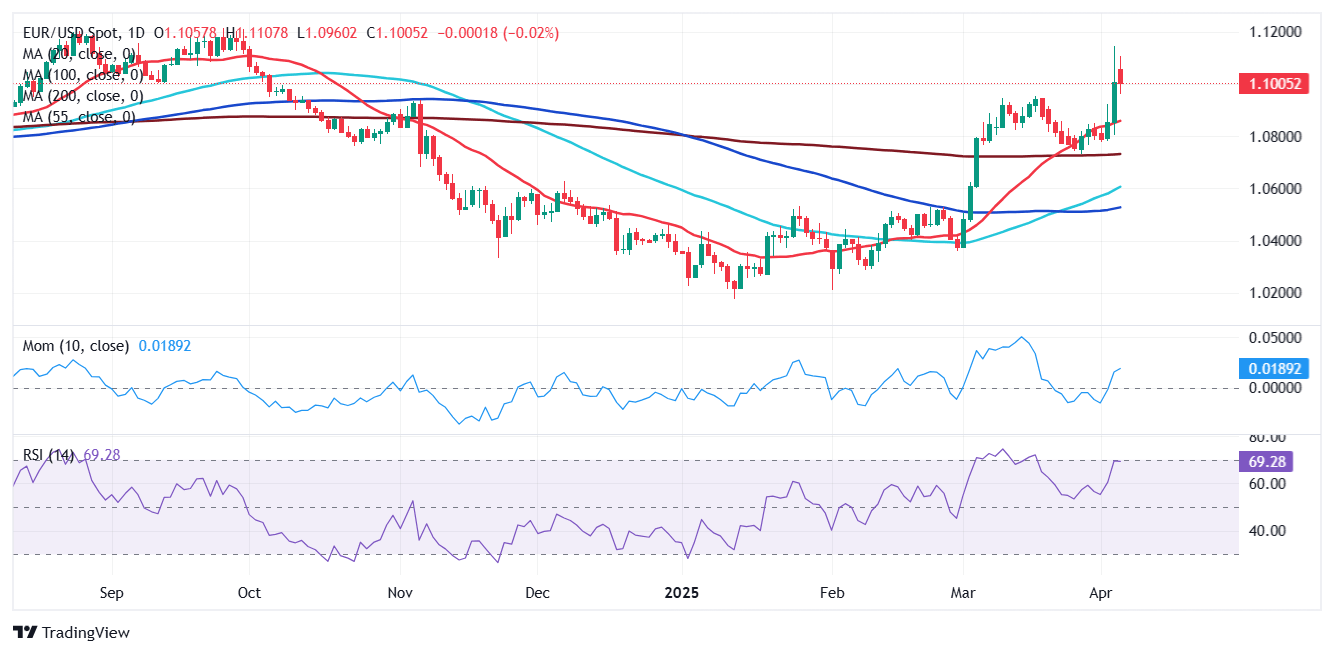
Financial markets navigated tumultuous waters in the first week of April. United States (US) President Donald Trump finally unveiled his reciprocal tariffs plan and spurred panic among worldwide investors. The EUR/USD pair peaked at 1.1146 mid-week, its highest since September 2024, amid broad US Dollar (USD) weakness, to finally settle at around 1.1000.
Trump’s tariffs triggered chaos
Speaking at the Rose Garden on Wednesday, US President Trump unveiled details on widespread levies. He presented lists of tariffs that different countries supposedly charge on the US, alongside the taxes the US will add to such countries. Later, it was revealed that the calculations are based on a country’s goods trade deficit with the US, by calculating the percentage difference between exports and imports, then dividing by two.
Trump imposed a baseline 10% reciprocal tariff on over 180 countries, with much steeper levies on some of America’s biggest trading partners, such as an additional 34% on China, 20% on the European Union (EU), 24% on Japan and 32% on Taiwan. Such taxes will come into effect between April 5 and April 9.
Trump said on Thursday he would be open to negotiations as long as they offer the US something “phenomenal.” Panic, however, did not recede as previously to his comments, several White House officials said that the newly announced reciprocal tariffs were not negotiable. Contradictions kept uncertainty at record levels ahead of the weekly close.
Wall Street collapsed, suffering losses last seen in 2020 on Thursday, while the picture worsened heading into the weekend. US indexes maintained the negative route in the last trading day of the week, with the Dow Jones Industrial Average (DJIA) shedding over 1,000 points for a second consecutive day.
Retaliation coming up next
European authorities did not hesitate to respond. European Commission President Ursula von der Leyen said that the global economy “will massively suffer,” expressing concerns about rising inflation and resurgent protectionism. Von der Leyen added that they would work toward reducing barriers, not raising them, yet made it clear that failure to negotiate will lead to counter-tariffs.
Additionally, German Vice Chancellor and Economic Affairs Minister Robert Habeck noted: “For American consumers, this day will not be a 'Liberation Day' but an 'Inflation Day.’”
China also announced retaliatory measures, with levies matching the 34% announced by the US on all American goods coming into effect on April 10. Meanwhile, the United Kingdom (UK) and some Asian countries opened negotiations to reduce the impact of tariffs.
By the end of the week, financial markets remain on edge. Commodities are down alongside equities, while the USD holds on to weekly losses, unevenly across the FX board. Safe-haven Japanese Yen (JPY) and Swiss Franc (CHF) are the clearer winners alongside the Pound Sterling (GBP), as the US hit the UK with the minimum tax.
Fears of widespread recession and higher inflationary pressures will likely dominate the upcoming days’ headlines. The US Dollar is likely to remain weak despite the late recovery driven by profit-taking ahead of the weekend rather than confidence in the American currency.
Generally speaking, the chaotic picture is set to continue, unless Trump backs up, which seems highly unlikely, while fueled by retaliatory announcements.
Macro data keeps being ignored
On the data front, it is worth mentioning that German inflation was softer than anticipated in March, according to preliminary estimates. The Harmonized Index of Consumer Prices (HICP) rose 2.3% year-on-year (YoY), below the previous 2.6% and the 2.4% anticipated by market participants. The EU annualized core HICP was up 2.4%, easing from the 2.6% posted in February and below the 2.5% anticipated by market players.
Across the pond, the ISM Purchasing Managers Indexes (PMI) and employment data showed the US economy is far from a recession, despite mounting fears about it. The ISM Manufacturing PMI resulted at 49.0 in March, although a contraction was already anticipated. Services output was worse than anticipated, with the index down to 50.8 from 53.5 in February.
As per US employment figures, the picture was mixed. The ADP Employment Change report showed that the private sector added 155K new positions in March, beating the 105K expected. Additionally, the March Challenger Job Cuts report showed that the number of layoffs soared to record levels, only surpassed by those reported in the first months of the Covid-related shutdowns. US-based employers announced 275,240 job cuts in the month, a 60% increase from the 172,017 cuts announced in February. It is worth noting that furloughs in the federal government totaled 216,215 for the month as part of the new Department of Government Efficiency's effort to pare down the federal workforce.
Job openings declined in February according to the JOLTS report, down to 7.56 million from the previous 7.76 million.
Finally, the US March Nonfarm Payrolls report showed the country added a total of 228K new jobs in the month, much better than the 135K expected. The Unemployment Rate ticked higher, to 4.2%, while wage-related inflation eased by more than anticipated.
In the upcoming days, the macroeconomic calendar will feature the Federal Open Market Committee (FOMC) Meeting Minutes and the US March Consumer Price Index (CPI). The country will also release the Producer Price Index (PPI) for the same month and the preliminary estimate of the April Michigan Consumer Sentiment Index. As for the EU, the most relevant release will be February Retail Sales.
EUR/USD technical outlook
The EUR/USD pair trimmed half of its weekly gains but still trades roughly 200 pips above its opening on Friday. Technical readings in the weekly chart show that the bullish momentum remains strong, with technical indicators heading firmly north well above their midlines. Even further, a flat 100 Simple Moving Average (SMA) at around 1.0780 provided support, while the pair ran past the 200 SMA. Finally, the 20 SMA turned higher well below the longer ones, reflecting buyers’ determination.
In the daily chart, the EUR/USD pair trades well above all its moving averages, with the 20 SMA maintaining its bullish slope above the longer ones, currently at around 1.0860. Technical indicators turned south, reflecting the intraday slide, yet remain within positive levels, still far from suggesting a steeper slide ahead.
A break through the 1.0900 figure should deny the bullish case in the upcoming days, with 1.0860 and 1.0800 acting as the next support levels. The battle around 1.1000 is likely to continue until the pair clears the 1.1050 area. Beyond it, 1.1100 and 1.1145 are the next levels to watch.
Tariffs FAQs
Tariffs are customs duties levied on certain merchandise imports or a category of products. Tariffs are designed to help local producers and manufacturers be more competitive in the market by providing a price advantage over similar goods that can be imported. Tariffs are widely used as tools of protectionism, along with trade barriers and import quotas.
Although tariffs and taxes both generate government revenue to fund public goods and services, they have several distinctions. Tariffs are prepaid at the port of entry, while taxes are paid at the time of purchase. Taxes are imposed on individual taxpayers and businesses, while tariffs are paid by importers.
There are two schools of thought among economists regarding the usage of tariffs. While some argue that tariffs are necessary to protect domestic industries and address trade imbalances, others see them as a harmful tool that could potentially drive prices higher over the long term and lead to a damaging trade war by encouraging tit-for-tat tariffs.
During the run-up to the presidential election in November 2024, Donald Trump made it clear that he intends to use tariffs to support the US economy and American producers. In 2024, Mexico, China and Canada accounted for 42% of total US imports. In this period, Mexico stood out as the top exporter with $466.6 billion, according to the US Census Bureau. Hence, Trump wants to focus on these three nations when imposing tariffs. He also plans to use the revenue generated through tariffs to lower personal income taxes.
Premium
You have reached your limit of 3 free articles for this month.
Start your subscription and get access to all our original articles.
Author
Valeria Bednarik
FXStreet
Valeria Bednarik was born and lives in Buenos Aires, Argentina. Her passion for math and numbers pushed her into studying economics in her younger years.

















