EUR/USD Weekly Forecast: Federal Reserve, ECB decisions and more
- US inflation rose below expectations in September, markets keep betting on an upcoming rate cut.
- The Federal Reserve and the European Central Bank will announce their monetary policy decisions.
- EUR/USD is technically bearish, but anything can happen after central banks.

The EUR/USD pair ends the week with modest losses in the 1.1620 region, having shown little signs of life over the past few days. Financial markets got little to work with amid the continued United States (US) government shutdown and the subsequent lack of macroeconomic releases.
Even further, with the Federal Reserve (Fed) and the European Central Bank (ECB) monetary policy meetings in the docket in the upcoming days, policymakers have shed little light on forthcoming monetary policy decisions.
True, some trade war headlines hit the news feeds at the beginning of the week, but as days went by, concerns about an escalation of the US-China conflict receded.
US government shutdown continues
The federal stalemate in the world’s largest economy has now become the second largest in US history. To sum it up, the government has run out of funding on October 1, and Congress needs to pass a new funding bill. Democrats and Republicans in the Senate have opposed visions on it, and hence, have voted multiple times on different proposals, but reached no agreement. At this point, thousands of workers have been furloughed, and many have lost their jobs. The military has run out of funding, and so has food support. The situation seems critical, but it does not seem that lawmakers are willing to end it anytime soon.
The shutdown also means federal offices are not releasing any kind of official data. As an exception, the US Bureau of Labor Statistics (BLS) published the September Consumer Price Index (CPI) figures on Friday. According to the report, annual inflation in the US rose to 3% in September from 2.9% in August. On a monthly basis, the CPI rose 0.3% following the 0.4% increase recorded in August, while the core monthly CPI increased 0.2%, and the core annual CPI was up 3% in September. All readings came below expectations, indicating easing price pressures despite the US government shutdown and fresh tariffs-related concerns. At the same time, the outcome was not enough to affect the odds for an interest rate cut when the Fed meets next week.
Trade tensions back on the table
The US and China stole the limelight at the beginning of the week amid escalating threats between the two economies. However, tensions cooled as US President Donald Trump and Chinese leader Xi Jinping are likely to meet in South Korea in the upcoming days.
However, President Trump chose another opponent. On Friday, he shared on his Truth Social account: “CANADA CHEATED AND GOT CAUGHT!!! They fraudulently took a big buy ad saying that Ronald Reagan did not like Tariffs, when actually he LOVED TARIFFS FOR OUR COUNTRY, AND ITS NATIONAL SECURITY. Canada is trying to illegally influence the United States Supreme Court in one of the most important rulings in the history of our Country. Canada has long cheated on Tariffs, charging our farmers as much as 400%. Now they, and other countries, can’t take advantage of the U.S. any longer. Thank you to the Ronald Reagan Foundation for exposing this FRAUD. MAKE AMERICA GREAT AGAIN!!!”
The White House reported late on Thursday that it would be terminating all trade negotiations with Canada after the Ontario provincial government aired an ad featuring former President Ronald Reagan speaking negatively about tariffs. The news had no immediate impact on the USD, but if tensions continue, it could end up affecting not only the economy but also the Fed’s future decisions.
Growth-related data adding a pinch of salt
S&P Global, alongside local banks, released the preliminary estimates of the October Purchasing Managers’ Indexes (PMIs) on Friday.
European data was upbeat, according to the Hamburg Commercial Bank (HCOB), providing near-term support to the Euro (EUR). The EU Manufacturing PMI surged to 50 from the previous 49.5, while services output printed at 52.6 following the 51.1 from September. The Composite PMI was then confirmed at 52.2. “The strongest increase in new orders for two-and-a-half years supported a faster expansion in Eurozone business activity in October, according to provisional PMI survey data,” the report stated. German data was also upbeat, although the Manufacturing PMI remained in contraction territory, printing at 49.6, following the 49.5 posted in September.
Across the pond, US growth data was also encouraging. The S&P Global Manufacturing PMI surged to 52.2 from 52, while the services index improved to 55.2 from previous54.2. The Composite PMI was confirmed at 54.8. However, the University of Michigan reviewed the October Consumer Sentiment Index to 50.3 from a preliminary estimate of 51.2.
Central banks and more
The macroeconomic calendar will be busy in the upcoming days, even if the US government shutdown continues. Minor privately estimated figures are scheduled throughout the week, while the October CB Consumer Confidence will be out on Tuesday. Of course, the Federal Open Market Committee (FOMC) will be the main event. Policymakers will announce their decision on monetary policy after a two-day meeting on Wednesday, and market participants anticipate a 25-basis-point (bps) rate cut. Generally speaking, a rate cut tends to weaken the local currency, although in this particular case, financial markets have long ago priced in the announcement. A 50 bps cut could put extra pressure on the USD, while an on-hold decision would fuel demand for the American currency. The odds for any of these two scenarios are very limited.
Still, market players will pay attention to Chair Jerome Powell's words, and he may paint a clearer picture of what to expect for the December monetary policy meeting.
The ECB will announce its decision on Thursday, but the situation there is quite different. Not only has the central bank been steadily cutting rates, but policymakers explicitly stated that they are comfortable with the current rates and don’t plan to do anything in the near term. If anything, market participants will be looking for hints about future action.
Other than that, Germany will publish the October IFO Business Climate survey and the November GfK Consumer Confidence Survey. The country will also release the preliminary estimate of the Q3 Gross Domestic Product (GDP) and the initial estimates of the October Harmonized Index of Consumer Prices (HICP). Finally, Germany will unveil Retail Sales figures next Friday.
As for the Eurozone, the bloc will also release the preliminary estimates of Q3 GDP and October HICP data, alongside October Consumer Confidence.
As a side note, the US should release Durable Goods Orders and Personal Consumption Expenditures (PCE) Price Index figures, but if the shutdown continues, data won’t be out.

EUR/USD technical outlook
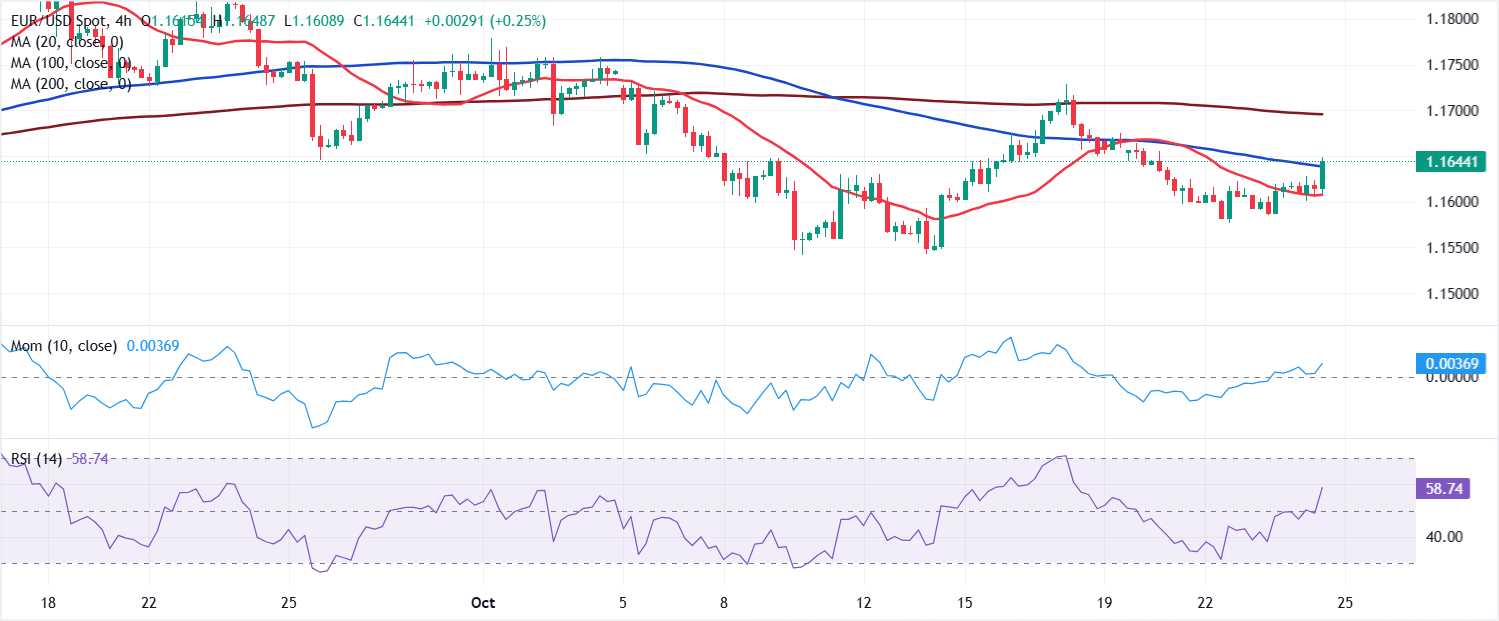
In the daily chart, EUR/USD is currently trading at around 1.1630. The near-term tone is fragile as spot holds beneath the 20- and 100-day SMAs, which converge as immediate resistance at around 1.1660. The 20-day SMA has rolled over and slipped just under the 100-day SMA, flagging fading upside pressure. That said, the medium- and long-term baselines retain a positive slope, with the 200 SMA edging higher at 1.1285, implying the broader backdrop remains supported despite the current pullback. At the same time, technical indicators offer a mixed picture. The 10-period Momentum has recovered from a string of negative prints to a marginally positive 0.0012, but is pointing to a lack of bullish follow-through. Meanwhile, the Relative Strength Index (RSI) indicator has ticked up to 46.4 from recent lows yet remains below the 50 mid-line, indicating sellers still hold a slight edge even as downside pressure eases. A sustained break above the 1.1655-1.1660 cap is needed to revive topside traction, while the rising 200-day SMA at 1.1285 stands as key long-term support.
In the weekly chart, a bullish 20-week SMA runs above the current level, maintaining its upwards slope at around 1.1680, capping the upside after the pair slipped marginally below it. Also, the 100-week SMA is bullish, standing at 1.1010, while the 200-week SMA is also edging higher at 1.0836. This moving-average configuration preserves the broader positive backdrop despite the latest pause, with dips likely to attract buying interest ahead of the longer ones. Weekly Momentum has rolled over into negative territory. It sits below its 100 line, in line with easing buying pressure and hinting at the risk of a deeper pullback even as the broader structure remains bullish. Meanwhile, the RSI holds in the mid-50s near 56 and is little changed, pointing to rangebound consolidation within an overall bullish setup. Immediate resistance is the rising 20-week SMA at 1.1679; a sustained break higher would reassert the upside. On the downside, initial support comes at the October low in the 1.1540 region, followed by the aforementioned 100-week and 200-week SMAs.
(This content was partially created with the help of an AI tool)
Economic Indicator
Fed Interest Rate Decision
The Federal Reserve (Fed) deliberates on monetary policy and makes a decision on interest rates at eight pre-scheduled meetings per year. It has two mandates: to keep inflation at 2%, and to maintain full employment. Its main tool for achieving this is by setting interest rates – both at which it lends to banks and banks lend to each other. If it decides to hike rates, the US Dollar (USD) tends to strengthen as it attracts more foreign capital inflows. If it cuts rates, it tends to weaken the USD as capital drains out to countries offering higher returns. If rates are left unchanged, attention turns to the tone of the Federal Open Market Committee (FOMC) statement, and whether it is hawkish (expectant of higher future interest rates), or dovish (expectant of lower future rates).
Read more.Next release: Wed Oct 29, 2025 18:00
Frequency: Irregular
Consensus: 4%
Previous: 4.25%
Source: Federal Reserve
Author

Valeria Bednarik
FXStreet
Valeria Bednarik was born and lives in Buenos Aires, Argentina. Her passion for math and numbers pushed her into studying economics in her younger years.