EUR/USD Weekly Forecast: US inflation and S&P Global PMIs under scrutiny
- The United States government shutdown continues, becoming the second-largest in the country’s history.
- The US Bureau of Labor Statistics will publish the September Consumer Price Index on Friday.
- EUR/USD lost bullish momentum, but an upcoming bearish leg is still unclear.

The EUR/USD pair started the week on the wrong footing, as a dismal market mood benefited the US Dollar (USD). The pair, however, quickly changed course as turmoil came from the United States (US). As a result, EUR/USD peaked at 1.1728 on Friday, closing the week with modest gains below the 1.1700 mark.
Bringing back the trade war
US President Donald Trump surprised investors negatively on Friday, October 10, by escalating trade tensions with China. Beijing expanded its control of rare earth minerals, triggering Trump’s rage.
China announced foreign companies would now need the government’s approval to export any product that contains whatever amount of rare earths. It’s worth remembering that the Asian giant has a near-monopoly in the processing of such minerals. As a result, US President Trump threatened the country with 100% levies. Beijing quickly responded to the threat by charging new port fees to US vessels.
Concerns about the escalation of the trade war partially receded throughout the week, but tensions between the US and China remain high and linger like a Damocles’ sword, negatively affecting the USD.
United States government shutdown
The US federal government ran out of funding on October 1, and so far, Congress has been unable to solve it. Democratic and Republican senators have continued voting on opposing funding bills, but the stalemate continues as neither has gotten enough support. Not even a temporary funding bill to maintain military operations. It has now become the second-largest government shutdown, yet lawmakers seem in no rush to solve it. With Senators leaving Washington for the weekend, no news on the matter is expected at the beginning of the new week.
Central bankers taking centre stage
In the absence of relevant macroeconomic figures, with most US data releases suspended amid the shutdown, the focus stood on policymakers’ words.
European Central Bank (ECB) President Christine Lagarde shared her confident perspective, repeating that interest rates are now at appropriate levels to deal with whatever turbulence. She also noted that risks to inflation and economic growth have become more balanced. Additionally, ECB Government Council member and Bank of France Governor François Villeroy gave a televised interview with Bloomberg on Tuesday. Villeroy sees more downside than upside inflation risks, noting that the ECB is in a good place yet adding “but that place isn't fixed.”
Still, other ECB members seem to be in a less comfortable spot. Policymaker and Chairman of the Board Bank of Lithuania Gediminas Šimkus said in Friday’s European session that risks to both inflation and growth have tilted to the downside. Also, Chief Economist Philip Lane noted that, while uncertainty has abated after the US-European Union (EU) trade deal, the ECB will continue to be data-dependent.
Across the pond, Federal Reserve (Fed) Chair Jerome Powell discussed quantitative tightening at the National Association for Business Economics conference in Philadelphia. On monetary policy, Powell reiterated that policymakers are concerned about the tightening labor market skewing the balance of risks between employment and inflation. Powell maintained the door open for upcoming interest rate cuts, with investors having fully priced in cuts in the two pending 2025 Federal Open Market Committee (FOMC) meetings. Most FOMC members were aligned with Powell, with the obvious exception of Stephen Miran. Among other things, Miran noted that the economy is more vulnerable to shocks because monetary policy is restrictive, as he believes the neutral rate has fallen.
Miran added that there’s no evidence in the data that tariffs are raising inflation, and blamed the latter on population increases.
As the October FOMC meeting looms, officials have entered a blackout period, meaning market participants won’t hear from the Fed until the upcoming decision.
Scarce macroeconomic releases
Over the last few days, Germany confirmed that the Harmonized Index of Consumer Prices (HICP) rose 2.4% in the year to September, as previously estimated. The core annual reading also matched the preliminary estimate at 2.4%. The final estimate of the Eurozone HICP for the same period printed at 2.2%, meeting the previous estimate, albeit the core annual figure was upwardly revised to 2.4% from 2.3%.
Other than that, Germany published the ZEW survey on Economic Sentiment, which improved to 39.3 in October from 37.3 in September, but missed the market forecast of 40.5. The assessment of the current situation fell to -80 from the previous -76.4, compared to the expected improvement to -75. Finally, the Eurozone Economic Sentiment slid to 22.7 below the 30.2 expected and the 26.1 posted in September.
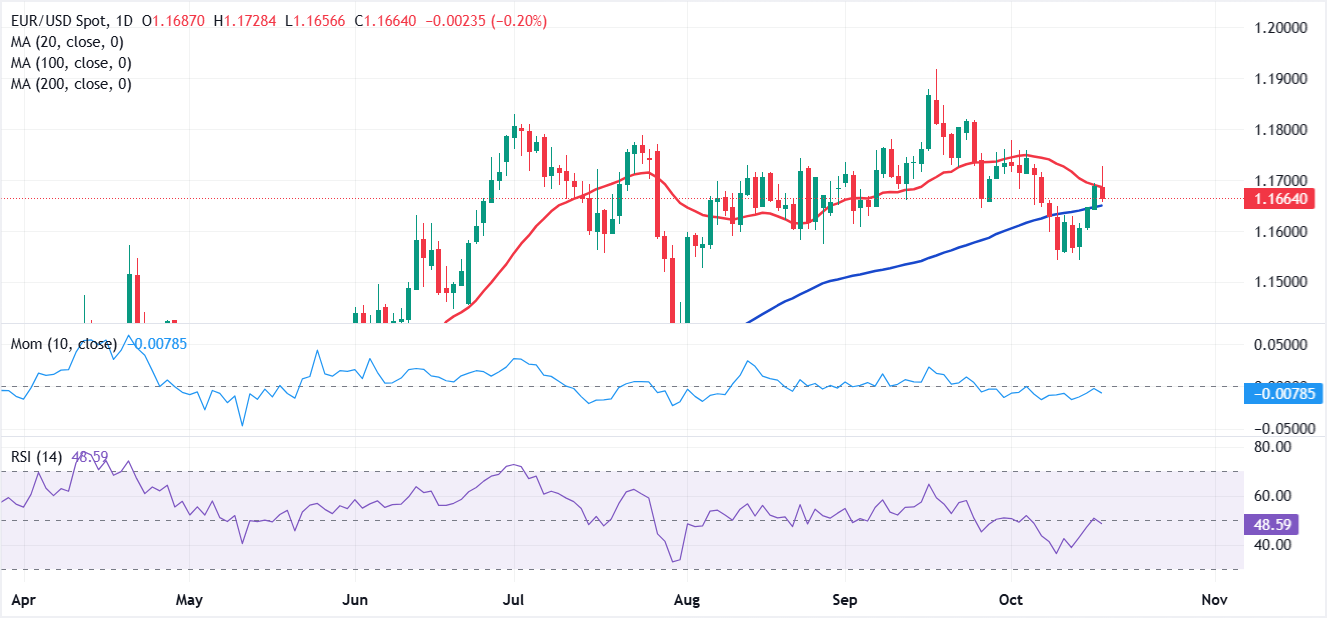
In the upcoming days, multiple ECB officials will be on the wires, including President Christine Lagarde, although not always discussing monetary policy. Germany will publish the September Producer Price Index (PPI) on Monday, while the Eurozone will publish the August Current Account and Construction Output on the same day.
Friday will be quite an intense day, as S&P Global will release the preliminary estimates of the October Purchasing Managers’ Indexes (PMIs) for all major economies. Additionally, the US Bureau of Labor Statistics (BLS) announced it will publish the September 2025 Consumer Price Index (CPI) on Friday, October 24, 2025, at 8:30 A.M. Eastern Time. The BLS posted on its site: “No other releases will be rescheduled or produced until the resumption of regular government services. This release allows the Social Security Administration to meet statutory deadlines necessary to ensure the accurate and timely payment of benefits.”
Finally, the University of Michigan will publish the final estimate of the October Consumer Sentiment Index.
EUR/USD technical outlook
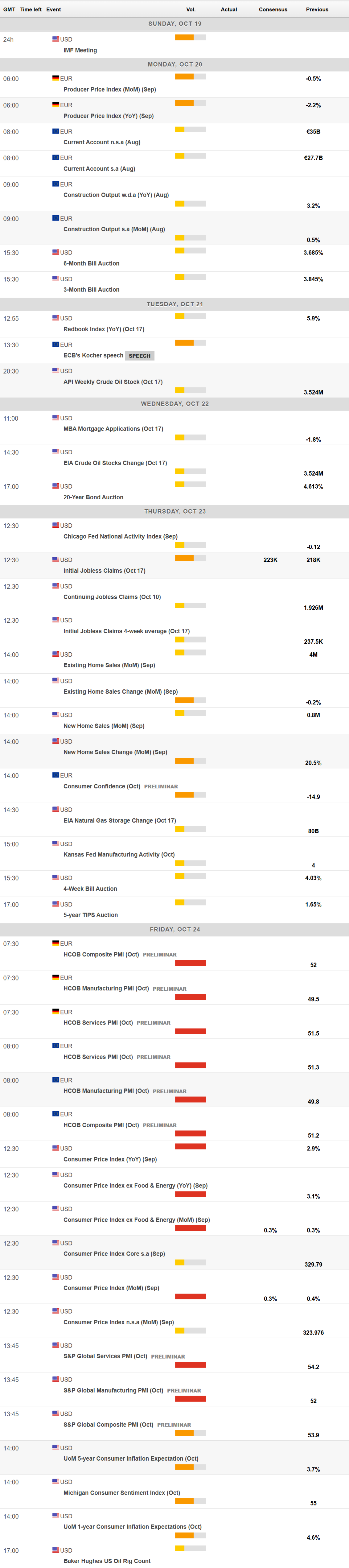
The weekly chart for the EUR/USD pair shows it is stuck around a bullish 20 Simple Moving Average (SMA), unable to recover beyond it after the previous week's bearish breakout. At the same time, a mildly bullish 100 SMA advances beyond a flat 200 SMA far below the current level, modestly skewing the risk to the upside, albeit too far away to be relevant. The same chart shows technical indicators are neutral, with the Momentum hovering around its 100 line and the Relative Strength Index (RSI) indicator ticking north at around 57.
The daily chart shows that EUR/USD currently develops within a tight range, limited on the upside by a bearish 20 SMA and to the downside by a directionless 100 SMA, the latter at around 1.1640. Technical indicators retreat from their midlines after failing to overcome them, skewing the risk to the downside without confirming another leg south.
Below the 1.1640 mark, EUR/USD could find support around 1.1520, ahead of the August monthly low at 1.1391. The aforementioned weekly high at 1.1728 comes as immediate resistance ahead of 1.1830, followed by 1.1918, the 2025 high.
Economic Indicator
Consumer Price Index ex Food & Energy (YoY)
Inflationary or deflationary tendencies are measured by periodically summing the prices of a basket of representative goods and services and presenting the data as the Consumer Price Index (CPI). CPI data is compiled on a monthly basis and released by the US Department of Labor Statistics. The YoY reading compares the prices of goods in the reference month to the same month a year earlier. The CPI Ex Food & Energy excludes the so-called more volatile food and energy components to give a more accurate measurement of price pressures. Generally speaking, a high reading is bullish for the US Dollar (USD), while a low reading is seen as bearish.
Read more.Next release: Fri Oct 24, 2025 12:30
Frequency: Monthly
Consensus: 3.1%
Previous: 3.1%
Source: US Bureau of Labor Statistics
The US Federal Reserve has a dual mandate of maintaining price stability and maximum employment. According to such mandate, inflation should be at around 2% YoY and has become the weakest pillar of the central bank’s directive ever since the world suffered a pandemic, which extends to these days. Price pressures keep rising amid supply-chain issues and bottlenecks, with the Consumer Price Index (CPI) hanging at multi-decade highs. The Fed has already taken measures to tame inflation and is expected to maintain an aggressive stance in the foreseeable future.
Author

Valeria Bednarik
FXStreet
Valeria Bednarik was born and lives in Buenos Aires, Argentina. Her passion for math and numbers pushed her into studying economics in her younger years.

















