EUR/USD Weekly Forecast: Euro poised for further advances near term
- EUR/USD regained the smile this week, approaching the 1.1700 barrier.
- The Greenback lost momentum on the back of trade and Fed jitters.
- US inflation data will be the next salient event on the calendar.

In the last few days…
The Euro (EUR) successfully recovered from its previous week's losses against the US Dollar (USD). Indeed, EUR/USD traded with an upside bias throughout the week, briefly flirting with the key resistance in the 1.1700 region just to ease some ground as the week drew to an end.
The pair’s decent gains came exclusively from the Greenback’s dynamics amid muted dockets on both sides of the Atlantic, while the resurgence of trade concerns via fresh tariffs kept investors watchful over their potential impact on the US economy.
A fleeting trade truce
Initial euphoria over the fresh US–EU accord — cutting most levies on European goods to 15% from the threatened 30% — has already faded. Aerospace, semiconductors and farm products escaped the tariff net, yet steel and aluminium still face 50% duty.
In exchange, Europe agreed to buy $750 billion worth of US energy, raise defence orders, and channel more than $600 billion into American investments.
Berlin and Paris were unimpressed: German Chancellor Friedrich Merz warned the deal pinches an already fragile industrial base, while French President Emmanuel Macron called it “a dark day” for the continent.
Adding to the sour environment, on August 7, President Trump’s “reciprocal” tariffs on imports from 69 partners took effect, lifting duties to between 10% and 41% within a week and threatening tougher measures against Russia if the war in Ukraine drags on.
In fact, by August 12, President Trump must also decide whether to extend the truce with Beijing; letting it lapse would see tariffs snap back to triple-digit rates and risk reigniting a full-blown trade war.
Central banks stay on hold
The Federal Reserve (Fed) left policy unchanged at the end of July with Chair Jerome Powell sounding cautious even as Governors Waller and Bowman dissented.
In relation to the Fed, President Trump has nominated Stephen Miran, who is currently the Chairman of the Council of Economic Advisors, to replace FOMC Governor Adriana Kugler. Miran will serve on the FOMC until January 31, 2026, while the search for a permanent replacement continues.
Meanwhile, FOMC Governor Christopher Waller seems to be among the preferred candidates for succeeding Chief Jerome Powell at the Fed.
Across the Atlantic, European Central Bank (ECB) President Christine Lagarde described growth as “solid, if a little better,” yet money markets now pencil in the first rate cut for spring 2026, all following the central bank’s steady hand at its latest gathering.
Positioning shifts
When it comes to positioning, the Commodity Futures Trading Commission's (CFTC) latest report through July 29 saw non-commercial net longs in the single currency drop to three-week lows around 123.3K contracts, while institutional net shorts (usually hedge funds) slipped to about 175.8K. Following this weekly pullback, net longs in the Euro remain at levels last seen in late 2023. Furthermore, open interest fell for the first time in six weeks, reaching nearly 828.6K.
Technical picture
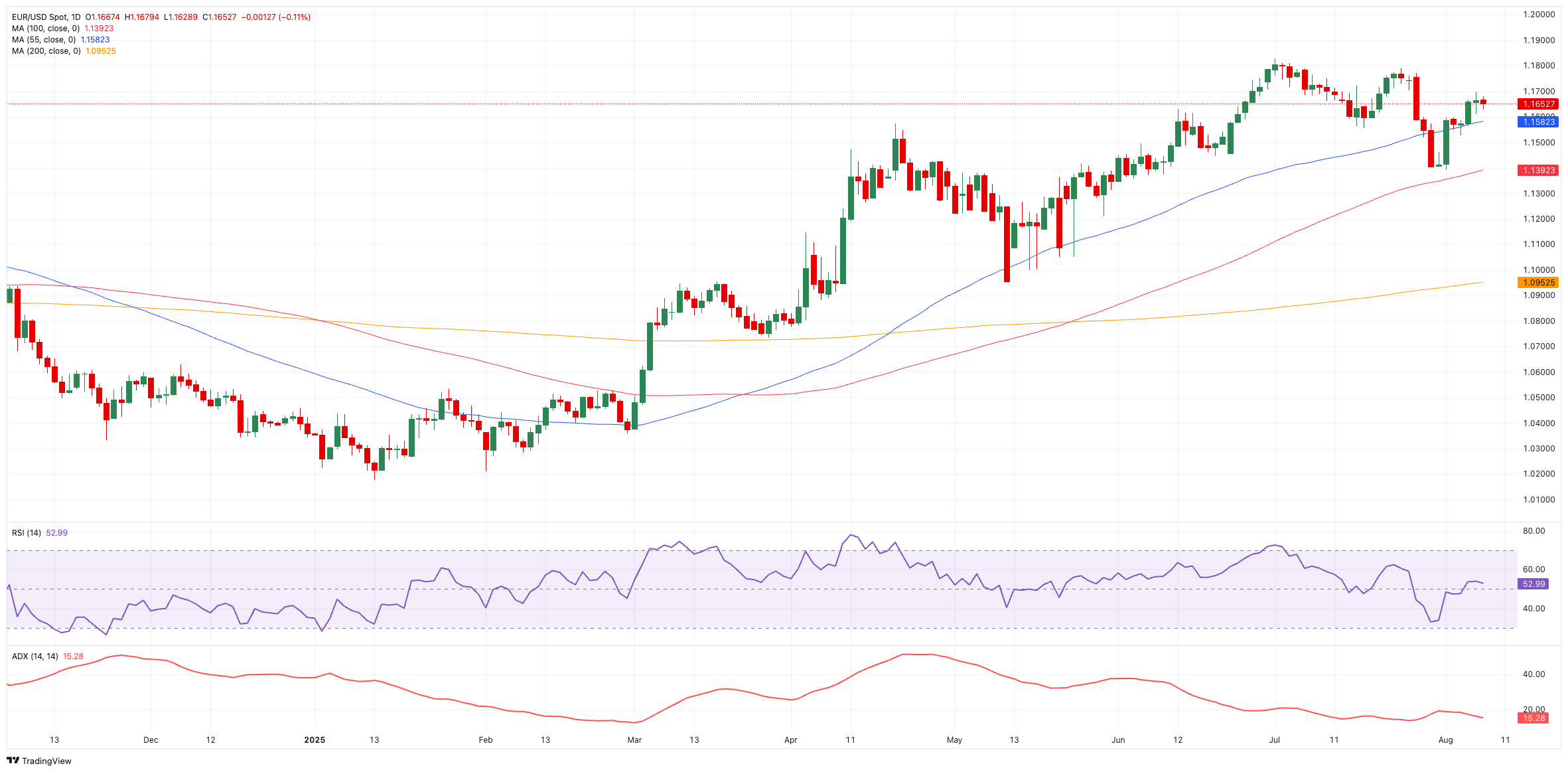
Resistance is found at the weekly top of 1.1788 (July 24), followed by the 2025 high of 1.1830 (July 1). Beyond that lies the September 2021 peak of 1.1909 (September 3) before the psychological 1.2000 line.
Support starts at the August trough of 1.1391 (August 1), which is propped up by the interim 100-day SMA, ahead of the weekly floor at 1.1210 (May 29).
Momentum gauges are mixed: the Relative Strength Index (RSI) remains near 54, hinting at further upside potential, while an Average Directional Index (ADX) near 18 still signals an inconclusive trend.
EUR/USD daily chart
Short-term outlook
The perception of a politicised and more dovish Fed may begin to exert pressure on the US Dollar, potentially leading to a further upward impulse in EUR/USD. Regarding trade, a genuine thaw in tensions could spark some range-bound trade, as this scenario is seen as generally benefiting both the European and US economies.
Euro FAQs
The Euro is the currency for the 19 European Union countries that belong to the Eurozone. It is the second most heavily traded currency in the world behind the US Dollar. In 2022, it accounted for 31% of all foreign exchange transactions, with an average daily turnover of over $2.2 trillion a day. EUR/USD is the most heavily traded currency pair in the world, accounting for an estimated 30% off all transactions, followed by EUR/JPY (4%), EUR/GBP (3%) and EUR/AUD (2%).
The European Central Bank (ECB) in Frankfurt, Germany, is the reserve bank for the Eurozone. The ECB sets interest rates and manages monetary policy. The ECB’s primary mandate is to maintain price stability, which means either controlling inflation or stimulating growth. Its primary tool is the raising or lowering of interest rates. Relatively high interest rates – or the expectation of higher rates – will usually benefit the Euro and vice versa. The ECB Governing Council makes monetary policy decisions at meetings held eight times a year. Decisions are made by heads of the Eurozone national banks and six permanent members, including the President of the ECB, Christine Lagarde.
Eurozone inflation data, measured by the Harmonized Index of Consumer Prices (HICP), is an important econometric for the Euro. If inflation rises more than expected, especially if above the ECB’s 2% target, it obliges the ECB to raise interest rates to bring it back under control. Relatively high interest rates compared to its counterparts will usually benefit the Euro, as it makes the region more attractive as a place for global investors to park their money.
Data releases gauge the health of the economy and can impact on the Euro. Indicators such as GDP, Manufacturing and Services PMIs, employment, and consumer sentiment surveys can all influence the direction of the single currency. A strong economy is good for the Euro. Not only does it attract more foreign investment but it may encourage the ECB to put up interest rates, which will directly strengthen the Euro. Otherwise, if economic data is weak, the Euro is likely to fall. Economic data for the four largest economies in the euro area (Germany, France, Italy and Spain) are especially significant, as they account for 75% of the Eurozone’s economy.
Another significant data release for the Euro is the Trade Balance. This indicator measures the difference between what a country earns from its exports and what it spends on imports over a given period. If a country produces highly sought after exports then its currency will gain in value purely from the extra demand created from foreign buyers seeking to purchase these goods. Therefore, a positive net Trade Balance strengthens a currency and vice versa for a negative balance.
Premium
You have reached your limit of 3 free articles for this month.
Start your subscription and get access to all our original articles.
Author

Pablo Piovano
FXStreet
Born and bred in Argentina, Pablo has been carrying on with his passion for FX markets and trading since his first college years.