EUR/USD Weekly Forecast: US Dollar under pressure amid bets for sooner rate cuts
- Building hopes for Federal Reserve rate cuts sent the USD to fresh three-week lows.
- Eurozone macroeconomic data keeps delivering positive surprises.
- EUR/USD could extend its rally and turn bullish once it clears the 1.0850 price zone.

The EUR/USD pair finally gathered directional strength following a two-week consolidative stage and reconquered the 1.0800 mark, currently trading ahead of the close at around 1.0820 and after hitting 1.0841, its highest in three weeks. Multiple factors put the US Dollar under selling pressure, while Euro buyers were cautiously optimistic.
What happened to the US Dollar?
The USD kick-started the week by gapping lower as market participants continued digesting United States (US) inflation data. On June 28, the US Bureau of Economic Analysis (BEA) reported that the Personal Consumption Expenditures (PCE) Price Index rose 2.6% YoY in May while holding steady on a monthly basis. The Greenback’s slide accelerated on Wednesday when Federal Reserve (Fed) Chairman Jerome Powell participated in the European Central Bank’s (ECB) Forum on Central Banking in Sintra. Powell surprised with a more dovish than usual stance, as he said that the disinflationary trend is giving signs of resuming, despite also repeating policymakers need to be more confident in data before trimming interest rates. Furthermore, he noted the US economy has made “quite a bit of progress” towards the 2% inflation goal. Speculative interest understood Chair Powell could be paving the way for a September rate cut.
Additionally, the US released multiple employment-related figures. The ADP report showed that the private sector added 150K new jobs in June, missing the 160K expected. Additionally, Initial Jobless Claims for the week ending June 28 increased by 238K, higher than the 235K anticipated by market players.
However, US employers announced 48,786 cuts in June, down 23.6% from the 63,816 cuts announced in the previous month. This indicates the second-highest hiring level of the year. The May JOLTS Job Openings report showed the number of open positions grew to 8.14 million, signaling continued resilience in the sector.
Finally, the US published the June Nonfarm Payrolls (NFP) report on Friday. According to the report, the economy added 206K new jobs in the month, higher than the expected 190K, while the unemployment rate rose to 4.1%. Furthermore, wage inflation, as measured by the change in the Average Hourly Earnings, declined to 3.9% on a yearly basis from 4.1%, as expected. The USD ticked higher with the news but quickly changed course, retaining the weak tone after the dust settled.
Beyond employment figures, the USD took a hit from negative macroeconomic surprises. The ISM Services PMI contracted to 48.8 in June, much worse than the previous 53.8, while the ISM Manufacturing PMI printed at 48.5 in the same month, also worsening from the previous reading.
In the Eurozone, macroeconomic data was mixed. On the one hand, the Hamburg Commercial Bank (HCOB) upwardly resided the June Manufacturing and Services PMIs, with the final EU Composite PMI reaching 50.9. Retail Sales in the EU rose a measly 0.1% in May.
On the other hand, Germany published the preliminary estimate of the Harmonized Index of Consumer Prices (HICP), which rose 2.5% YoY in June, easing from the previous 2.8% and below the 2.6% anticipated by financial markets. The EU HICP was estimated at 2.5% in the same period, although the core annual reading came at 2.9%, matching May's reading.
Finally, German growth-related figures disappointed, as Factory Orders fell by 1.6% MoM in May, while Industrial Production in the same period was down by 2.5%.
Here comes the US Consumer Price Index
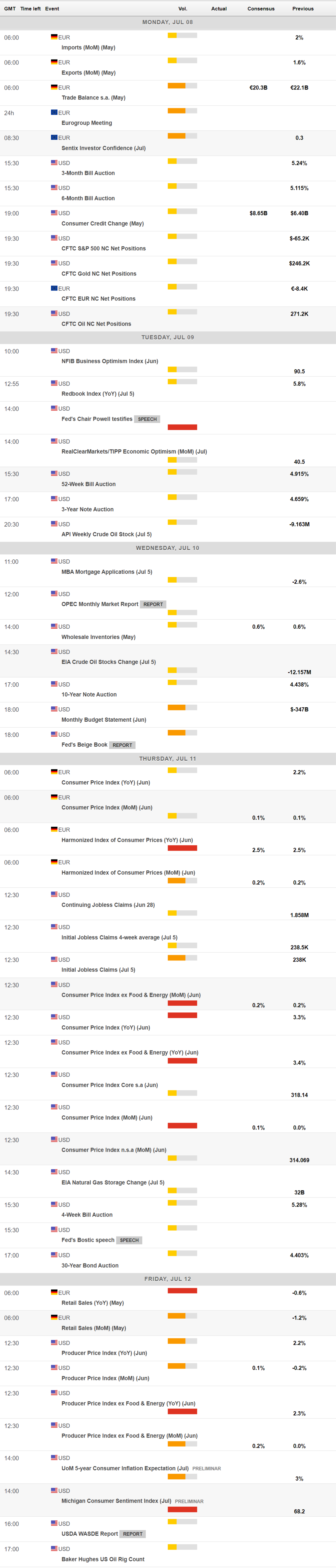
Next Tuesday, Fed Chairman Jerome Powell is due to testify before the Senate Banking Committee in Washington, DC, as part of the Semi-Annual Monetary Policy Report and his comments on monetary policy may affect financial markets. On Thursday, the US will release the June Consumer Price Index (CPI), while on Friday, the focus will be on the Producer Price Index (PPI) and the preliminary estimate of the July Michigan Consumer Sentiment Index.
EUR/USD technical outlook
According to technical readings in the weekly chart, the case for a firmer recovery is still in doubt. The EUR/USD pair is battling around a flat 20 Simple Moving Average (SMA), while a flat 100 SMA provides dynamic support at around 1.0660. Technical indicators, in the meantime, picked up upward strength but hold within neutral levels.
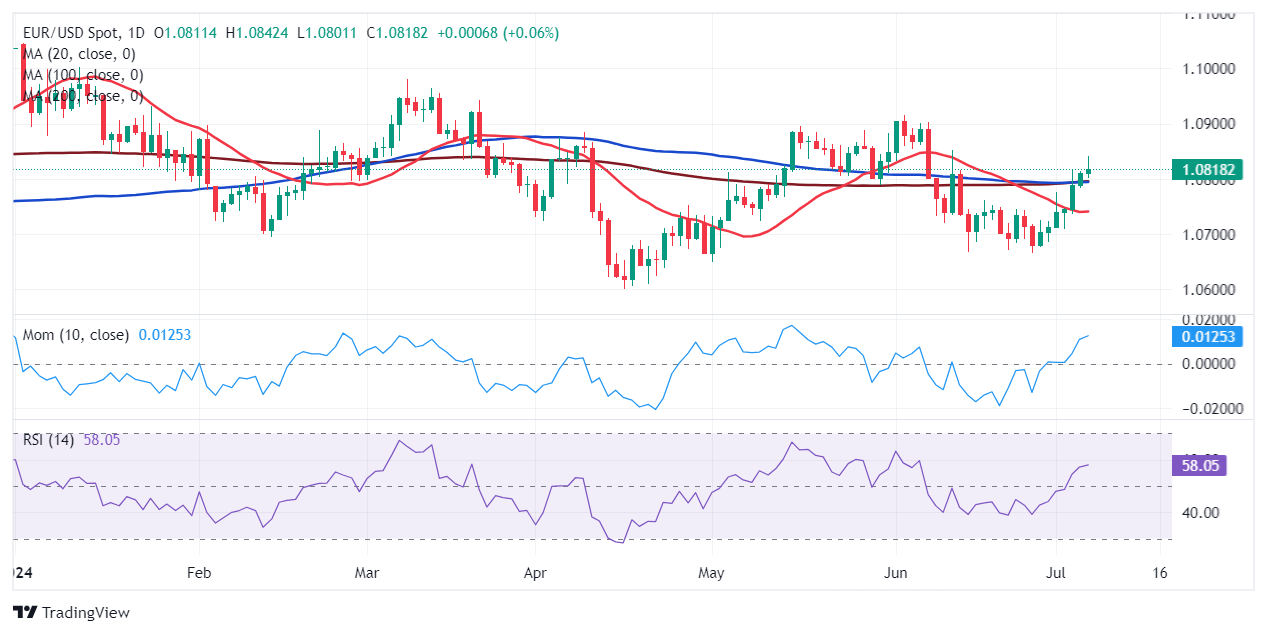
The daily chart for the EUR/USD pair supports a bullish continuation, as the pair is comfortably trading above all its moving averages. The 100 and 200 Simple Moving Averages (SMAs) converge directionless at around 1.0790, while the 20 SMA is also flat, although in the 1.0740 price zone. Technical indicators, in the meantime, remain within positive levels, although they have lost their bullish strength.
The 1.0850 area provides resistance, but a break above it should expose the 1.0910 price zone. Beyond the latter, EUR/USD can extend its advance towards the 1.0960 level. The immediate support comes at 1.0790, with a break below it favoring an approach to the 1.0700 region.
Economic Indicator
Consumer Price Index (YoY)
Inflationary or deflationary tendencies are measured by periodically summing the prices of a basket of representative goods and services and presenting the data as The Consumer Price Index (CPI). CPI data is compiled on a monthly basis and released by the US Department of Labor Statistics. The YoY reading compares the prices of goods in the reference month to the same month a year earlier.The CPI is a key indicator to measure inflation and changes in purchasing trends. Generally speaking, a high reading is seen as bullish for the US Dollar (USD), while a low reading is seen as bearish.
Read more.Next release: Thu Jul 11, 2024 12:30
Frequency: Monthly
Consensus: 3.1%
Previous: 3.3%
Source: US Bureau of Labor Statistics
The US Federal Reserve has a dual mandate of maintaining price stability and maximum employment. According to such mandate, inflation should be at around 2% YoY and has become the weakest pillar of the central bank’s directive ever since the world suffered a pandemic, which extends to these days. Price pressures keep rising amid supply-chain issues and bottlenecks, with the Consumer Price Index (CPI) hanging at multi-decade highs. The Fed has already taken measures to tame inflation and is expected to maintain an aggressive stance in the foreseeable future.
Author

Valeria Bednarik
FXStreet
Valeria Bednarik was born and lives in Buenos Aires, Argentina. Her passion for math and numbers pushed her into studying economics in her younger years.