|

EUR/USD wavers after NFP bounce

  • EUR/USD stalls NFP rally near 1.1600.
  • Technical signals are mixed.
  • Break above 1.1760 could revive bullish appetite.

Chart

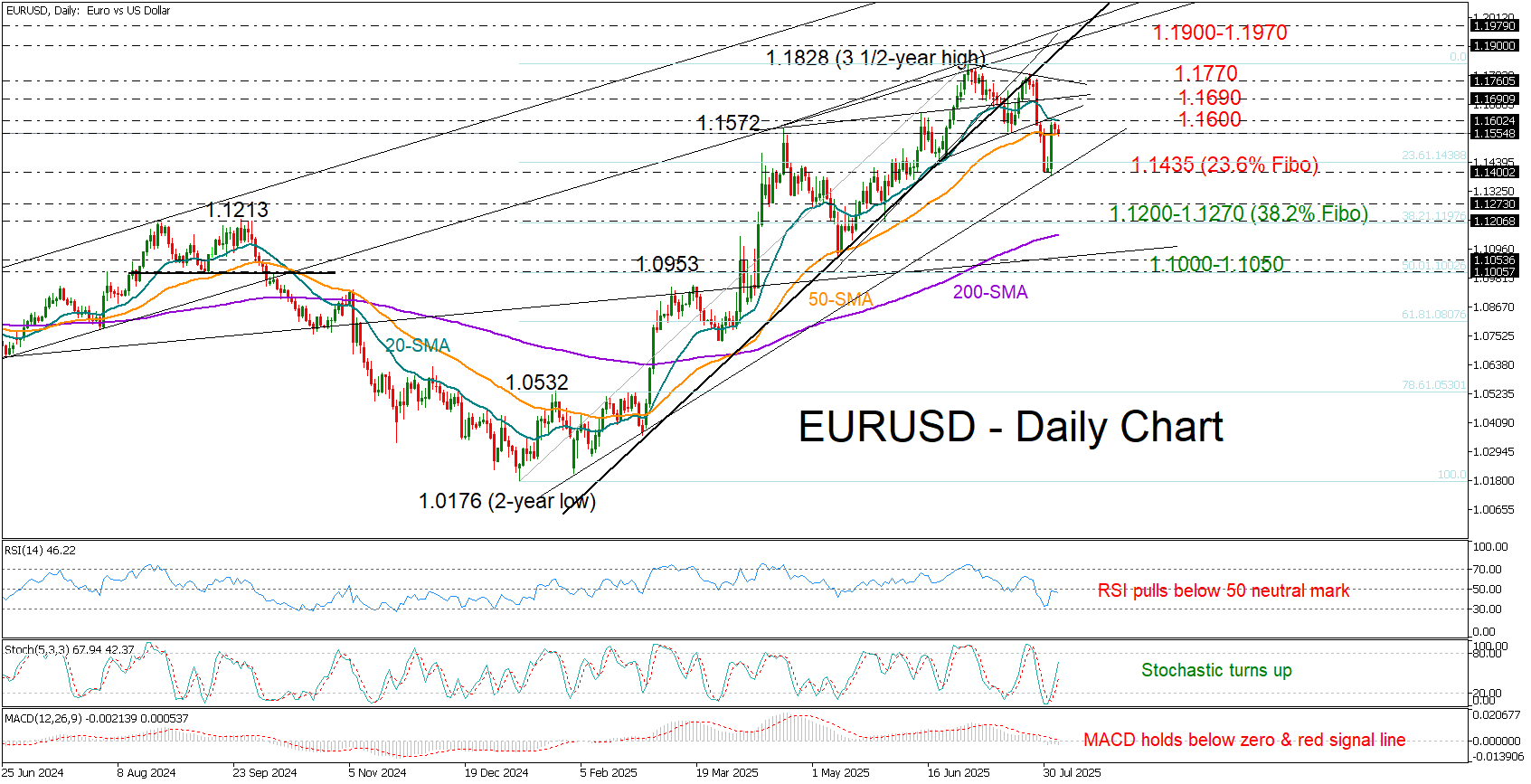
EUR/USD failed to attract sufficient buying interest to extend Friday’s post-NFP rally above its 20-day simple moving average (SMA) and the psychological 1.1600 level on Monday.

Price momentum remains weak for a second consecutive day, raising concerns that the recent rebound from the eight-week low of 1.1390 may be just a temporary correction within the developing downtrend that began in July.

However, technical signals are currently mixed. A bullish hammer candlestick pattern formed last week, and an upward-sloping stochastic oscillator are counterbalancing the bearish signals from the falling RSI and MACD.

The 50-day SMA, currently at 1.1554, is now in focus. A move below this level could undermine bullish hopes and push the price back toward the 1.1400 support zone. A deeper decline could lead the bears into the 1.1200–1.1270 region – a key area that includes the 38.2% Fibonacci retracement of the 2025 uptrend – and possibly bring the 200-day SMA near 1.1150 into play.

On the upside, if the pair manages to climb above its 20-day SMA, immediate resistance could be found between 1.1690 and 1.1760. A decisive close above this area could revive bullish sentiment, potentially opening the door for a new higher high around the 1.1900–1.1980 trendline zone.

Summing up, EUR/USD is currently in a neutral phase. Despite Friday’s sharp rebound, the bulls will need to reclaim the 20-day SMA at 1.1600 to regain control. Failure to do so, especially a drop below 1.1550, could invite renewed selling pressure.

Author

Christina Parthenidou

Christina joined the XM investment research department in May 2017. She holds a master degree in Economics and Business from the Erasmus University Rotterdam with a specialization in International economics.


More from Christina Parthenidou
Share:

Editor's Picks

EUR/USD weakens to near 1.1900 as traders eye US data

EUR/USD eases to near 1.1900 in Tuesday's European trading hours, snapping the two-day winning streak. Markets turn cautious, lifting the haven demand for the US Dollar ahead of the release of key US economic data, including Retail Sales and ADP Employment Change 4-week average.

GBP/USD stays in the red below 1.3700 on renewed USD demand

GBP/USD trades on a weaker note below 1.3700 in the European session on Tuesday. The pair faces challenges due to renewed US Dollar demand, UK political risks and rising expectations of a March Bank of England rate cut. The immediate focus is now on the US Retail Sales data. 

Gold sticks to modest losses above $5,000 ahead of US data

Gold sticks to modest intraday losses through the first half of the European session, though it holds comfortably above the $5,000 psychological mark and the daily swing low. The outcome of Japan's snap election on Sunday removes political uncertainty, which along with signs of easing tensions in the Middle East, remains supportive of the upbeat market mood. This turns out to be a key factor exerting downward pressure on the safe-haven precious metal.

Bitcoin Cash trades lower, risks dead-cat bounce amid bearish signals

Bitcoin Cash trades in the red below $522 at the time of writing on Tuesday, after multiple rejections at key resistance. BCH’s derivatives and on-chain indicators point to growing bearish sentiment and raise the risk of a dead-cat bounce toward lower support levels.

Follow the money, what USD/JPY in Tokyo is really telling you

Over the past two Tokyo sessions, this has not been a rate story. Not even close. Interest rate differentials have been spectators, not drivers. What has moved USD/JPY in local hours has been flow and flow alone.

Bitcoin Cash trades lower, risks dead-cat bounce amid bearish signals

Bitcoin Cash (BCH) trades in the red below $522 at the time of writing on Tuesday, after multiple rejections at key resistance. BCH’s derivatives and on-chain indicators point to growing bearish sentiment and raise the risk of a dead-cat bounce toward lower support levels.