EUR/USD soars to 1.1700 as Strait of Hormuz is set to open
- EUR/USD rockets to a five-week high on a US-Iran temporary ceasefire.
- Bulls surge beyond long-term SMAs but must hold above 1.1670 to retain momentum.

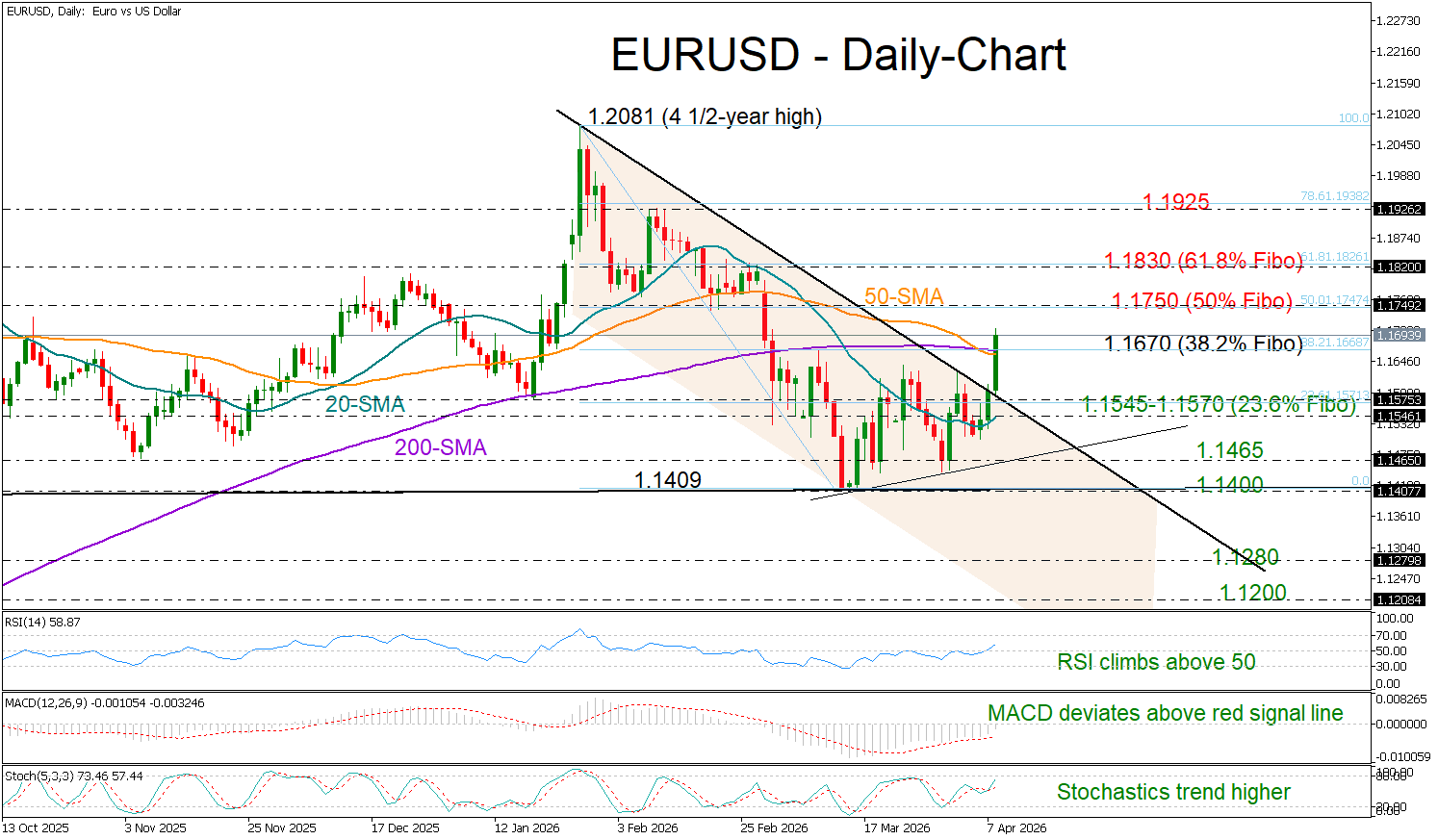
EUR/USD surged to a five-week high of 1.1700 early Wednesday, buoyed by news that the US and Iran have agreed on a two-week ceasefire that would reopen the Strait of Hormuz after President Trump threatened to kill a "whole civilization." The bullish push came as expectations of aggressive rate hikes eased - though they haven’t disappeared - causing European bond yields to drift lower.
While permanent peace remains uncertain, the temporary de-escalation has given the euro a chance to recover. The pair bounced back above its 50- and 200-day simple moving averages (SMAs) near 1.1670, signaling renewed bullish energy. Now, the challenge for the bulls is to maintain their footing above this level. A move past 1.1750, which coincides with the 50% Fibonacci retracement of the latest downleg, could open the door to test the 1.1830 zone. Beyond that, resistance may appear around 1.1925.
The technical indicators support the optimistic view. The RSI is rising above its neutral 50 mark for the first time in two months, and the MACD is showing signs of improvement above its red signal line, hinting that upside momentum could persist.
Yet, the encouraging picture is not entirely secure. A failure to hold above 1.1670 could activate some selling, with support likely emerging around the broken resistance trendline at 1.1570 and the 20-day SMA at 1.1545. If pressure mounts further, the 1.1400–1.1465 zone could become a critical battleground. A breach there could accelerate losses toward 1.1280.
In short, EUR/USD’s rebound above 1.1600 has strengthened short-term technical conditions, but the bulls must now defend 1.1670 to preserve the momentum needed for further gains.
Author

Christina joined Trading Point in May 2017. She holds a master degree in Economics and Business from the Erasmus University Rotterdam with a specialization in International economics.