EUR/USD Price Forecast: USD collapses on reciprocal tariffs, slump likely to continue

EUR/USD Current price: 1.1094
- Massive US President Donald Trump's reciprocal tariffs sent the US Dollar into a selling spiral.
- Global stocks collapsed amid fears that US levies will take their toll on worldwide growth.
- EUR/USD is extremely overbought but sentiment-related momentum likely to prevail.
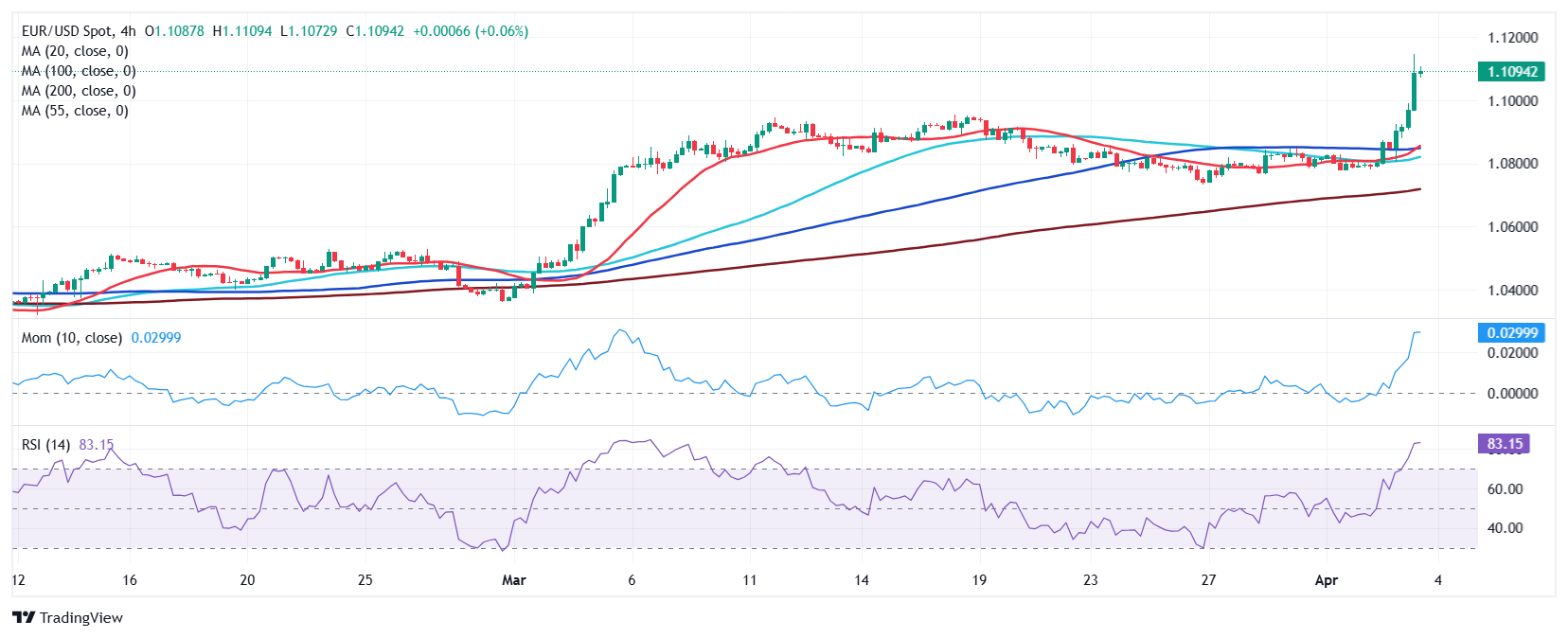
The EUR/USD pair soared to 1.1145, over 300 pips above its weekly opening on Thursday, retreating afterwards but still holding on to massive intraday gains.
Hell broke loose after the United States (US) President Donald Trump launched his reciprocal tariffs late on Wednesday, spurring global panic. Trump announced a baseline of 10% tariffs on all US imports, with heavier duties on China, the Eurozone, Japan, Vietnam and Taiwan.
Wall Street plummeted in after-hours trading, leading to sharp losses in Asian and European indexes. Fears also weigh on the US Dollar (USD), as speculative interest believes widespread levies will take their toll on the American economy. Government bonds surged while yields collapsed, as Trump’s announcement is the largest tax increase in over five decades.
Maroš Šefčovič, European Union (EU) Commissioner for Trade and Economic Security, noted that unjustified tariffs will inevitably backfire. The EU response will not take long, nor will the Chinese one. But those won’t be the only ones, and financial markets gear up for additional turmoil and worsening economic conditions.
Meanwhile, the US released the March Challenger Job Cuts report, which showed that the number of layoffs soared to record levels, only surpassed by those reported in the first months of the Covid-related shutdowns. US-based employers announced 275,240 job cuts in the month, a 60% increase from the 172,017 cuts announced in February. It is worth noting that furloughs in the federal government totaled 216,215 for the month as part of the new Department of Government Efficiency's effort to pare down the federal workforce.
Additionally, the US released Initial Jobless Claims, which rose 219K in the last full week of March, better than the 225K anticipated and easing from the previous 225K. Later in the session, S&P Global will publish the final estimates of the March Services Purchasing Managers’ Index (PMI) and the Composite index for the same month. The US will also release the ISM Services PMI for the same month.
EUR/USD short-term technical outlook
The EUR/USD pair’s strong upward momentum is set to persist, according to technical readings in the daily chart. The pair soared above all its moving averages, with a bullish 20 Simple Moving Average (SMA) heading north above the 100 and 200 SMAs and currently in the 1.0850 region. Technical indicators, in the meantime, turned higher and advance almost vertically within positive levels, with the Relative Strength Index (RSI) already entering overbought territory. The extent of the daily advance, however, may result in near-term corrective slides.
In the near term, and according to the 4-hour chart, the EUR/USD pair is extremely overbought, with the RSI indicator currently at 86, yet without signs of turning lower. The Momentum indicator is also sharply up with a vertical slope, reflecting panic USD selling. Finally, the pair has soared past all its moving averages, with a bullish 20 SMA about to cross a flat 100 SMA, both converging around 1.0850.
Support levels: 1.1040 1.1000 1.0960
Resistance levels: 1.1145 1.1190 1.1235
Author

Valeria Bednarik
FXStreet
Valeria Bednarik was born and lives in Buenos Aires, Argentina. Her passion for math and numbers pushed her into studying economics in her younger years.