EUR/USD Price Forecast: There is a minor resistance around 1.0850
- EUR/USD added to Monday’s pullback below the 1.0800 support.
- The US Dollar failed to sustain initial gains despite heightened tariff jitters.
- Advanced prints saw inflation receding in the euro zone in March.

The Euro (EUR) maintained the 1.0800 threshold under pressure once again vs. the US Dollar (USD) on turnaround Tuesday, motivating EUR/USD to recede modestly following Monday’s inconclusive price action.
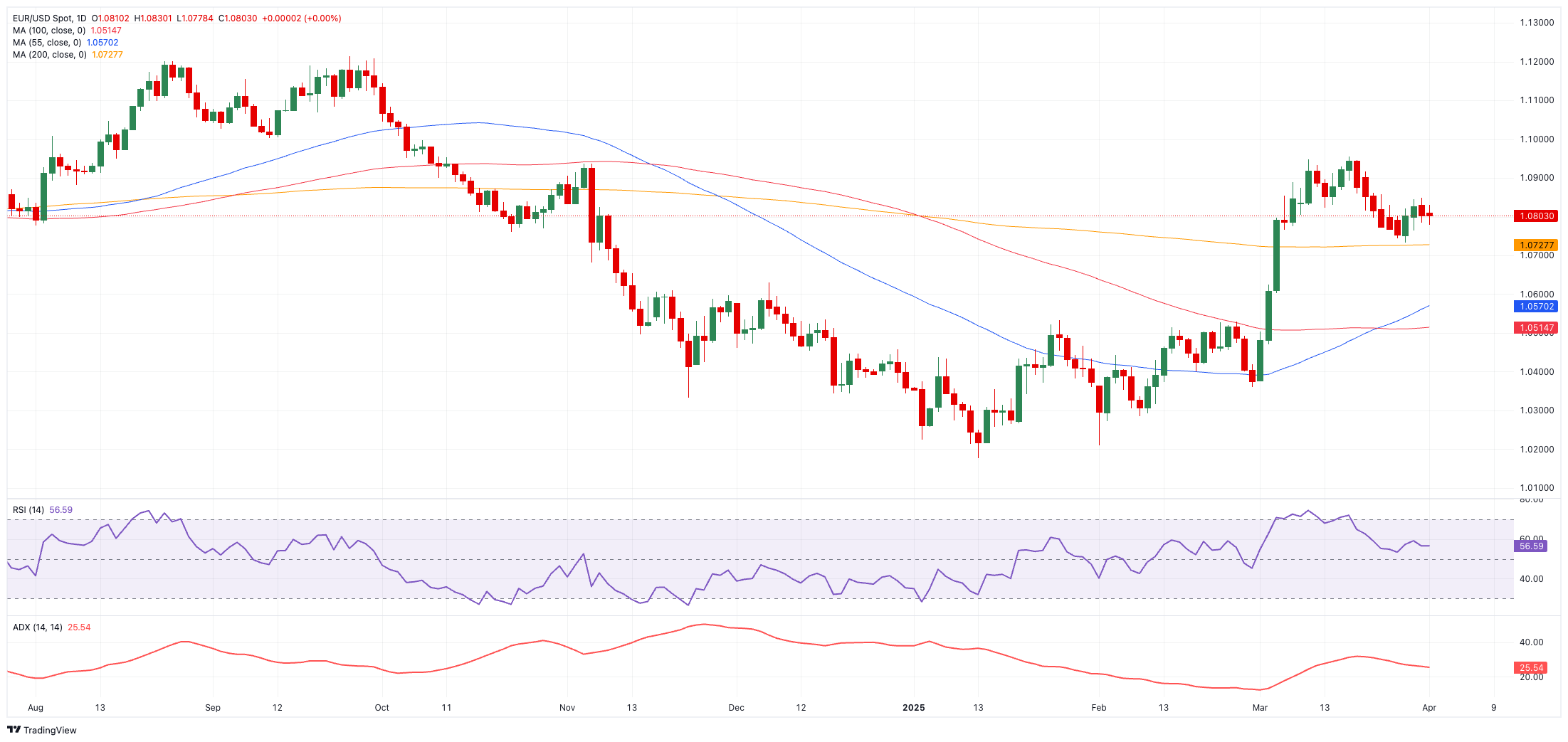
So far, spot also stayed comfortably above last week’s test of its critical 200-day Simple Moving Average (SMA) in the 1.0730 region, signalling that buyers may remain active despite recent turbulence.
On the flip side, the US Dollar Index (DXY) hovered around the 104.00 mark as traders grappled with the dual threat of fresh tariff measures and signs of a softening US economy, all prior to Wednesday’s “Liberation Day”.
Renewed tariff threats target the EU
President Trump’s suggestion of an additional 20% tariff on European goods—which could be announced as soon as on Wednesday—rekindled transatlantic trade fears. Auto and pharmaceutical sectors are said to be in the crosshairs, prompting concerns that retaliatory moves from the European Union (EU) could stifle global growth and weigh further on the Euro.
Ceasefire in Eastern Europe offers a breather
On another front, and in a bit of positive geopolitical news, Ukrainian President Volodymyr Zelenskiy announced in past days a ceasefire covering strategic energy sites and Black Sea routes, brokered in part by the United States.
Meanwhile, President Trump hinted at a potential US-Ukraine deal on mineral revenue-sharing, which could open the door for US investment in Ukraine’s energy infrastructure.
Central banks: Navigating inflation and uncertainty
- Federal Reserve (Fed): The Fed held rates steady at its last meeting but acknowledged that ongoing trade disputes could stoke inflation, potentially warranting a more hawkish stance. At the same time, cooling growth indicators call for caution. Fed Chair Jerome Powell underscored the bank’s “data-dependent” approach, with up to 50 bps of easing still on the table later this year if economic conditions worsen.
- European Central Bank (ECB): The ECB cut its key rate by 25 bps and hinted at further easing if uncertainties persist. Updated forecasts point to weaker growth and sticky near-term inflation, although policymakers expect price pressures to moderate by 2026. ECB President Christine Lagarde warned that a US-EU tariff war could shave 0.5% off Eurozone GDP, even as she praised Germany’s fiscal stimulus efforts.
Money markets now see about an 80% chance of a rate cut this month. Despite the optimism, ECB officials remain cautious—Fabio Panetta advised careful rate adjustments, while Finland’s Olli Rehn backed an April move if inflation stays in line with forecasts.
Euro bulls edge back in
Speculative traders appear to be tiptoeing back into the Euro. Net long positions have risen for three consecutive weeks, exceeding 65K contracts—the highest level since late September 2024. Hedge funds, however, extended their short bets, pushing total contracts above 100K, per the latest CFTC data.
EUR/USD technical overview
Resistance levels stand at 1.0954 (the March 18 YTD high) and 1.0969 (the 23.6% Fibonacci retracement). A sustained break above the latter could put the 1.1000 psychological barrier back on the radar, marking an important bullish shift.
On the downside, support emerges at 1.0730 (200-day SMA), followed by 1.0570 (55-day SMA), 1.0520 (100-day SMA), and the weekly low at 1.0359 (February 28). If these levels fail, attention may turn to another weekly low at 1.0282 (February 10), prior to the 2025 bottom of 1.0176 (January 13).
Regarding momentum indicators, the RSI eases a tad to the 56 region, pointing to some loss of bullish momentum, while the ADX near 26 indicates a moderate trend strength.
What to watch
EUR/USD remains highly sensitive to trade-policy updates, monetary policy signals, and geopolitical events. Investors will closely monitor any new tariff measures from the US, the evolving situation in Eastern Europe, and further guidance from the Fed and ECB for cues on the pair’s next potential move.
Author

Pablo Piovano
FXStreet
Born and bred in Argentina, Pablo has been carrying on with his passion for FX markets and trading since his first college years.