EUR/USD Price Forecast: There is a minor resistance around 1.0530
- EUR/USD failed to extend the uptick beyond 1.0500.
- The US Dollar traded in a vacillating mood near recent lows.
- Investors continued to adjust to the results of the German elections.


EUR/USD failed to extend another surpass of the key barrier at 1.0500 the figure on a sustainable fashion on Monday. Indeed, the pair rapidly advanced beyond 1.0500 during early trade as investors assessed the conservatives’ win in the German elections on Sunday, although that initial move fizzled out afterwards as speculation over coalition talks kicked in.
Regarding the US Dollar (USD), the lack of a clear direction prevailed in quite an apathetic kickstart of the week, with the US Dollar Index (DXY) navigating slightly on the defensive near recent lows, always in the sub-107.00 region.
Tariffs still in focus
Although there have been no major new announcements on US trade policy, tariffs remain a central concern for markets. The White House’s decision to postpone a 25% tariff on Canadian and Mexican imports—while maintaining a 10% levy on Chinese goods—has left investors unsure about the next move.
Worries escalated when President Trump imposed a 25% tariff on steel and aluminium imports, fuelling fears of more retaliatory measures. While these steps initially weighed on the dollar, any inflationary effects could push the Federal Reserve (Fed) to keep interest rates higher for longer, which could ultimately strengthen the greenback.
Central banks at the helm
The Fed recently held interest rates steady at 4.25%–4.50%, weighing solid US economic growth, stubborn inflation, and a strong labour market. During his congressional testimony, Fed Chair Jerome Powell reiterated that it’s too early to think about cutting rates, emphasizing that inflation and jobs data remain the guiding forces for policy decisions.
Minutes from the latest Federal Open Market Committee (FOMC) meeting revealed that officials remain wary of the inflationary impact of tariffs, especially if companies pass on those costs to consumers. Policymakers also highlighted that ongoing trade disputes, geopolitical events, and robust consumer spending could keep inflation elevated, reinforcing the argument for leaving rates unchanged until prices start moving clearly toward the Fed’s 2% target.
Meanwhile, the European Central Bank (ECB) opted for a 25-basis-point rate cut to bolster the eurozone’s sluggish economy. ECB President Christine Lagarde dismissed calls for a bigger 50-point reduction, preferring a gradual, data-focused approach. Despite trade uncertainties, she remains hopeful that inflation will hit the ECB’s target by 2025, signalling a measured pace for any future rate changes.
Winners and losers
If tariffs ultimately drive up US inflation, the Fed may initially extend its hawkish stance, potentially lifting the dollar. In case of negative effects of tariffs on the economic activity, likely to emerge in the longer run, the central bank would be inclined to resume/intensify its easing cycle.
The imposition of US tariffs targeting EU goods could have an important impact on the single currency, prompting EUR/USD to accelerate it downward bias and potentially hit the psychological parity level.
Key levels in play
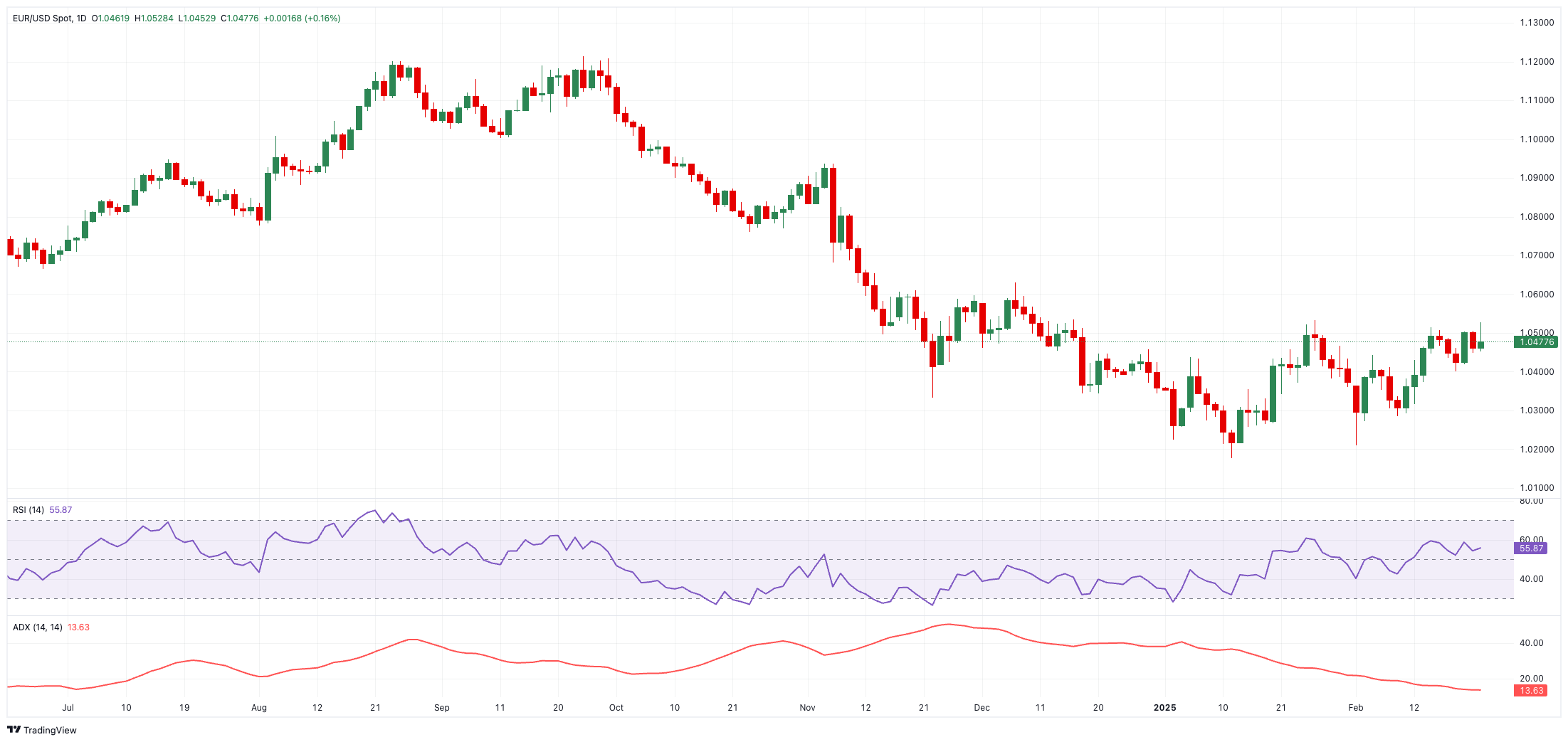
A continued move higher could prompt EUR/USD to retest 1.0527 (the February 24 high), followed by 1.0532 (the 2025 top from January 27), then the 100-day Simple Moving Average (SMA) at 1.0547, and eventually December’s top at 1.0629.
On the downside, the first line of support appears at 1.0282 (February 10 weekly low), followed by 1.0209 (February 3 monthly low). A drop below that would point toward 1.0176, the 2025 bottom from January 13.
Technical indicators remain mixed, with the RSI near 56 suggesting bullish momentum, while an ADX reading under 14 indicates a lack of strong directional conviction.
What’s next?
EUR/USD will likely remain in a tug-of-war between trade developments, diverging central bank policies, weaker eurozone growth, and political uncertainties—especially in Germany. Until there’s more clarity on tariff policy and a clearer sense of where both the Fed and ECB are headed, the outlook for the euro remains murky.
Premium
You have reached your limit of 3 free articles for this month.
Start your subscription and get access to all our original articles.
Author
Pablo Piovano
FXStreet
Born and bred in Argentina, Pablo has been carrying on with his passion for FX markets and trading since his first college years.