EUR/USD Price Forecast: Struggling for direction amid tepid US data, Middle East crisis

EUR/USD Current price: 1.1560
- The German ZEW survey showed an unexpected improvement in economic sentiment.
- US Retail Sales fell by 0.9% in May, worse than anticipated and weighing on the USD.
- EUR/USD trades range-bound around 1.1550, risk skews to the upside.
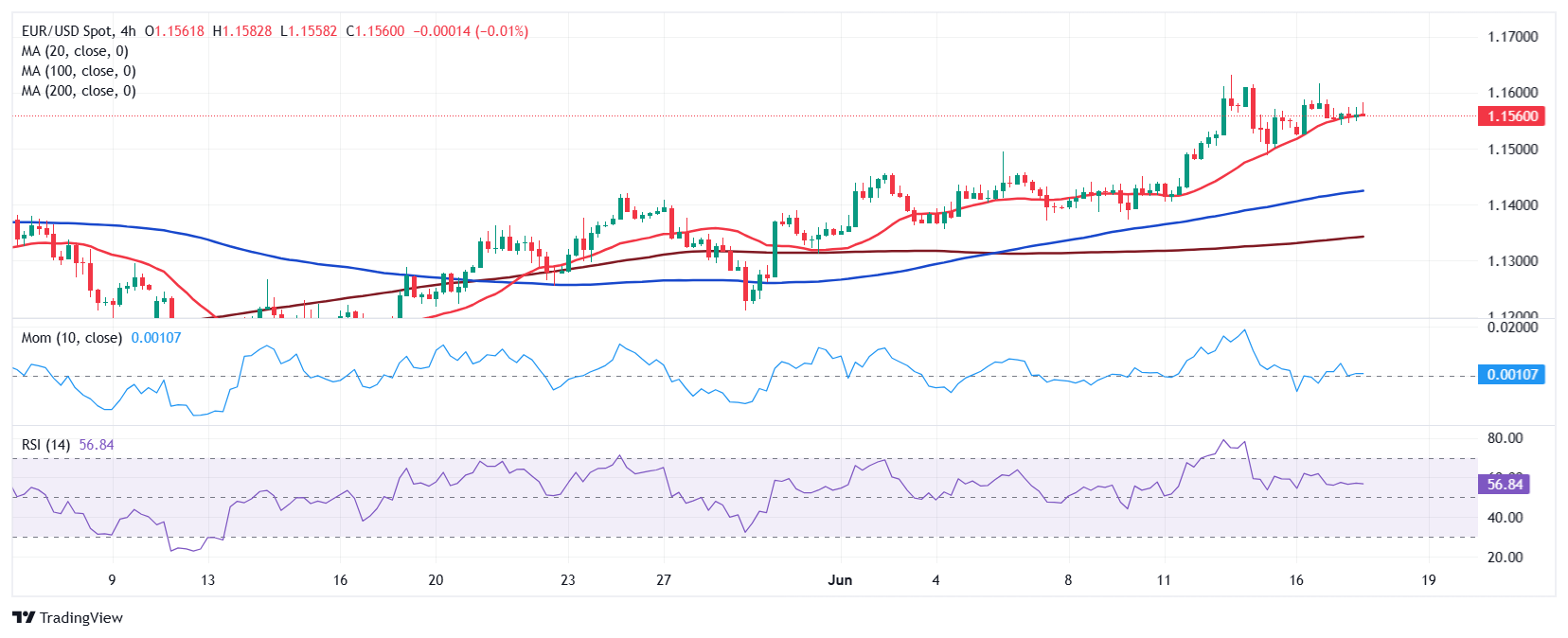
The EUR/USD pair trades in a tight range on Tuesday, although pressuring an intraday high at 1.1571, as the US Dollar (USD) retains its broad weakness. Market participants maintain their eyes on the Middle East, amid the escalating conflict between Israel and Iran. Missiles keep flying back and forth throughout the Asian session and despite headlines indicating Iran seeks to de-escalate hostilities and negotiate on Monday.
Meanwhile, Germany released the June ZEW, which showed Economic Sentiment improved to 47.5 from the previous 25.2, also better than the 35 expected. Economic Sentiment in the EU rose to 35.3 from the 11.6 posted in May. Finally, the assessment of the current situation index printed at -72, beating the expected -74 and improving from the previous -82.
Across the pond, the United States (US) released May Retail Sales, which fell by 0.9% in the month, much worse than the previous -0.1% slide or the -0,7% expected.
EUR/USD short-term technical outlook
The EUR/USD pair peaked at 1.1581 following the release of US data, but quickly returned to the current 1.1560 area. The daily chart shows the pair is barely up, although still well-above all its moving averages. The 20 Simple Moving Average (SMA) retains its upward slope far above the 100 and 200 SMAs, in line with the dominant bullish trend. Finally, technical indicators head modestly higher, well above their midlines, lacking momentum yet still favouring an upward extension.
In the near term, and according to the 4-hour chart, EUR/USD is neutral-to-bullish. The pair is currently seesawing around a flat 20 SMA, while above bullish 100 and 200 SMAs. Technical indicators, in the meantime, aim marginally higher just above their midlines, skewing the risk to the upside without confirming another leg north.
Support levels: 1.1530 1.1490 1.1440
Resistance levels: 1.1600 1.1640 1.1685
Premium
You have reached your limit of 3 free articles for this month.
Start your subscription and get access to all our original articles.
Author

Valeria Bednarik
FXStreet
Valeria Bednarik was born and lives in Buenos Aires, Argentina. Her passion for math and numbers pushed her into studying economics in her younger years.