EUR/USD Price Forecast: Rangebound until Fed or trade news hits
- EUR/USD recouped part of Tuesday’s sharp pullback on Wednesday.
- The US Dollar traded on the back foot in response to poor labour market data.
- The US JOLTS Job Openings disappointed expectations in July at 7.181 million.

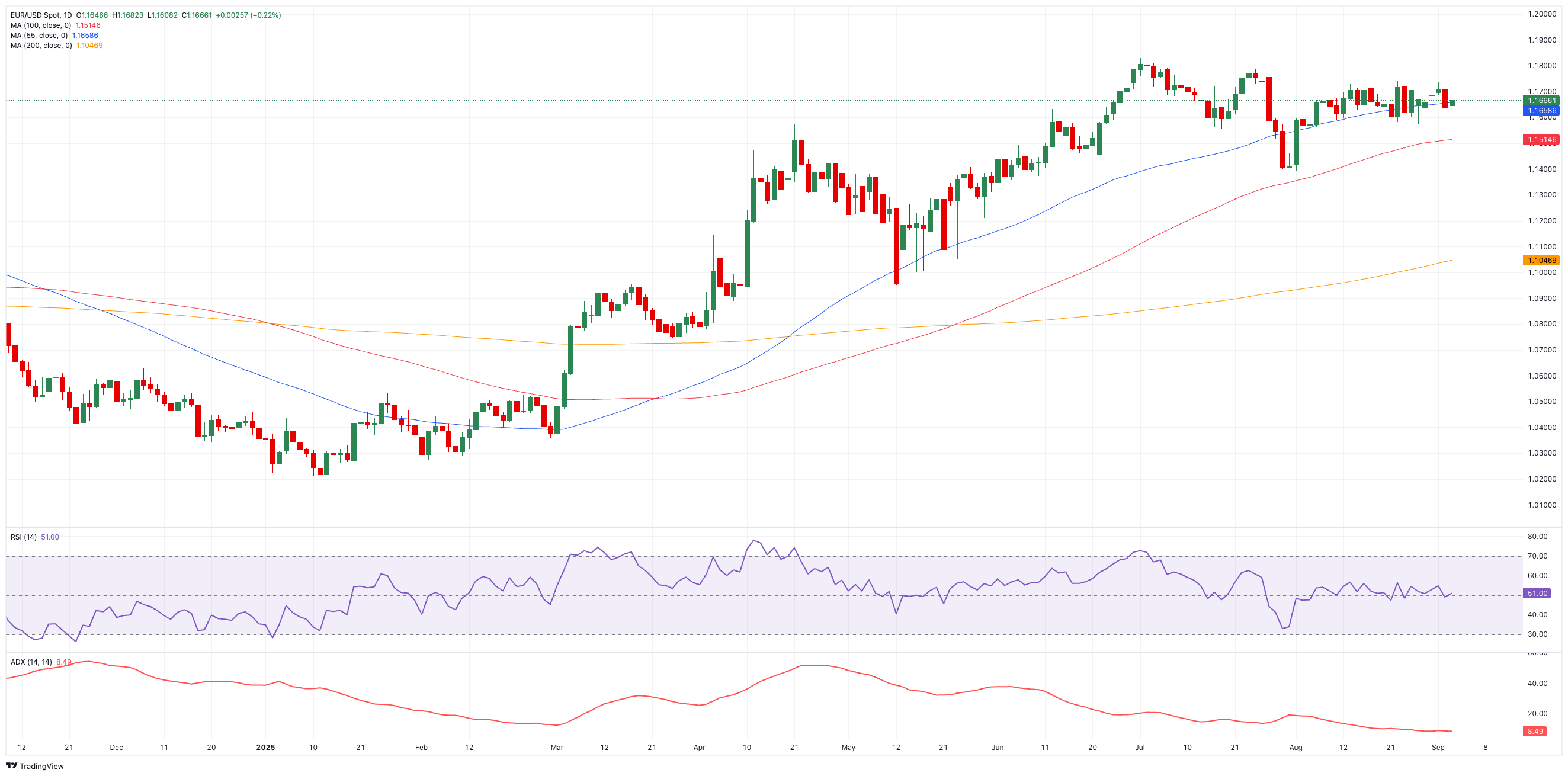
The Euro (EUR) found its footing on Wednesday, regaining traction against the US Dollar (USD) as EUR/USD pushed back toward the 1.1680 area, climbing above its 55-day Simple Moving Average (SMA).
The move coincided with the Greenback's overall decline, as the US Dollar Index (DXY) retreated to the 98.00 support zone, accompanied by declining US Treasury yields. Pressure built after US data showed job openings fell more than expected in July, reinforcing bets that the Federal Reserve could cut rates as soon as September.
Trade truce cools nerves, but tariffs linger
Global trade tensions eased after Washington and Beijing extended their truce for 90 days. President Trump delayed planned tariff hikes until November 10, while China pledged reciprocal steps. Still, US imports of Chinese goods remain subject to 30% levies, and Chinese duties of 10% on US exports are also intact.
Meanwhile, Washington struck a deal with Brussels, imposing a 15% tariff on most European imports in exchange for the European Union (EU) dropping duties on US industrial goods and opening up its market for American farm and seafood products. A cut to tariffs on European cars could follow, depending on new EU legislation.
France braces for confidence vote
Political risks are rising in Europe. French Prime Minister François Bayrou faces a September 8 confidence vote on his budget plan. With opposition parties, from the National Rally to the Greens and Socialists, refusing to back him, his minority government looks vulnerable. A defeat could leave President Emmanuel Macron weighing whether to replace Bayrou, keep him on as caretaker, or call snap elections.
Fed keeps traders guessing
The Fed left rates unchanged at its last meeting. Chair Jerome Powell warned of labour market risks but said inflation has not yet returned to its target, keeping a September cut firmly on the table.
Markets are now focused on Friday’s August Nonfarm Payrolls (NFP) report and fresh inflation numbers next week, both considered key drivers for the Fed’s next move.
ECB signals patience
The European Central Bank (ECB) struck a calmer tone. President Christine Lagarde described eurozone growth as “solid, if a little better,” suggesting no urgency to ease policy. Markets currently expect the ECB to remain on hold through 2025, with the first cut not priced in until spring 2026.
Speculators add to Euro longs
According to the Commodity Futures Trading Commission (CFTC), non-commercial net longs in the Euro rose to a four-week high just above 123K contracts in the week to August 26. At the same time, institutional net shorts also increased, hitting 173.2K contracts, while open interest rose for a third straight week to around 842.2K contracts.
Tech view: EUR/USD boxed in a range
EUR/USD has momentum but remains stuck in a 1.1400–1.1800 range. Resistance is first at the August high of 1.1742 (August 22). A break higher would target 1.1788 (July 24) and the 2025 ceiling at 1.1830 (July 1), with the September 2021 high at 1.1909 and the psychological 1.2000 mark further out.
On the downside, interim support comes at the 100-day SMA of 1.1520, ahead of the August low at 1.1391 (August 1) and the weekly trough at 1.1210 (May 29).
Momentum signals remain mixed. The Relative Strength Index (RSI) has risen past 51, hinting at room for more strength, while the Average Directional Index (ADX), near 9, points to a still weak underlying trend.
EUR/USD daily chart
Outlook: Dollar sets the tone
For now, EUR/USD looks likely to continue consolidating within its range. A breakout will need a clear catalyst, whether from the Fed, fresh US data, or a shift in global trade dynamics. Until then, the pair’s path remains at the mercy of the US Dollar.
Employment FAQs
Labor market conditions are a key element to assess the health of an economy and thus a key driver for currency valuation. High employment, or low unemployment, has positive implications for consumer spending and thus economic growth, boosting the value of the local currency. Moreover, a very tight labor market – a situation in which there is a shortage of workers to fill open positions – can also have implications on inflation levels and thus monetary policy as low labor supply and high demand leads to higher wages.
The pace at which salaries are growing in an economy is key for policymakers. High wage growth means that households have more money to spend, usually leading to price increases in consumer goods. In contrast to more volatile sources of inflation such as energy prices, wage growth is seen as a key component of underlying and persisting inflation as salary increases are unlikely to be undone. Central banks around the world pay close attention to wage growth data when deciding on monetary policy.
The weight that each central bank assigns to labor market conditions depends on its objectives. Some central banks explicitly have mandates related to the labor market beyond controlling inflation levels. The US Federal Reserve (Fed), for example, has the dual mandate of promoting maximum employment and stable prices. Meanwhile, the European Central Bank’s (ECB) sole mandate is to keep inflation under control. Still, and despite whatever mandates they have, labor market conditions are an important factor for policymakers given its significance as a gauge of the health of the economy and their direct relationship to inflation.
Premium
You have reached your limit of 3 free articles for this month.
Start your subscription and get access to all our original articles.
Author

Pablo Piovano
FXStreet
Born and bred in Argentina, Pablo has been carrying on with his passion for FX markets and trading since his first college years.