EUR/USD Price Forecast: Rangebound, but Fed and trade could shift momentum
- EUR/USD rose further, flirting with monthly peaks near 1.1740 on Monday.
- The US Dollar fell to new five-week lows ahead of a week packed with data.
- Final HCOB Manufacturing PMIs in Germany and the EMU came in firmer.

The Euro (EUR) extended its recovery on Monday, with EUR/USD pushing above 1.1700 to hit six-day highs.
The move came as the US Dollar (USD) lost more ground, with the US Dollar Index (DXY) slipping under 98.00 and clocking multi-week troughs. That said, traders leaned into steady Fed rate-cut bets, while President Trump’s clashes with the Federal Reserve (Fed) and a court ruling that many tariffs are illegal added extra pressure on the Greenback.
Trade tensions ease, but tariffs linger
Global trade nerves calmed as Washington and Beijing agreed to extend their truce for 90 days. Trump delayed tariff hikes until November 10, with Beijing pledging reciprocal steps. Meanwhile, US imports of Chinese goods will face 30% levies, and US exports entering China will pay 10% tariffs.
The US and EU also came to an agreement: Washington levied a 15% tariff on most European imports, while Brussels eliminated duties on US industrial goods and expanded access for American farm and seafood exports. A cut in US tariffs on European cars could follow, depending on new EU legislation.
France faces political test
In Europe, attention is shifting to France, where Prime Minister François Bayrou faces a September 8 confidence vote on his budget plan. With opposition parties, from National Rally to the Greens and Socialists, refusing support, his minority government looks vulnerable. A defeat could force President Emmanuel Macron to name a new prime minister, keep Bayrou on as caretaker, or even call snap elections.
Fed stays data-driven
The Fed kept rates steady at its last meeting, with Chair Jerome Powell striking a cautious balance. He flagged labour market risks but noted inflation hasn’t yet returned to target, keeping the door open for a cut as soon as September.
Traders are now watching the August Nonfarm Payrolls (NFP) later this week and fresh inflation data the following one for clues on the Fed’s next step.
ECB holds its nerve
The European Central Bank (ECB) has been calmer. President Christine Lagarde described eurozone growth as “solid, if a little better”, signalling no rush to ease. Markets expect the ECB to stay on hold through 2025, with the first cut only pencilled in for spring 2026.
Speculators build long positions
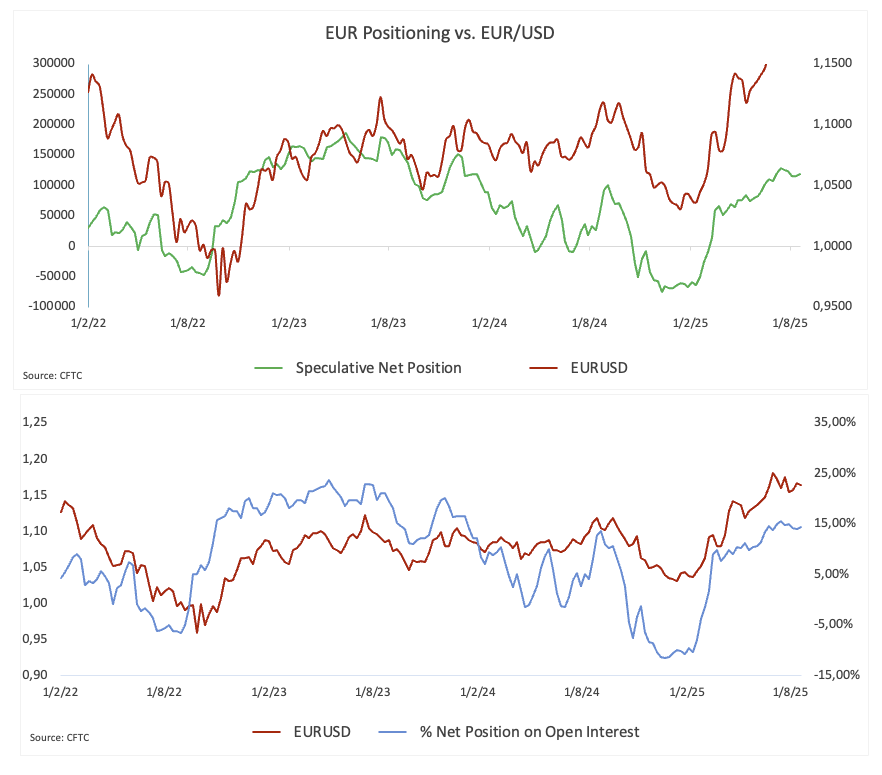
Commodity Futures Trading Commission (CFTC) data for the week ending August 26 showed non-commercial net longs in the Euro rising to four-week highs just above 123K contracts. At the same time, institutional net shorts grew to around 173.2K contracts, also a multi-week peak. In addition, open interest climbed for a third straight week to about 842.2K contracts.
Tech picture: EUR/USD stuck in range
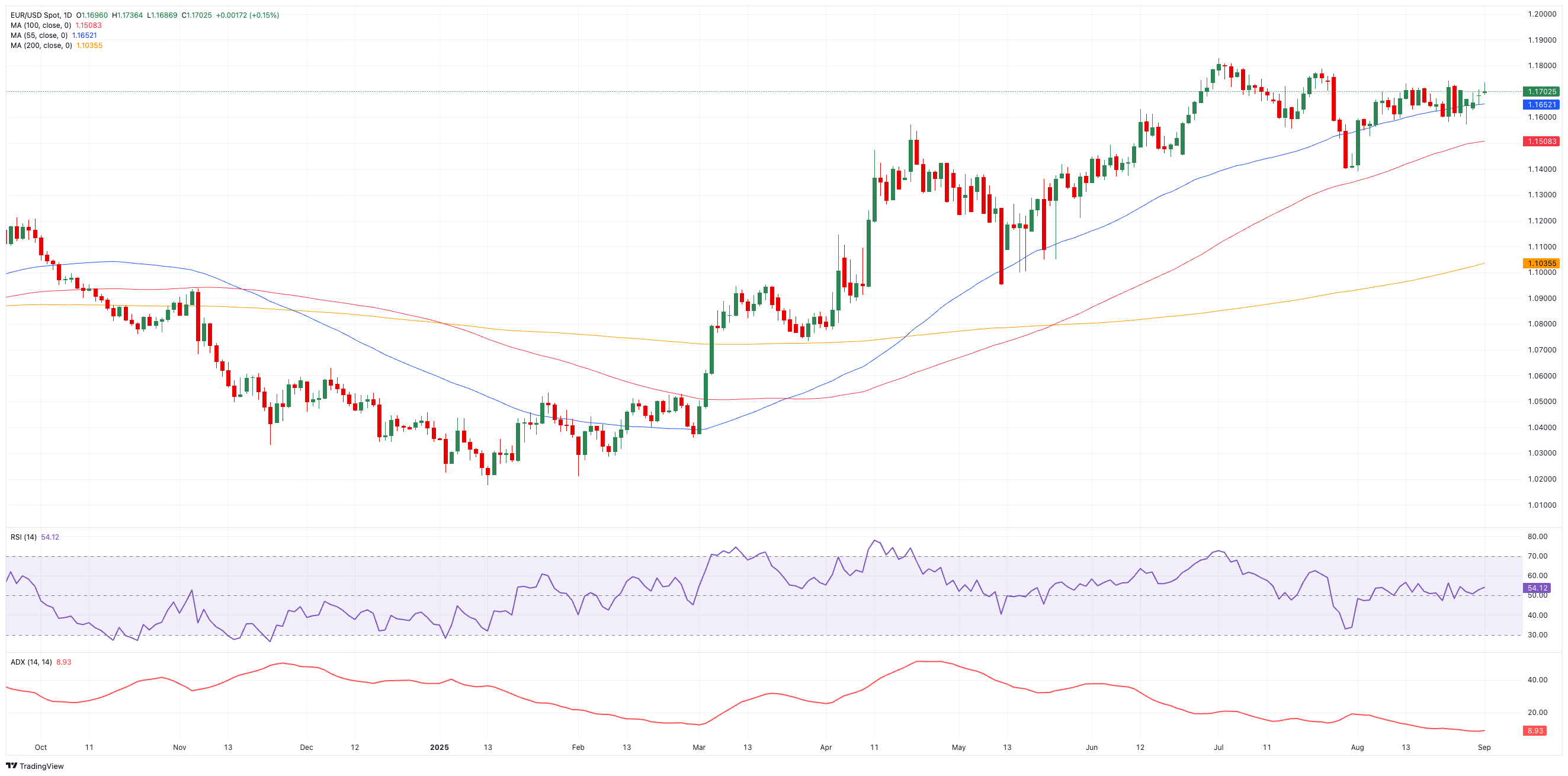
EUR/USD has momentum but remains boxed in.
On the topside, resistance sits at the August high of 1.1742 (August 22). A break would open the way to 1.1788 (July 24) and the 2025 ceiling at 1.1830 (July 1). A stronger push could even target the September 2021 top at 1.1909, just below the psychological 1.2000 level.
On the downside, there is an interim contention at the 100-day Simple Moving Average (SMA) at 1.1514, ahead of the August low at 1.1391 (August 1) and the weekly base at 1.1210 (May 29).
Momentum signals are mixed: the Relative Strength Index (RSI) just above 55 suggests a mild upside bias, while the Average Directional Index (ADX) near 11 shows the trend still lacks strength.
EUR/USD daily chart
Outlook: Dollar still in charge
For now, EUR/USD looks likely to stay in its 1.1400–1.1800 range. A break outside will need a catalyst, whether from new Fed signals or another twist in trade. Until then, the US Dollar should continue to set the tone.
US-China Trade War FAQs
Generally speaking, a trade war is an economic conflict between two or more countries due to extreme protectionism on one end. It implies the creation of trade barriers, such as tariffs, which result in counter-barriers, escalating import costs, and hence the cost of living.
An economic conflict between the United States (US) and China began early in 2018, when President Donald Trump set trade barriers on China, claiming unfair commercial practices and intellectual property theft from the Asian giant. China took retaliatory action, imposing tariffs on multiple US goods, such as automobiles and soybeans. Tensions escalated until the two countries signed the US-China Phase One trade deal in January 2020. The agreement required structural reforms and other changes to China’s economic and trade regime and pretended to restore stability and trust between the two nations. However, the Coronavirus pandemic took the focus out of the conflict. Yet, it is worth mentioning that President Joe Biden, who took office after Trump, kept tariffs in place and even added some additional levies.
The return of Donald Trump to the White House as the 47th US President has sparked a fresh wave of tensions between the two countries. During the 2024 election campaign, Trump pledged to impose 60% tariffs on China once he returned to office, which he did on January 20, 2025. With Trump back, the US-China trade war is meant to resume where it was left, with tit-for-tat policies affecting the global economic landscape amid disruptions in global supply chains, resulting in a reduction in spending, particularly investment, and directly feeding into the Consumer Price Index inflation.
Author

Pablo Piovano
FXStreet
Born and bred in Argentina, Pablo has been carrying on with his passion for FX markets and trading since his first college years.














