EUR/USD Price Forecast: Outlook should shift to bullish above the 200-day SMA
- EUR/USD extended its strong weekly rebound well past the 1.0800 level.
- The US Dollar revisited multi-month lows amid tariff jitters, mixed yields.
- The ECB lowered its policy rate by 25 basis points, as predicted.


On Thursday, EUR/USD continued its upward momentum, climbing beyond 1.0800 the figure to set new multi-month highs and moving decisively above the key 200-day Simple Moving Average (SMA) at 1.0725.
Helping the euro’s rally was an improved growth outlook for Europe, triggered by Germany's announcement of a massive €500 billion infrastructure fund. This strategic initiative, confirmed late Tuesday by Germany's prospective government coalition, includes significant infrastructure investments and reforms in borrowing rules. Investors viewed these plans as a positive buffer against global trade uncertainties, significantly enhancing market confidence.
The pair also benefited from a sharp pullback in the US Dollar (USD), driven by continued investor worries over the health of the US economy and President Trump’s back-and-forth regarding trade policies. The Dollar Index (DXY) extended its rout below the 104.00 mark for the first time since early November.
Trade tensions and geopolitics influence markets
Earlier this week, heightened trade tensions emerged after President Trump imposed 25% tariffs on Canadian and Mexican goods and a 20% tariff on imports from China. Retaliatory tariffs from Beijing and Canada added fuel to the uncertainty.
However, latest news on Thursday signalled that Trump announced that Mexico would temporarily avoid tariffs on goods covered by the United States-Mexico-Canada Agreement (USMCA) until April 2. However, he did not confirm a similar exemption for Canada, despite earlier comments from his Commerce Secretary suggesting a comparable arrangement was likely.
The ongoing tariff escalations can impact currency markets in two main ways:
- Inflation Pressure: Rising tariffs could lead to higher inflation, potentially prompting the Federal Reserve (Fed) to maintain restrictive monetary policy, generally supportive of the USD.
- Growth Concerns: Tariffs could also slow economic growth, pushing the Fed toward a more cautious stance, which could weigh on the USD.
In Europe, potential US tariffs on EU exports could negatively impact the euro, adding pressure to EUR/USD. However, optimism emerged amid reports of potential progress toward a peace deal between Russia and Ukraine, offering markets some relief following last week's tense White House meeting between Presidents Trump and Zelenskyy.
Central bank policies under spotlight
The Fed maintained interest rates at 4.25%–4.50% during its latest meeting, with Chair Jerome Powell emphasizing strong US economic fundamentals, stable inflation, and a tight labour market, signalling no immediate intention to cut rates. Concerns persist about trade-driven inflation complicating future policy decisions.
The European Central Bank (ECB) lowered its key interest rates by 25 basis points, as widely expected, while indicating that further easing could be on the horizon. This decision comes amid increasing uncertainty surrounding Europe's economic outlook, fueled by escalating trade tensions with the US and plans for significant military spending—factors contributing to one of the region's most pivotal economic policy shifts in recent decades.
Additionally, the ECB revised its economic growth projections downward, highlighting persistent challenges ahead. Despite raising its inflation forecasts for this year, the central bank anticipates inflation will stabilize and return to its targeted level by 2026.
EUR/USD technical outlook
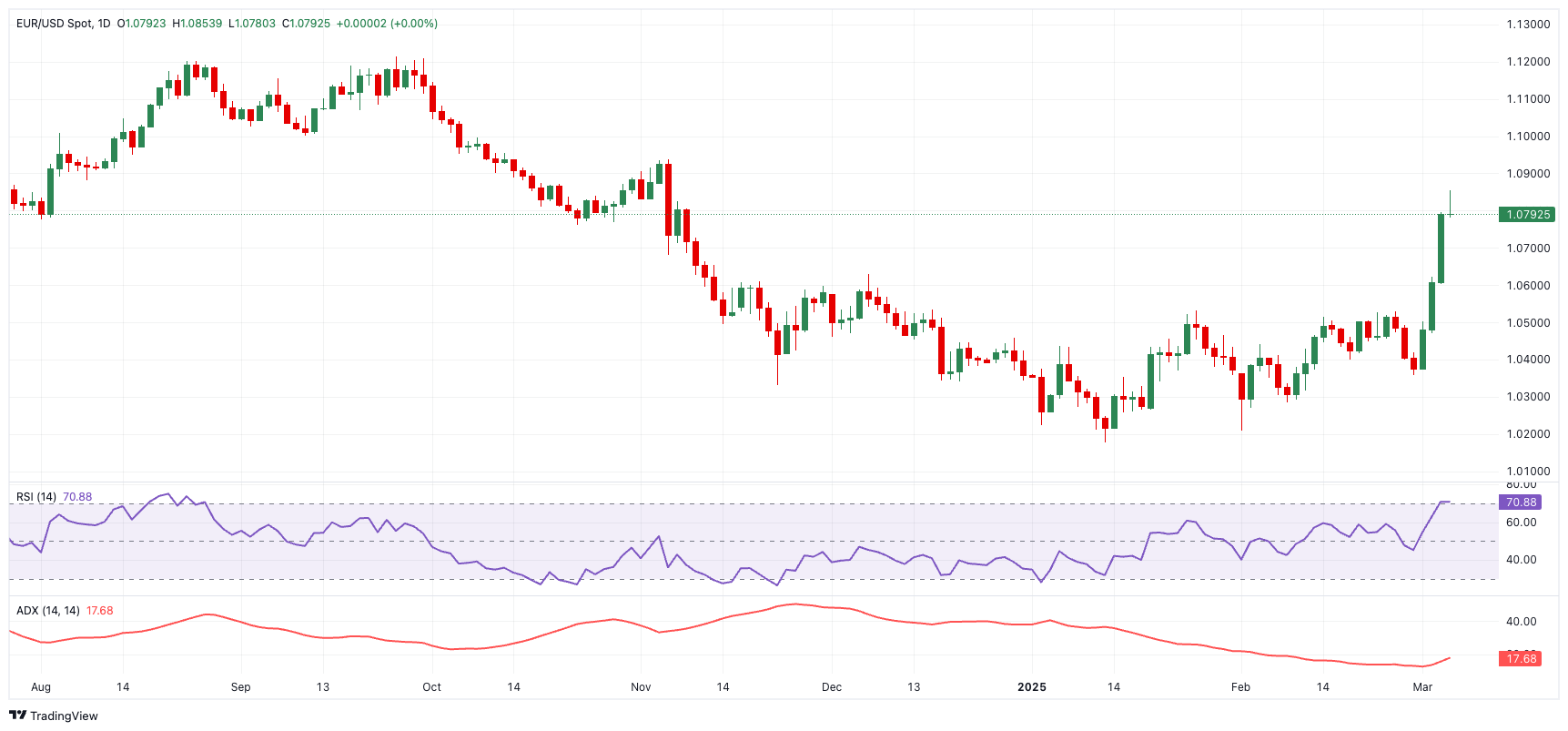
Currently, EUR/USD clings to daily gains around 1.0800, coming under some pressure following earlier 2025 tops in the 1.0850-1.0855 band.
Immediate resistance sits at 1.0853 (2025 high from March 6). Clearing this level could pave the way toward 1.0936 (November 2024 high), ahead of 1.0969 (23.6% Fibo of the September-January sell-off).
On the downside, interim support is at the 100-day and 55-day SMAs at 1.0516 and 1.0407, respectively, followed by the February 28 low at 1.0359. Further below, key support levels include 1.0282 (February 10 low) and 1.0209 (February 3 low), with a deeper retreat potentially targeting the 2025 bottom at 1.0176 (January 13).
Momentum indicators support bullish sentiment, with the Relative Strength Index (RSI) entering overbought territory slightly above 71. Additionally, the Average Directional Index (ADX) rebounded further and approached 18, pointing to some strengthening of the trend.
EUR/USD daily chart
Short-term considerations
The near-term outlook for EUR/USD remains closely tied to ongoing developments in trade policies, contrasting approaches by central banks, economic growth in the eurozone, and evolving political and economic scenarios in Germany.
Premium
You have reached your limit of 3 free articles for this month.
Start your subscription and get access to all our original articles.
Author
Pablo Piovano
FXStreet
Born and bred in Argentina, Pablo has been carrying on with his passion for FX markets and trading since his first college years.