EUR/USD Price Forecast: Next on tap comes 1.1400
- EUR/USD extends its march south, breaking below the 1.1500 support.
- The US Dollar maintains its bull run well in place and trades at three-month highs.
- The US ISM Services PMI will be the salient event on Wednesday.

EUR/USD extends its slide in early-week trading, breaking below the key 1.1500 level and touching new three-month lows after five straight daily declines.
The move comes as the US Dollar (USD) continues to power ahead. The US Dollar Index (DXY) has climbed above the psychological 100.00 mark and is flirting with fresh six-month highs, even as US Treasury yields have lost some of their recent upward momentum.
Political gridlock starts to sting
The ongoing government shutdown in Washington is beginning to bite. Almost a month in, lawmakers are still deadlocked, and the economic fallout is getting harder to ignore. Hundreds of thousands of federal workers remain unpaid, public services are slowing, and confidence among both consumers and businesses is starting to waver.
President Trump again called on the Senate to scrap the filibuster rule over the weekend, hoping to break the impasse and push through funding without Democratic support.
But with the Senate failing for the 14th time to move a bill forward, the shutdown is now set to become the longest in US history.
Trade tensions ease, at least for now
After weeks of friction, Presidents Donald Trump and Xi Jinping met in South Korea last week, managing to carve out a small win for markets: another pause in the trade war.
Following nearly two hours of talks, Trump said the US would roll back some tariffs, while China agreed to resume soybean imports, keep rare earth exports flowing, and step up efforts to tackle fentanyl trafficking. Beijing later confirmed that both sides had extended their temporary trade truce for another year, building on progress made in earlier negotiations in Malaysia.
A cautious Fed
The Federal Reserve (Fed) struck a careful tone at its October 29 meeting, cutting rates by 25 basis points and announcing a modest restart of Treasury purchases to ease money market strains.
The 10–2 vote to lower the target range to 3.75%–4.00% came as little surprise, with officials describing it as a precaution against a cooling labour market rather than the start of a new easing cycle.
In his subsequent press conference, Fed Chair Jerome Powell acknowledged growing differences within the Federal Open Market Committee (FOMC) and warned markets not to assume another rate cut in December.
Meanwhile, investors are now pricing in around 17 basis points of additional easing by year-end and roughly 83 basis points by the end of 2026.
ECB stays patient
Over in Europe, the European Central Bank (ECB) left rates unchanged at 2.00% for a third consecutive meeting last week, offering little fresh guidance. For now, officials appear comfortable with steady growth and inflation hovering near target, a rare combination among major central banks.
After cutting rates by two percentage points through the first half of the year, the ECB has shifted to wait-and-see mode.
President Christine Lagarde noted that some global risks have eased following the latest trade developments and Washington’s partial tariff rollback, but she cautioned that uncertainty remains elevated.
With implied rates seeing just over 10 basis points of easing through 2026, it’s clear investors believe the ECB’s rate-cutting cycle is largely over for now.
Tech corner
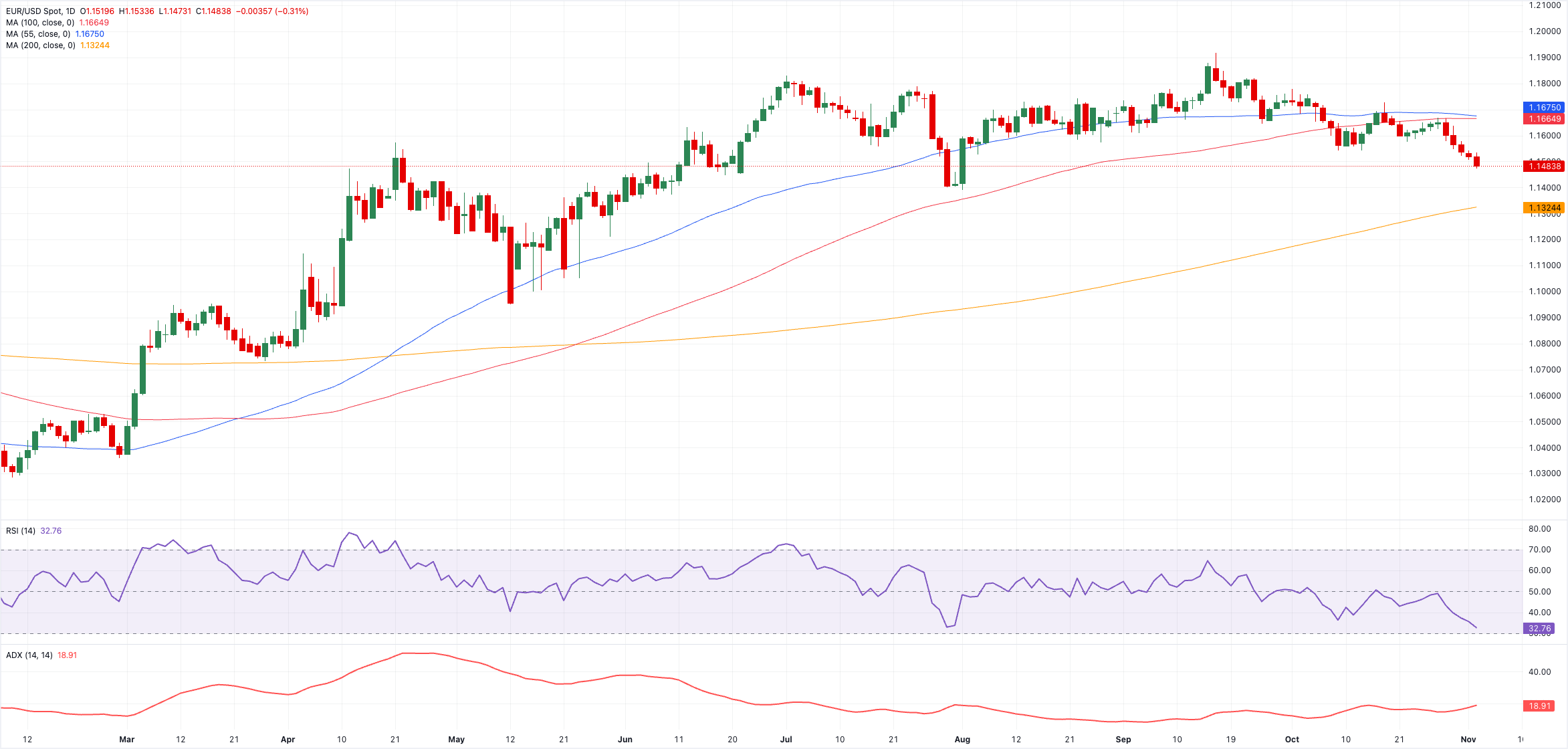
The continuation of the bearish trend should prompt EUR/USD to retarget the 1.1400 region in the near term.
Extra downside should break below the November floor at 1.1473 (November 4). The breach below this region would expose a potential visit to the August base at 1.1391 (August 1), prior to the important 200-day SMA at 1.1327. Further south sits the weekly low at 1.1210 (May 29).
Conversely, immediate resistance comes at the weekly top at 1.1728 (October 17) seconded by the October high at 1.1778 (October 1). If bulls push harder, then the 2025 ceiling of 1.1918 (September 17) should come into focus before the 1.2000 milestone.
In the meantime, momentum indicators lean bearish: the Relative Strength Index (RSI) approaches the oversold region near the 32 level, while the Average Directional Index (ADX) past 18 suggests that the current trend could be gathering steam.
Looking for direction
For now, EUR/USD remains range-bound, searching for a clear catalyst. A more dovish Fed, improving global risk appetite, or signs of stronger demand for Eurozone assets could finally give the pair room to breathe — but until then, the Dollar’s strength continues to set the tone.
ECB FAQs
The European Central Bank (ECB) in Frankfurt, Germany, is the reserve bank for the Eurozone. The ECB sets interest rates and manages monetary policy for the region. The ECB primary mandate is to maintain price stability, which means keeping inflation at around 2%. Its primary tool for achieving this is by raising or lowering interest rates. Relatively high interest rates will usually result in a stronger Euro and vice versa. The ECB Governing Council makes monetary policy decisions at meetings held eight times a year. Decisions are made by heads of the Eurozone national banks and six permanent members, including the President of the ECB, Christine Lagarde.
In extreme situations, the European Central Bank can enact a policy tool called Quantitative Easing. QE is the process by which the ECB prints Euros and uses them to buy assets – usually government or corporate bonds – from banks and other financial institutions. QE usually results in a weaker Euro. QE is a last resort when simply lowering interest rates is unlikely to achieve the objective of price stability. The ECB used it during the Great Financial Crisis in 2009-11, in 2015 when inflation remained stubbornly low, as well as during the covid pandemic.
Quantitative tightening (QT) is the reverse of QE. It is undertaken after QE when an economic recovery is underway and inflation starts rising. Whilst in QE the European Central Bank (ECB) purchases government and corporate bonds from financial institutions to provide them with liquidity, in QT the ECB stops buying more bonds, and stops reinvesting the principal maturing on the bonds it already holds. It is usually positive (or bullish) for the Euro.
Author

Pablo Piovano
FXStreet
Born and bred in Argentina, Pablo has been carrying on with his passion for FX markets and trading since his first college years.

















